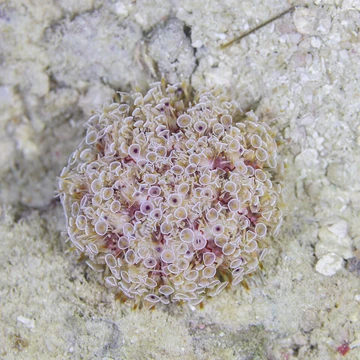
Glyptocidaridae
A monotypic sea urchin family with a single living species.

Glyptocidaridae is a family of sea urchins in the order Stomopneustoida, containing a single extant genus, Glyptocidaris, with one living species, Glyptocidaris crenularis. The family was erected by M. Jensen in 1982 based on a cladistic analysis of Euechinoidea, and its placement in Stomopneustoida was confirmed by Kroh and Smith in 2010. It is notable for its unique ambulacral plate compounding and for being one of only two extant families in its order.
Quick Facts
- Taxon
- Glyptocidaridae
Facts from the source article.
Lore & Background
The genus Glyptocidaris was described by Alexander Agassiz in 1864 based on specimens collected by Dr. W. Stimpson during the North Pacific Exploring and Surveying Expedition, with the syntype (MCZ 1105) collected from Hakodate, Japan. For many years, Glyptocidaris was classified as the sole living representative of the order Phymosomatoida because its tubercles are imperforate and crenulate, a feature shared with phymosomatoid sea urchins. However, its ambulacral plate compounding resembles that of stomopneustid sea urchins, and it has a small hemicyclic apical disc attached to the corona, unlike the large monocyclic disc typical of Phymosomatoida. Jensen erected the family Glyptocidaridae in 1982, and Kroh and Smith confirmed its placement in Stomopneustoida in 2010 following a phylogenetic analysis of 169 taxa and 306 skeletal characters.
Reader's Guide
Glyptocidaridae holds significance as a relict lineage within Stomopneustoida, an order that contains only two extant families, each with a single living species. The family's taxonomic history reflects a long-standing dispute over its classification, resolved only through modern phylogenetic analysis. Its single species, Glyptocidaris crenularis, is notable for its distinctive skeletal features, including ambulacral plates composed of three primary plates and two demi-plates, a structure that distinguishes it from both phymosomatoids and other stomopneustids. The species is found in the northwest Pacific Ocean, from Japan to Korea and northern China, inhabiting depths of 20–150 m on rocky substrates. It has commercial potential in China, where it is harvested in the Yellow Sea and Bohai Sea, and is known in Japan as tsugaru uni. Phenotypic variation in gonad and body traits suggests potential for selective breeding in aquaculture. The species also serves as a model for studying the effects of ocean acidification, which reduces fertilization success, decreases hatching rates, and causes larval abnormalities.
Did You Know?
- Glyptocidaridae contains only one extant genus and one living species, Glyptocidaris crenularis.
- Glyptocidaris crenularis is known as tsugaru uni in Japan.
- Experimental ocean acidification reduces fertilization success and causes larval abnormalities in this species.
More in Sea Urchins, Part 2 1-24
Spotted an error? Know more?
Reader corrections go straight into our review queue. Suggest an edit · How this site is sourced