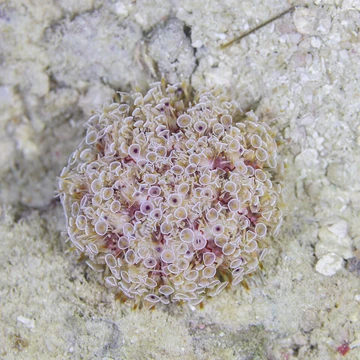
Eucidaris
Slate pencil urchins with stout, beaded spines and wide distribution.

Eucidaris is a group of cidaroid sea urchins, often called slate pencil urchins because their spines resemble slate pencils. These urchins have a fairly thick shell, a top disc that is usually made of a single ring of plates, and tubercles that are pierced but not ridged. Their ambulacra are almost straight, with pairs of pores arranged horizontally. The large primary spines are few and spaced far apart; they are thick, with blunt, flat tips and a beaded surface. The smaller secondary spines are short and lie flat against the body. This genus first appeared during the Miocene epoch. Today, living species are found in the tropical Indo-Pacific, the eastern Pacific, the Atlantic Ocean, and the Caribbean Sea.
Quick Facts
- Taxon
- Eucidaris
- Type Species
- Cidarites monilifera
- Type Species Authority
- Goldfuss, 1829
Facts from the source article.
Lore & Background
The genus Eucidaris was established by Pomel in 1883. Its members are distinguished by a moderately thick test and a usually monocyclic apical disc. The tubercles are perforate and non-crenulate, and the ambulacra are nearly straight with horizontal pore pairs. The primary spines are few, widely spaced, stout, and have blunt flat tips with beaded ornamentation, while the secondary spines are short and appressed.
Eucidaris originated in the Miocene epoch. Extant species are found across tropical and subtropical waters, including the Indo-Pacific, East Pacific, Atlantic Ocean, and Caribbean Sea. The World Register of Marine Species lists five extant species and two fossil species, with one additional species (Eucidaris clavata) brought into synonymy with Eucidaris tribuloides.
Reader's Guide
The genus Eucidaris is notable for its distinctive slate pencil-like primary spines, which are stout, blunt-tipped, and beaded, giving the urchins a characteristic appearance. The genus has a long fossil record dating to the Miocene, and its extant members occupy a broad geographic range spanning the Indo-Pacific, East Pacific, Atlantic, and Caribbean. The species list includes both living and fossil forms, with Eucidaris tribuloides having a synonym (Eucidaris clavata) recognized by Mortensen in 1928. The classification of the genus was formalized by Pomel in 1883. The genus's morphological traits—such as the monocyclic apical disc, perforate non-crenulate tubercles, and horizontal pore pairs—are key to its identification within the cidaroid group. The presence of both extant and fossil species underscores its evolutionary persistence since the Miocene.
Did You Know?
- Eucidaris is known as slate pencil urchins, named after the slate pencil.
- The genus originated in the Miocene epoch.
- Extant members are found in the tropical Indo-Pacific Ocean, East Pacific, Atlantic Ocean, and Caribbean Sea.
- Eucidaris clavata is a synonym of Eucidaris tribuloides.
More in Sea Urchins, Part 2 1-24
Spotted an error? Know more?
Reader corrections go straight into our review queue. Suggest an edit · How this site is sourced