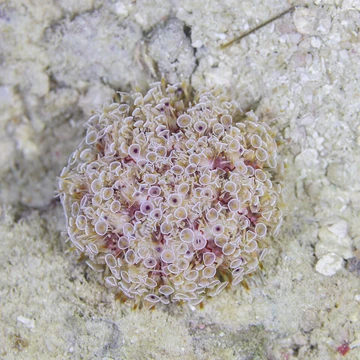
Echinothrix calamaris
A sea urchin with banded spines and a rudimentary visual system.

Echinothrix calamaris, called the banded sea urchin or double spined urchin, belongs to the family Diadematidae. Its test (shell) is slightly oval and grows to about 5 cm across. Like most Diadematidae, but most obviously in this species, it has two kinds of spines: short, slender, closed spines that range from yellow to dark brown and can deliver a painful sting, and longer, thicker spines that are often banded in light and dark colors (though they can be all dark or all white). These longer spines reach 10 to 15 cm, are hollow, and can be blunt. The spines are arranged so that five bare zones appear on the central part of the test in a star pattern called iridophores, which is often blue. The anal papilla is large, translucent, and very visible on the upper side; it is usually whitish with black and white speckles, circled by a ring of light-sensitive cells that give it basic vision.
In its darkest forms, it can be mistaken for *Diadema setosum* or *Diadema savignyi* (both of which may keep banded spines as adults). However, those species are larger, more uniformly black, have less noticeable secondary spines, and are identified by five white dots on top of the test and an orange ring around the anus. The most common confusion is with the closely related *Echinothrix diadema*, which can have banded spines when young. But *E. diadema* has a very small, all-black anal papilla, spines with a blue sheen, and its primary spines are more solid—unlike the hollow spines of *E. calamaris*, which can be crushed between two fingers.
A dark form of this urchin is reported in the Indian Ocean (Red Sea, Mascarene Islands, Seychelles, Maldive Islands). It has very dark, often unbanded spines with a green sheen, and a test that is more or less reddish (sometimes completely red, especially in the Red Sea). The anal papilla is black, sometimes dotted with white, but occasionally only black, making it hard to distinguish from *E. diadema*. This form also lacks iridophores, and its spines are sharper, more solid, and cannot be crushed. It may be a subspecies or separate species, as its ecological niche seems slightly different.
The banded sea urchin is widespread across tropical waters of the Indo-Pacific, from eastern Africa to French Polynesia, including Hawaii and the Red Sea. It lives from the surface down to 70 meters deep, in lagoons, outer reef slopes, and channels.
Quick Facts
- Taxon
- Echinothrix calamaris
Facts from the source article.
Lore & Background
The banded sea urchin has a slightly oval test reaching about 5 cm in diameter. Like almost all Diadematidae, it possesses two sets of spines: short, slender closed spines that range from yellow to dark and can deliver a nasty sting, and longer, thicker spines that are often banded with light and dark colors (but sometimes all dark or all white), reaching 10 to 15 cm. These primary radiolas are hollow and can be blunt. The spines are grouped to reveal five naked zones on the central part of the test in a star pattern called iridophores, often colored blue. The anal papilla is large, translucent, and whitish with black and white dots, circled by a ring of visual receptors granting rudimentary vision.
A dark form is reported in the Indian Ocean (Red Sea, Mascarene Islands, Seychelles, the Maldive Islands), with very dark radioles often not banded, a green sheen, and a reddish test (sometimes completely red, especially in the Red Sea). In this form, the anal papilla is black, more or less punctuated with white, and iridophores are absent. The spines are sharper and more solid, not crushable between fingers. This could be a subspecies or separate species, as their ecological niche seems slightly different.
Reader's Guide
Echinothrix calamaris is widespread throughout the tropical Indo-Pacific, from the eastern coast of Africa to French Polynesia, including Hawaii and the Red Sea. It occurs from the surface to 70 meters depth in lagoons, external reef slopes, and channels. The species is active at night, hiding in crevices or under rocks during the day. Its thinner spines are venomous but not dangerous. Many juvenile cardinalfish (Apogonidae) may hide in its spines for protection. In Hawaii, it is often host to a symbiotic crab, Echinoecus pentagonus. The species can be confused with Diadema setosum or Diadema savignyi, which are bigger, more uniformly black, and have five white points at the top of the test and an orange anal ring. The most common confusion is with Echinothrix diadema, which has a very small, all-black anal papilla and spines with a blue sheen; E. calamaris has more fragile, hollow primary radiolas that can be crushed between two fingers, unlike E. diadema.
Did You Know?
- The banded sea urchin has two sets of spines: short venomous ones and longer hollow ones that are often banded.
- Its anal papilla is circled by a ring of visual receptors that grant it rudimentary vision.
- A dark form in the Indian Ocean may be a separate subspecies or species, with sharper, solid spines.
- Juvenile cardinalfish often hide among its spines for protection.
More in Sea Urchins, Part 2 1-24
Spotted an error? Know more?
Reader corrections go straight into our review queue. Suggest an edit · How this site is sourced