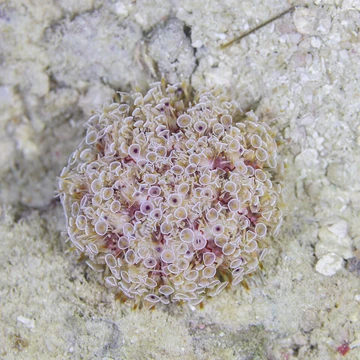
Coelopleurus exquisitus
Deepwater urchin discovered via eBay, prized for vivid colouration.

Coelopleurus exquisitus, called the exquisite urchin, is a sea urchin that lives off New Caledonia in the Pacific Ocean. It dwells on the seafloor in deep water, between 240 and 520 meters (790 to 1,710 feet) down, and was first identified and named in 2006.
Its coloring is bright and unusual. The body, or test, reaches up to 35 mm (1.4 inches) across, with long, curved spines that are banded in red and light green. Large purple areas on the test have wavy lavender lines, while the rest of the skin is olive or light brown. This striking appearance makes the urchin popular with collectors, which could put the species at risk, but not enough is known to estimate its population. Why the urchin has such vivid pigment in both its skin and skeleton is unclear, given the dim light at its depth. One idea is that it moved up from shallower water and kept its colors.
The species was first recognized after appearing on the auction website eBay. In 2004, marine biologist Simon Coppard, a member of the International Commission on Zoological Nomenclature, was shown a listing for it. He often identified species for people but did not recognize this one. With help from Heinke Schultz, he realized it was a new species. It was given a name fitting its unusual, beautiful coloring, and details were published in the journal *Zootaxa* on August 7, 2006. Right after that, the price of specimens on eBay jumped from $8 to $138. Coppard worried that urchins like this could become endangered if sellers take advantage of weak regulations: "The collection and sale of these urchins should be regulated and monitored; otherwise, we may decimate the populations before we know much more about it." A similar event happened in 2008, when a fossilized aphid in amber bought on eBay turned out to be a new species, named *Mindarus harringtoni* after the buyer.
Quick Facts
- Genus
- Coelopleurus
- Species
- exquisitus
Facts from the source article.
Lore & Background
The species was first identified after appearing on auction website eBay. Simon Coppard, marine biologist and member of the International Commission on Zoological Nomenclature, was directed to a listing on the site in 2004. Coppard was frequently asked to identify species, but did not recognise this particular specimen. Further investigation with the help of Heinke Schultz led him to realise it was a previously unidentified species. The species was given a name fitting its unique and beautiful colouring, with details about C. exquisitus first published in taxonomy journal Zootaxa on 7 August 2006.
Examined individuals of the species show that the test is up to 35 mm (1.4 in) in diameter, with long, curved spines. These primary spikes are curved and banded with red and light green. It has large purple interambulacral regions with undulating lavender lines, while the remainder of the epithelium is coloured olive or light brown. The purpose of the pigmentation, which is present in both the skin and skeleton, is also unknown, given the low light conditions of its habitat. One presented theory is that the species migrated from shallower waters and has maintained its colouring.
Immediately after its public introduction, the value of specimens for sale on eBay rocketed from $8 to $138. Coppard expressed concern that sea urchins like C. exquisitus could become endangered by sellers who abuse the insufficient regulatory protocols currently in place: 'The collection and sale of these urchins should be regulated and monitored; otherwise, we may decimate the populations before we know much more about it.' A similar event occurred in 2008 when a fossilised aphid encased in amber was purchased from eBay; the species was found to never have been described and was given the name Mindarus harringtoni after the buyer's name.
Reader's Guide
The significance of Coelopleurus exquisitus lies in its unusual discovery pathway and the conservation concerns it raises. The species was first identified from an eBay listing in 2004, highlighting how online marketplaces can serve as unexpected sources for taxonomic discovery. Its vibrant colouration—banded red and light green spines, purple interambulacral regions with lavender lines, and olive or light brown epithelium—makes it highly sought after by collectors, which may threaten the species. However, too little is known about the species to confirm their number. The purpose of the pigmentation, present in both skin and skeleton, remains unknown given the low light conditions of its deepwater habitat; one theory suggests the species migrated from shallower waters and retained its colouring. The rapid price increase from $8 to $138 after its formal description in Zootaxa on 7 August 2006 illustrates the commercial pressure on newly described species. Coppard's warning about insufficient regulatory protocols underscores the potential for overcollection before basic biological knowledge is obtained. The parallel case of the fossilised aphid Mindarus harringtoni, also discovered via eBay in 2008, reinforces the pattern of online commerce intersecting with taxonomy. The legacy of C. exquisitus is thus twofold: as a striking deepwater urchin and as a cautionary example of how market demand can outpace scientific understanding and conservation measures.
Did You Know?
- The species lives at depths between 240 and 520 m off New Caledonia.
- After its formal description, eBay prices rose from $8 to $138.
More in Sea Urchins, Part 2 1-24
Spotted an error? Know more?
Reader corrections go straight into our review queue. Suggest an edit · How this site is sourced