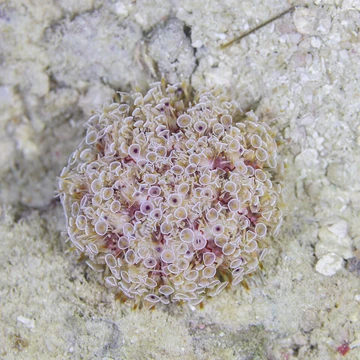
Cidaris blakei
A deep-sea urchin with distinctive fan-like spines.

Cidaris blakei is a sea urchin in the family Cidaridae. Its body is covered with three kinds of spines, including a broad, flat, paddle-shaped form that makes the species easy to identify. American zoologist Alexander Agassiz gave the first scientific description in 1878. The animal lives on the deep seabed in the Gulf of Mexico and off the Bahamas.
The species was named after the research vessel USC&GS *George S. Blake*, which dredged up many deep-sea creatures from the Gulf of Mexico. The genus name *Cidaris* comes from a Latin word for a tiara worn by ancient Persian kings.
Unlike most sea urchins, the spines of *Cidaris* species are not covered with skin. This leaves them bare, so barnacles, tube worms, and other organisms often grow on them. *C. blakei* has three distinct spine forms; the function of the unusual fan-shaped spines is unknown.
The urchin’s range covers the tropical western Atlantic, including the Gulf of Mexico and deep waters near the Bahamas, where specimens have been collected from the seabed at about 600 meters (2,000 feet) deep.
Its larvae are planktotrophic, meaning they spend a long time drifting in the water column—about four months from egg to metamorphosis—which allows them to spread widely. They first live off the egg yolk, then feed on zooplankton and phytoplankton. Researchers believe the larvae cannot survive the warmer temperatures found higher in the water column, so they do not migrate upward.
Quick Facts
- Taxon
- Cidaris blakei
Facts from the source article.
Lore & Background
Cidaris blakei was first described by the American zoologist Alexander Agassiz in 1878. It was among many deep sea animals dredged up from abyssal depths in the Gulf of Mexico during the explorations of the USC&GS George S. Blake, one of the first United States oceanographic research vessels, and from which it derives its specific name. The genus name is Latin for a headdress or tiara worn by ancient Persian kings.
Although their appearance is quite variable, other members of the genus Cidaris have long cylindrical blunt or pointed spines that are not covered with skin as are most sea urchin spines. As a result, barnacles, tube worms and other epizoic organisms grow on them. The spines of C. blakei are present in three different forms, one form being broad, flat and paddle-shaped. They are also naked and epizoics grow on them, but the function of these strange-shaped spines is unclear.
Larvae of C. blakei are planktotrophic, spending a long time living in the water column, taking four months to develop from egg to metamorphosis, and as a result can disperse widely. During this time they are sustained at first by the egg yolk, and later feed on zooplankton and phytoplankton. However, researchers think that they would be unlikely to survive the warmer temperatures present higher in the water column, and are therefore unable to migrate vertically.
Reader's Guide
Cidaris blakei is significant as a deep-sea species first described in 1878 from material collected during the pioneering oceanographic voyages of the USC&GS George S. Blake. Its distinctive fan-like spines, one of three types present, make it easily recognized among sea urchins. The function of these broad, flat, paddle-shaped spines remains unclear, adding to the species' scientific interest. Its planktotrophic larvae, which take four months to develop, allow wide dispersal, though researchers believe they cannot survive warmer surface waters, limiting vertical migration. The species is found on the seabed at depths around 600 m in the Gulf of Mexico and off the Bahamas. Its legacy lies in its contribution to understanding deep-sea biodiversity and the unusual spine morphology within the family Cidaridae.
Did You Know?
- Cidaris blakei was first described by Alexander Agassiz in 1878.
- Its spines come in three forms, one of which is broad, flat, and paddle-shaped.
- Its larvae are planktotrophic and take four months to develop from egg to metamorphosis.
More in Sea Urchins, Part 2 1-24
Spotted an error? Know more?
Reader corrections go straight into our review queue. Suggest an edit · How this site is sourced