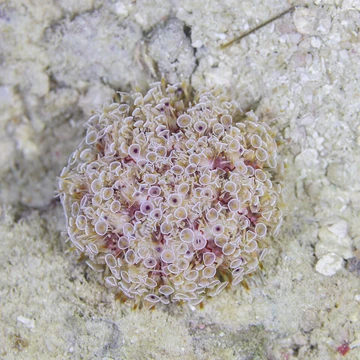
Centrostephanus longispinus
A sea urchin with long, toxic spines and two Atlantic subspecies.

Centrostephanus longispinus, called the hatpin urchin, belongs to the family Diadematidae. It has two subspecies: Centrostephanus l. longispinus, which lives in the eastern Atlantic and Mediterranean Sea, and Centrostephanus l. rubricingulus, found in the western Atlantic.
In 1940, Mortenson considered C. longispinus and C. rubicingulus to be closely related but separate species, noting that C. longispinus has smaller and fewer secondary interambulacral tubercles. In 1975, Fell reviewed the genus and could not find enough differences to keep them as distinct species, so he proposed treating C. rubicingulus as a subspecies of C. longispinus. Fell also could not reliably tell either of them apart from C. besnardi except by collection location (C. besnardi comes from the eastern Pacific), and he could not distinguish juveniles of C. coronatus from juveniles of the other species.
This urchin has a small central test and spines up to 30 centimeters long. The spines are toxic and can cause a painful sting. They vary in length, are mobile, and are used for movement. On the oral (lower) surface, there are club-shaped spines—a trait it shares with C. besnardi and C. coronatus but not with other members of the genus. These spines are reddish brown with purple or pink tips. In the subspecies C. l. longispinus, the spines have purple bands on a pale green, buff, or whitish background. Juvenile C. l. rubricingulus have reddish-brown spines on a pale background, while adults have either brown-banded spines on pale brown or uniformly dark spines. The urchin has light-sensitive chromatophores (pigment-bearing structures in cells) that change shape, altering the animal’s color from black at night to grayish brown during the day.
Centrostephanus longispinus lives on the continental shelf on both sides of the Atlantic. Its range stretches from the Mediterranean Sea and North African coast to the Caribbean Sea and Gulf of Mexico. It is found at depths between 40 and 210 meters. Off Florida, it typically occurs on algae or broken coral substrates, especially the rubble of dead ivory bush coral (Oculina varicosa). It is part of a diverse community that includes other sea urchins, mollusks, polychaete worms, crabs, and encrusting organisms.
Quick Facts
- Genus
- Centrostephanus
- Species
- longispinus
Facts from the source article.
Lore & Background
In 1940, Mortenson believed that C. longispinus and C. rubicingulus were closely related species but distinguished by C. longispinus having smaller and fewer secondary interambulacral tubercles. In 1975, Fell re-examined the genus and could not find sufficient differences to justify separating them into two species, suggesting that C. rubicingulus should be considered a subspecies of C. longispinus. He also could not reliably distinguish the pair from C. besnardi except by collection location, nor distinguish juveniles of C. coronatus from juveniles of the other species.
The hatpin urchin has a small central test and spines up to 30 centimeters long that are mobile and used for locomotion. It possesses club-shaped spines on the oral surface, a characteristic shared with C. besnardi and C. coronatus but not other members of the genus. These spines are reddish brown with purple or pink tips. The subspecies C. l. longispinus has spines banded in purple on a pale green, buff or whitish background. Juvenile C. l. rubricingulus have reddish-brown spines on a pale background, while adults have either banded or uniformly dark spines. The urchin has chromatophores sensitive to light, changing its color from night-time black to daytime greyish brown.
Centrostephanus longispinus occurs on the continental shelf on both sides of the Atlantic, from the Mediterranean Sea and North African coast to the Caribbean Sea and Gulf of Mexico, at depths between 40 and 210 meters. Off Florida, it is usually found on algae or broken coral substrates, particularly the rubble of dead ivory bush coral (Oculina varicosa). It forms part of a species-rich community including other sea urchins, mollusks, polychaete worms, crabs, and encrusting organisms. It is not usually found on living reefs, possibly due to lack of macro-algae or predation by fish.
Reader's Guide
Centrostephanus longispinus is significant as a species whose taxonomic history reflects ongoing debate: Mortenson in 1940 treated C. rubicingulus as a separate species, but Fell in 1975 reclassified it as a subspecies due to insufficient morphological differences. This uncertainty extends to its relation to C. besnardi and C. coronatus, where location and juvenile stage hinder clear distinction. The species is notable for its long, toxic spines—up to 30 centimeters—and its ability to change color via light-sensitive chromatophores, shifting from black at night to greyish brown during the day. Its club-shaped oral spines are a shared trait with only two other members of the genus. Ecologically, it inhabits continental shelf depths of 40 to 210 meters on both sides of the Atlantic, often on algae or broken coral substrates like dead ivory bush coral off Florida, and is part of a diverse community. Its diet consists largely of red algae, with small invertebrate prey when algae is unavailable; in the lab it will eat seagrass and may attack starfish if hungry. The species' distribution and habitat preferences—avoiding living reefs—suggest possible pressures from predation or food availability.
Did You Know?
- The spines of Centrostephanus longispinus are toxic and can cause a painful sting.
- Fell in 1975 could not reliably distinguish C. longispinus from C. besnardi except by collection location.
- Off Florida, this urchin is often found on the rubble of dead ivory bush coral (Oculina varicosa).
More in Sea Urchins, Part 2 1-24
Spotted an error? Know more?
Reader corrections go straight into our review queue. Suggest an edit · How this site is sourced