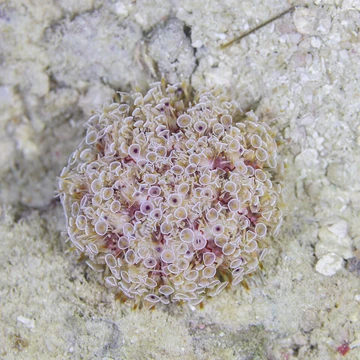
Centrostephanus coronatus
A nocturnal, carnivorous sea urchin with long, sharp spines.

Centrostephanus coronatus, called the crowned sea urchin, belongs to the family Diadematidae. Yale zoology professor Addison Emery Verrill first scientifically described it in 1867.
Adults are entirely black, with a hint of blue near the base of the spines. Juveniles have gray bands running along their spines. The test, or body shell, ranges from 32 to 63 millimeters across. The spines are thin, hollow, brittle, and extremely sharp; the longest can reach 125 millimeters. On the underside, five clusters of smaller spines surround the mouth.
This urchin lives in the eastern Pacific Ocean, from Monterey Bay, California, down to Peru, including the Gulf of California and the Galapagos Islands. Its range has expanded northward in recent years. It dwells on the bottom from the low-tide line down to 125 meters deep, preferring rocky substrates and reefs.
When resting, the crowned sea urchin seeks out holes and crevices in the rock. The rock shields it from predators on all sides except the opening, which the spines guard. If an individual finds a particularly snug hole, it can brace its spines against the rock walls to resist being pulled out. It is nocturnal, foraging within a few meters of its shelter and returning at dawn. Its diet is mostly carnivorous, consisting of sponges, tunicates, bryozoans, and algae. The species is gonochoric, meaning each individual is either male or female. Spawning occurs on a monthly cycle, possibly linked to tidal rhythms.
Quick Facts
- Genus
- Centrostephanus
- Species
- coronatus
Facts from the source article.
Lore & Background
The crowned sea urchin was first described to science by Yale zoology Professor Addison Emery Verrill in 1867. Adults are all black, with some blue at the base of the spines, while juveniles have gray bands on their spines. The test ranges from 32 to 63 millimeters in diameter. The spines are thin, hollow, brittle, and very sharp, with the longest reaching 125 millimeters. Five clusters of smaller spines surround the mouth on the underside of the test.
This species is found in the eastern Pacific Ocean from Monterey Bay, California to Peru, including the Gulf of California, and has expanded its range north in recent years. It also occurs in the Galapagos Islands. Crowned sea urchins live from the low-tide line to 125 meters deep, favoring rocky substrates and reefs as bottom dwellers.
In its life history, this urchin seeks holes and crevices in the bottom when resting, using the rock for protection and its spines to guard the opening. When an individual finds a particularly good fitting hole, it can brace its spines against the sides to resist being pulled out. It is nocturnal, foraging within a few meters of its shelter and returning at dawn. It is mostly carnivorous, feeding on sponges, tunicates, bryozoans, and algae. The species is gonochoric, with separate male and female individuals, and spawning occurs on a monthly cycle that may be tied to tidal rhythms.
Reader's Guide
The crowned sea urchin is significant as a species first described by a prominent Yale zoologist, Addison Emery Verrill, in 1867. Its description contributed to the scientific understanding of the family Diadematidae. The species is notable for its defensive adaptations: its long, sharp, brittle spines and its habit of sheltering in rock crevices, where it can brace itself against predators. Its recent northward range expansion suggests ongoing ecological changes in the eastern Pacific. As a nocturnal, mostly carnivorous forager, it plays a role in controlling populations of sponges, tunicates, bryozoans, and algae on rocky reefs. Its monthly spawning cycle, possibly tied to tidal rhythms, reflects a reproductive strategy linked to environmental cues. The species' presence from California to Peru and the Galapagos Islands underscores its broad distribution in the eastern Pacific.
Did You Know?
- The longest spines can reach 125 millimeters (4.9 inches) in length.
- It is gonochoric, with separate male and female individuals, and spawns on a monthly cycle possibly tied to tidal rhythms.
More in Sea Urchins, Part 2 1-24
Spotted an error? Know more?
Reader corrections go straight into our review queue. Suggest an edit · How this site is sourced