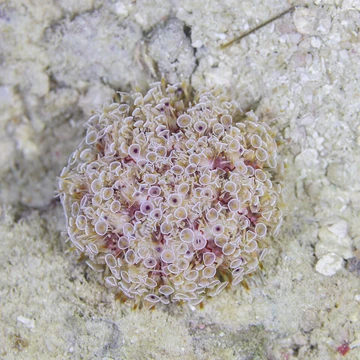
Astropyga radiata
A large, venomous Indo-Pacific urchin with blue-spotted bare areas.

Astropyga radiata, commonly known as the red urchin, fire urchin, false fire urchin, or blue-spotted urchin, is a large species of sea urchin in the family Diadematidae. It is notable for its long spines, bright coloration, and presence in the tropical Indo-Pacific region. First described in 1778 by the German naturalist Nathaniel Gottfried Leske, it is a visually striking species often encountered by divers and underwater photographers.
Quick Facts
- Genus
- Astropyga
- Species
- radiata
Facts from the source article.
Lore & Background
Astropyga radiata has a test diameter up to 20 cm, flattened or slightly concave on the aboral side. Its spines, up to 4 cm long, are grouped in five vertical clusters, with V-shaped bare areas between them that are red with lines of iridescent blue dots. The rest of the test and spines vary from reddish brown to purple, dark brown, or nearly black. The spines are hollow and of two kinds, the shorter being venomous. The anal sac is prominent, brown with a dark tip. Juveniles have spines with transverse banding, a trait that sometimes persists into adulthood.
Its range extends from the African coast to Hawaii and Australian waters, typically found in lagoons and bays on sand, shingle, or coral rubble at depths of 10 to 30 meters. It is mostly nocturnal, grazing on algae, and can angle its spines toward a threatening object. The sexes are separate, with planktonic larvae that settle and metamorphose into juveniles.
Several crustaceans and fish live in association with this urchin, including the commensal shrimps Periclimenes hirsutus and Stegopontonia commensalis, the crab Zebrida adamsii, and the symbiont crab Dorippe frascone, which carries the urchin on its back. Juvenile fish such as emperor red snappers, cardinal fish, and zebra lionfish also live among its spines.
Reader's Guide
Astropyga radiata holds significance as a large, brightly colored species that is relatively visible to divers, making accidental injuries from its venomous spines comparatively rare. Its beauty makes it popular among underwater photographers and some expert fish-keepers. Although not deadly to humans, its quills are quite venomous and capable of inflicting painful wounds; on the 'Kings of Pain' pain index, it rates a 12 out of 30. The species is also notable for its associations with various commensal and symbiotic crustaceans and fish, highlighting its role as a microhabitat in tropical Indo-Pacific ecosystems. Its common names—including false fire urchin (to distinguish it from the true fire urchin Asthenosoma varium), star urchin, and blue-spotted urchin—reflect its appearance and the star-shaped pattern around its anus, which gives the genus its name from Greek 'astro' (star) and 'pyga' (anus). The species name 'radiata' comes from Latin meaning 'radiant', referring to its colors and spines.
Did You Know?
- Its shorter spines are venomous, and the species rates 12 out of 30 on the 'Kings of Pain' pain index.
- The crab Dorippe frascone carries this urchin on its back as a symbiont.
- Juveniles often have spines with transverse banding, which may persist into adulthood.
More in Sea Urchins, Part 2 1-24
Spotted an error? Know more?
Reader corrections go straight into our review queue. Suggest an edit · How this site is sourced