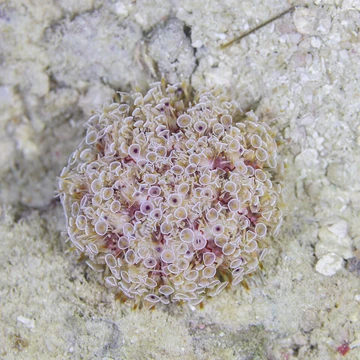
Aspidodiadema jacobyi
A deep-sea urchin studied for its unusual reproductive biology.

Aspidodiadema jacobyi is a small sea urchin in the family Aspidodiadematidae. It lives in tropical seas at great depths and was first scientifically described in 1880 by Alexander Emanuel Agassiz, an American scientist. It is notable as a model species for studying the reproductive biology of deep-water sea urchins.
Quick Facts
- Genus
- Aspidodiadema
- Species
- jacobyi
Facts from the source article.
Lore & Background
Aspidodiadema jacobyi has a globular hard test or shell protecting the inner organs. The mouth has 10 buccal plates and small rounded buccal notches and is on the oral (bottom) surface which is slightly flattened. The aboral (top) surface has a small coronal ring of tubercles surrounding the anus. The test is composed of 5 radial ambulacral sets of 3 plates, separated by 5 ambulacral grooves. There are rows of pairs of pores between the ambulacral areas through which the tube feet protrude. Every third row of plates is larger than the other 2 and has a zig-zag row of large primary tubercles. This row does not extend quite as far as the other 2 rows of plates which have similar primary tubercles set serially in a straight line. These large tubercles are perforate and crenulate. There are smaller, secondary tubercles at the edge of the plates. Slender, flexible spines articulate with all these tubercles. These spines are hollow and have bridging structures across their lumina with minute needle-like pillars. The test has green tubercles with purple interambulacral areas. This species is dioecious with individuals being either male or female. Mature individuals were gathered during the spring on a number of occasions spanning several years. They were collected in the Bahamas by suction at depths of 500 to 750 metres (1,640 to 2,460 ft) and were kept in containers in the laboratory. Attempts were made to initiate spawning but these were successful on only two occasions. The eggs measured 94–100μm and had a yolk so that newly hatched larvae do not need to feed at first. It was suggested that in the open sea this would allow the larvae to disperse in ocean currents, surviving in cold waters where little food is available. Alternatively, another study found that the eggs are surrounded by mucus through which the sperm, which have unusually elongated heads, must penetrate. The eggs clump together and may adhere in a viscous mass to the adult's spines and be brooded there. The sperm also form a mucous mass, and it may be that a form of pseudo-copulation takes place with the pressing together of the gamete masses of adjacent individuals.
Reader's Guide
Aspidodiadema jacobyi is significant as a model organism for studying the reproductive biology of deep-water sea urchins, about which little was known. The species is dioecious, and research involved collecting mature individuals in the Bahamas by suction at depths of 500 to 750 metres. Spawning was successfully induced only twice in the laboratory. The eggs, measuring 94–100 μm, contain yolk, allowing newly hatched larvae to survive without feeding initially—an adaptation that may aid dispersal in cold, food-poor deep waters. An alternative study suggests that eggs are surrounded by mucus, requiring sperm with unusually elongated heads to penetrate; eggs may clump and adhere to the adult's spines for brooding, and sperm also form a mucous mass, possibly indicating pseudo-copulation between adjacent individuals. In the laboratory, embryos developed over 5 months into echinopluteus larvae over 3000 μm long, fed on unicellular algae. Larval development included the appearance of 2 then 4 arms before the mouth formed at about 11 days, followed by three further pairs of long arms over 30 days, then a posterior process and a ciliated ring. At 75 days a rudimentary echinus appeared, and at 116 days podia were apparent. None of the larvae completed metamorphosis into a juvenile, possibly because chemical stimuli needed to initiate the process were absent in the in vitro experiment. This work highlights the challenges of studying deep-sea species and the potential role of chemical cues in development.
Did You Know?
- Its eggs measure 94–100 μm and contain yolk, allowing larvae to survive without feeding initially.
- Sperm of this species have unusually elongated heads.
- In the laboratory, larvae developed over 5 months but none completed metamorphosis into a juvenile.
More in Sea Urchins, Part 2 1-24
Spotted an error? Know more?
Reader corrections go straight into our review queue. Suggest an edit · How this site is sourced