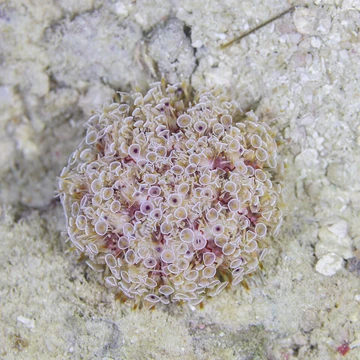
Arbacia nigra
The most common sea urchin on the coasts of Peru and Chile.

Arbacia nigra (also called Tetrapygus niger) is a sea urchin from the family Arbaciidae. First described in 1782 by Chilean naturalist Juan Ignacio Molina, it lives in the southeastern Pacific Ocean along the South American coast.
Its test is flattened on the underside and gently domed on top. A small apical disc sits at the top, and the ambulacral areas run straight. In the inter-ambulacral zones, rows of up to five large primary tubercles are spaced among smaller secondary ones. The mouth lies within a sunken, nearly five-sided peristome that is about half the width of the test. Primary spines are moderately long, secondary spines short, and the whole animal is purplish-black.
This urchin ranges from northern Peru down to the Strait of Magellan, at depths up to about 40 meters. It is the most common sea urchin along this stretch of coast.
A herbivore, it grazes on the kelp *Lessonia trabeculata*, which forms the main kelp forests on Chile’s rocky shores. Heavy grazing prevents young kelp from growing, while older plants lose only their stipes. Starfish such as *Luidia magellanica*, *Meyenaster gelatinosus*, *Stichaster striatus*, and *Heliaster helianthus* prey on these urchins. In 1998–1999, a population explosion of *T. niger* occurred in northern Chile, possibly because a drop in predatory starfish numbers—linked to poor starfish recruitment after the previous year’s El Niño—allowed urchins to multiply. This led to “urchin barrens,” areas stripped of macro-algae and low in biodiversity, where only encrusting coralline algae cover the rocks.
Quick Facts
- Genus
- Arbacia
- Species
- nigra
Facts from the source article.
Lore & Background
Arbacia nigra was first described by the Chilean naturalist Juan Ignacio Molina in 1782. Its test has a flattened oral surface and a shallowly domed aboral surface, with a small apical disc and straight ambulacral areas. The inter-ambulacral areas bear up to five large primary tubercles in rows, interspersed with smaller secondary tubercles. The mouth is surrounded by a sunken subpentagonal peristome half as wide as the test. Primary spines are moderately long, secondary spines short, and the overall color is purplish-black.
This sea urchin is found in the southeastern Pacific Ocean on the coasts of Peru and Chile, ranging from northern Peru to the Strait of Magellan, at depths down to about 40 m. It is the most common sea urchin on this stretch of coast.
Ecologically, Arbacia nigra is a herbivore that grazes on the kelp Lessonia trabeculata, the main constituent of kelp forests on the rocky coasts of Chile. Excessive grazing by the sea urchin prevents recruitment of the kelp by completely consuming young plants, while it only feeds on the stipe of older plants. Starfish such as Luidia magellanica, Meyenaster gelatinosus, Stichaster striatus, and Heliaster helianthus prey heavily on this sea urchin. In 1998–1999, a population explosion of T. niger occurred in northern Chile, possibly linked to a decrease in predatory starfish numbers, which decrease was probably caused by failure of the starfish to recruit as a result of the previous year's El Niño. This led to the formation of 'urchin barrens' with no macro-algae and limited biodiversity, the rocks covered with encrusting coralline algae.
Reader's Guide
Arbacia nigra is significant as the dominant sea urchin along the southeastern Pacific coast of South America, where its grazing behavior directly shapes kelp forest ecosystems. The article describes it as the most common sea urchin on this stretch of coast, indicating its ecological prominence. Its herbivory on the kelp Lessonia trabeculata can lead to a lack of kelp recruitment when grazing is excessive, as the urchin consumes young plants entirely. This dynamic is linked to broader ecological shifts: a population explosion of T. niger in northern Chile during 1998–1999, possibly caused by a decrease in predatory starfish (Luidia magellanica and Meyenaster gelatinosus) due to recruitment failure from the previous year's El Niño, resulted in 'urchin barrens'—areas devoid of macro-algae and with limited biodiversity, covered only by encrusting coralline algae. The legacy of this species is thus tied to its role as a keystone grazer and its capacity to trigger ecosystem state changes under altered predator regimes.
Did You Know?
- Its color is purplish-black.
- A population explosion in 1998–1999 in northern Chile led to the formation of 'urchin barrens'.
More in Sea Urchins, Part 2 1-24
Spotted an error? Know more?
Reader corrections go straight into our review queue. Suggest an edit · How this site is sourced