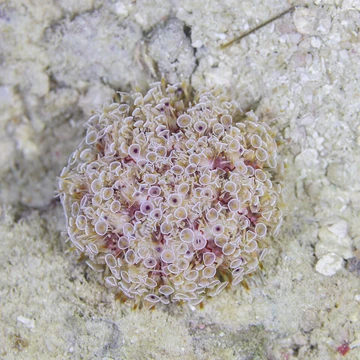
Arbacia lixula
A black sea urchin with uniform spines and an anal valve.

Arbacia lixula, called the black sea urchin, is a European sea urchin species. It is medium-sized, with a hemispherical body and a deep black color. Its spines are all roughly the same length and are held erect underwater, never appearing messy. The anus sits on top, surrounded by four plates that form an anal valve. The underside is mostly bare, with the mouth ringed by soft, dark-greenish skin.
This urchin can be mistaken for the purple sea urchin *Paracentrotus lividus*, but that species is never truly black, has spines of varying lengths that lie in disarray, often covers itself with debris, has spines around its mouth, lacks an anal valve, and does not live exposed on cliffs.
The species lives along the Mediterranean coast and the Macaronesian Islands (Azores, Madeira, Canary Islands), and less often on the Atlantic coast of West Africa and Brazil. It is found in shallow, rocky shores from 0 to 30 meters deep. It withstands strong water movement well because it attaches firmly to rocks.
It feeds mainly on crustose red algae and small filamentous algae. In one Mediterranean marine reserve, its population increased more than tenfold between 1983 and 1992, from 8 to 100 individuals per square meter. High seawater temperatures are thought to benefit this species. When it was removed from a part of the reserve, the density of filamentous algae rose.
Quick Facts
- Taxon
- Arbacia lixula
Facts from the source article.
Lore & Background
Arbacia lixula is a medium-sized sea urchin characterized by its deep black color and hemispherical shape. All of its spines are roughly the same size, with no secondary spines, and they remain erect in water, never dishevelled. The anus on top is surrounded by four plates forming an anal valve, while the oral face is nearly naked, with the mouth surrounded by soft, dark-greenish skin. This species can be confused with the purple sea urchin Paracentrotus lividus, but the latter is never truly black, has spines of many lengths, covers itself with debris, has spines around the mouth, lacks an anal valve, and does not live exposed on cliffs. Arbacia lixula is found on the coast of the Mediterranean Sea and Macaronesian Islands, and less commonly on the Atlantic coast of Western Africa and the Brazilian coast. It inhabits shallow waters from 0 to 30 m on rocky shores and has good resistance to hydrodynamism due to strong attachment to rocks. Its diet consists mainly of crustose red algae and small filamentous algae. In a marine reserve in the Mediterranean, its population increased dramatically between 1983 and 1992, from 8 to 100 individuals per square meter, a factor of over 10. High seawater temperatures are thought to favor this species. When it was excluded from an area of the reserve, the density of filamentous algae increased.
Reader's Guide
Arbacia lixula holds significance as a distinct species within European waters, particularly in the Mediterranean and Macaronesian Islands. Its uniform, erect spines and anal valve are key identifying features that separate it from the similar Paracentrotus lividus. The species' population dynamics in a Mediterranean marine reserve, where it increased more than tenfold between 1983 and 1992, highlight its responsiveness to environmental conditions, with high seawater temperatures thought to favor it. The experiment excluding it from an area, which led to increased filamentous algae, underscores its role in controlling algal growth. Its strong attachment to rocks allows it to thrive in hydrodynamic shallow rocky shores, contributing to its ecological niche. The species' range extends less commonly to the Atlantic coast of Western Africa and Brazil, indicating a broader distribution than often recognized. These biological and ecological traits make Arbacia lixula a notable subject for studies of marine invertebrate ecology and climate influence.
More in Sea Urchins, Part 2 1-24
Spotted an error? Know more?
Reader corrections go straight into our review queue. Suggest an edit · How this site is sourced