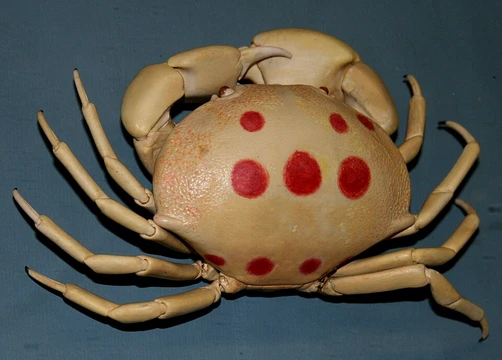
Xantho poressa
A crab that shifts from seagrass to rocky shores.

The jaguar round crab (*Xantho poressa*) is one of four crabs in its genus, found in the eastern Atlantic Ocean. Young crabs have a variable carapace—yellowish, reddish, brown, or dark grey—with patches of another color, usually white, which helps them blend in with the epibionts on *Posidonia* leaves. Their walking legs are typically banded with dark brown or black and white or translucent stripes or spots, though the fifth leg is brighter and often plain. Adults become a uniform dark grey and move from seagrass beds to open, rocky areas.
This crab lives across the Black Sea, the Mediterranean Sea, and the warmer parts of the northeastern Atlantic as far south as the Canary Islands. Its larvae go through four zoeal stages and one megalopa stage, each zoeal stage lasting 2–4 days and the megalopa about 10 days; the first juvenile crab appears after 23 days. Juveniles stay in *Posidonia* meadows until their final molt, then migrate to nearby rocky substrates. In the Black Sea, *X. poressa* is common near shore at depths under 1 meter, mainly on stones, pebbles, and crushed rock, and is rare on other substrates, though it can occur down to 15 meters.
Quick Facts
- Taxon
- Xantho poressa
Facts from the source article.
Lore & Background
Juveniles of Xantho poressa are cryptically colored as camouflage among the epibionts on the leaves of Posidonia. Their carapace color is variable, ranging from yellowish, reddish, brown, or dark grey with patches of another color, usually white. The pereiopods are usually banded with dark brown or black bands alternating with white or translucent stripes or spots, although the fifth pereiopod is brighter and often unmarked. Adults are uniformly dark grey and leave the seagrass beds for more open, rocky substrates.
The species is distributed throughout the Black Sea and the Mediterranean Sea and into the warmer parts of the northeastern Atlantic to the Canary Islands. In the Black Sea, X. poressa is common near the shoreline at depths less than 1 m, mainly on stones on substrates of pebble and crushed rock; it is rare on other substrates and may occur down to 15 m in depth.
The larvae go through four zoeal and one megalopal stages, typical of most related species in the subfamily Xanthinae. Each zoeal stage lasts 2–4 days, the megalopa stage lasts an average of 10 days, and the first juvenile crab stage is reached after 23 days. Juveniles live in Posidonia meadows until their last moult, when they migrate to the nearest rocky substrate.
Reader's Guide
Xantho poressa, the jaguar round crab, is one of four species in the genus Xantho. Its significance lies in its life history, which involves a dramatic shift in both habitat and coloration. Juveniles are cryptically colored to blend with the epibionts on Posidonia leaves, while adults become uniformly dark grey and move to rocky substrates. This ontogenetic change is a key adaptation. The species is distributed across the Black Sea, Mediterranean Sea, and into the northeastern Atlantic to the Canary Islands. Its larval development, with four zoeal and one megalopal stages, is typical of the subfamily Xanthinae. In the Black Sea, it is most common in shallow waters less than 1 m deep on pebble and crushed rock substrates, though it can occur down to 15 m. The species' reliance on Posidonia meadows for juvenile development and its subsequent migration to rocky areas highlight its ecological role in coastal marine environments.
Did You Know?
- Juveniles have a variable carapace color that can be yellowish, reddish, brown, or dark grey with white patches.
- Adults are uniformly dark grey and leave seagrass beds for rocky substrates.
- In the Black Sea, X. poressa is common at depths less than 1 m on pebble and crushed rock substrates.
Frequently Asked Questions
Who is Xantho poressa?
Xantho poressa, commonly called the jaguar round crab, is one of four species in the genus Xantho. It is a reef crab native to the eastern Atlantic Ocean, with a range that includes the Black Sea and the Mediterranean.
What does Xantho poressa look like at different life stages?
Juveniles sport a patchy carapace in yellowish, reddish, brown, or dark grey tones dotted with white, while their walking legs carry dark brown or black bands broken up by white or translucent spots; the fifth leg is typically brighter and plainer. Adults shed all that patchwork and settle into a uniform dark grey.
Where does Xantho poressa live and how does its habitat shift with age?
Young crabs shelter among Posidonia seagrass beds, where their mottled coloring lets them vanish against the leaves and the tiny organisms growing on them. Once they reach adulthood, they abandon the seagrass and move out to open, rocky coastal areas.
How long does Xantho poressa take to develop from larva to juvenile?
The species runs through four zoeal stages, each lasting roughly two to four days, followed by a single megalopal stage that averages about ten days. In total, approximately twenty-three days pass before the first recognizable juvenile crab emerges.
Why is Xantho poressa's camouflage considered notable?
Its juvenile coloration isn't merely decorative—it actively mimics the epibionts that coat Posidonia leaves, making the crab nearly undetectable to predators browsing the seagrass. This close visual match to its immediate surroundings is what gives the species its 'jaguar' nickname.
More in Reef Crabs 1-24
Spotted an error? Know more?
Reader corrections go straight into our review queue. Suggest an edit · How this site is sourced