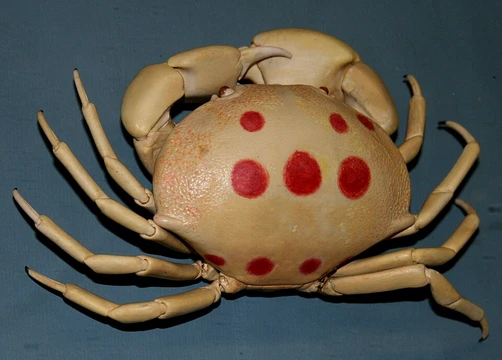
Actaea savignii
An Indo-Pacific xanthid crab that migrated into the Mediterranean via the Suez Canal.

Actaea savignii is an Indo-Pacific crab belonging to the Xanthidae family, a group known as spiny-legged rock crabs. Since the mid-2000s, it has established itself in the Levantine Sea after migrating from the Red Sea through the Suez Canal, a process known as Lessepsian migration.
The crab’s carapace is oval and slightly domed on top, with a flat central area. Its width is about 1.3 times its length, and the upper surface is covered in large, smooth, rounded, petal-shaped tubercles that are densely packed. The front edge of the carapace is strongly curved, measuring about 0.35 times the carapace width, and has two lobes separated by a wide V-shaped notch. Along the side, the anterolateral margin is slightly curved and divided into four vaguely defined, rounded, tuberculate lobes, with the frontmost lobe barely visible. The posterolateral margin is shorter and slightly concave, while the rear margin is straight and lined with a prominent row of tubercles. Nearly the entire underside is also densely covered with flattened, tightly packed tubercles of varying sizes, some simple and some petal-like. The claws are heavy, roughly equal in size, and also coated in dense tubercles. The fingers are noticeably shorter than the palm; the movable finger has flattened tubercles near its base and two to three larger tubercles that form teeth. The walking legs are similarly covered in tubercles, with larger conical ones on the upper surfaces of the carpus and propodus. The carapace is yellowish with distinct purple-brown blotches on the orbital and cardiac regions. The claws and walking legs show a similar color pattern, though the claw fingers are dark brown to black in males and paler in females. The crab can reach a carapace width of 19.7 mm.
This species has a broad Indo-Pacific range, from the Red Sea and eastern coast of Africa eastward to Japan, the eastern coast of Australia, and as far as New Caledonia. It was reported in the Suez Canal and its associated salt lakes as early as 1924. The first Mediterranean record came from off Lebanon in 2006, followed by sightings in Israel and Turkey.
Little is known about the biology of Actaea savignii, but most related species are largely herbivorous, and many xanthid crabs are toxic if eaten.
Quick Facts
- Taxon
- Actaea savignii
Facts from the source article.
Lore & Background
Actaea savignii has an oval carapace that is slightly convex on the dorsal surface with a flat median region. The dorsal regions are covered with large, smooth, rounded, petal-shaped, dense tubercles. The anterolateral margin is slightly curved and divided into four vaguely defined, tuberculate, rounded lobes, with the anteriormost barely marked. The posterolateral margin is shorter and slightly concave, while the posterior margin is straight and bears a prominent row of tubercles. The front margin is strongly curved, equivalent to about 0.35 times the carapace width, and has two lobes divided by a wide V-shaped cleft. Almost the entire under surface is densely tuberculate, with flattened, densely packed tubercles varying in size, partly simple and partly petal-like. The claws are subequal, heavy, and also covered in dense tubercles; the fingers are distinctly shorter than the palm, with the movable finger's proximal portion densely covered with flattened tubercles and bearing two to three larger tubercles forming teeth. The walking legs are densely covered with tubercles, including larger conical ones on the upper surface of the carpus and propodus. The dorsal carapace is yellowish with obvious purple-brown blotches on the orbital and cardiac regions; claws and walking legs show a similar pattern, though the claw fingers are dark brown to black in males and paler in females. Its biology is little known, but most related species are largely plant eaters, and most Xanthid crabs are toxic if consumed.
Reader's Guide
Actaea savignii is significant as a documented example of Lessepsian migration, having colonised the Levantine Sea through the Suez Canal from the Red Sea since the mid 2000s. Its Indo-Pacific distribution spans from the Red Sea and eastern coast of Africa east to Japan, the east coast of Australia, and as far east as New Caledonia. It was reported from the Suez Canal and its associated salt lakes as early as 1924, but its first Mediterranean record came from off Lebanon in 2006, with subsequent records from Israel and Turkey. The species is one of the spiny-legged rock crabs (family Xanthidae), and while its biology is little known, related species are largely herbivorous, and most xanthid crabs are toxic if consumed. Its physical description—including a densely tuberculate carapace, subequal heavy claws, and distinctive coloration—provides a basis for identification. The species' spread highlights ongoing biogeographic changes in the Mediterranean due to the Suez Canal, and its presence in the Levantine Sea represents a notable range expansion for an Indo-Pacific crab.
Did You Know?
- Actaea savignii was first recorded in the Mediterranean Sea off Lebanon in 2006.
- Its carapace width is about 1.3 times its length, and it can grow to 19.7 mm in carapace breadth.
- The species has been reported from the Suez Canal and its associated salt lakes since 1924.
- Most species of Xanthid crabs, including related ones, are toxic if consumed.
Frequently Asked Questions
What is Actaea savignii?
Actaea savignii is a small reef-dwelling crab native to the Indo-Pacific, placed in the Xanthidae family of spiny-legged rock crabs. It has recently become a non-native resident of the eastern Mediterranean.
What does Actaea savignii look like?
Its carapace is broadly oval and gently domed, with a flat central patch, and the upper surface is densely studded with large, smooth, petal-shaped tubercles. The shell is roughly 1.3 times as wide as it is long, and the strongly curved front margin spans about 35 % of the carapace width.
How did Actaea savignii reach the Mediterranean?
The crab moved from the Red Sea into the Levantine basin through the Suez Canal, a trans-oceanic dispersal route called Lessepsian migration. It has been establishing itself in these new waters since the mid-2000s.
Where and when was Actaea savignii first recorded in the Mediterranean?
The earliest Mediterranean observation dates to 2006 and was made off the coast of Lebanon. That initial record marked the species' arrival in the Levantine Sea.
How large does Actaea savignii grow?
The maximum carapace breadth on record is about 19.7 mm, placing it firmly in the small-crab category. Its compact, rounded body is well adapted to squeezing into crevices on rocky reef substrates.
More in Reef Crabs 1-24
Spotted an error? Know more?
Reader corrections go straight into our review queue. Suggest an edit · How this site is sourced