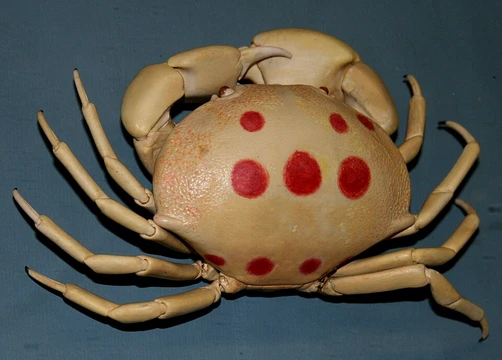
Atergatis floridus
A toxic Indo-Pacific crab with lace-like markings and lethal meat.

Atergatis floridus, also called the floral egg crab, green egg crab, pancake crab, or shawl crab, is a tropical Indo-Pacific crab belonging to the family Xanthidae. Its flesh is toxic, remaining dangerous even after cooking, and eating it frequently leads to death.
The crab has an oval, fairly narrow carapace with a smooth surface and smooth edges. The carapace is greenish or greenish-blue-brown, marked with a fine lace-like pattern of white or yellow lines that resembles a shawl. Its large claws are equal in size, smooth, and tipped with black, spoon-shaped ends; males may have larger claws than females. The walking legs are squarish, quite thick, hairless, and edged in lilac. The carapace width ranges from 8 to 10 cm (3.1–3.9 in), and it is about 1.4 times wider than it is long.
This species lives in the eastern Indian Ocean, from Southeast Asia south to Australia, reaching Rottnest Island in Western Australia and possibly Sydney in the east. Its range extends eastward across the western Pacific as far as Hawaii.
Atergatis floridus inhabits the neritic zone, favoring coral and rubble areas, and is mostly active at night. It serves as a host for the isopod *Gigantione hainanensis* and several rhizocephalan barnacles, including *Loxothylacus aristatus*, *Loxothylacus corculum*, *Sacculina gordonae*, *Sacculina robusta*, *Sacculina spinosa*, and *Sacculina weberi*.
Like many crabs in the family Xanthidae, its meat is toxic. The toxins are produced by symbiotic bacteria of the genus *Vibrio* and include tetrodotoxin, similar to that found in pufferfish, as well as saxitoxin, the main toxin responsible for paralytic shellfish poisoning.
Taxonomically, *Atergatis floridus* was once thought to have a wide Indo-Pacific range, but some experts now believe that specimens from the western Indian Ocean belong to a separate species, *Atergatis ocryoe*, previously considered a junior synonym. In its strict sense, *A. floridus* is found only in the eastern Indian Ocean and western Pacific.
Quick Facts
- Taxon
- Atergatis floridus
Facts from the source article.
Lore & Background
Atergatis floridus has an oval carapace that is smooth and greenish or greenish-blue-brown, marked with a fine network of white or yellow lines resembling a shawl. Its large claws are equal in size, smooth with black spoon-shaped tips, and may be larger in males. The pereiopods are squarish, thick, with lilac edges and no hair. The carapace width is 8–10 cm and is about 1.4 times broader than long.
This species occurs in the eastern Indian Ocean from southeast Asia south to Australia, reaching Rottnest Island in Western Australia and possibly Sydney, and extends eastward across the western Pacific to Hawaii. It inhabits the neritic zone, preferring coral and rubble, and is largely nocturnal. It hosts the isopod Gigantione hainanensis and several rhizocephalan barnacles.
The meat is toxic due to tetrodotoxin and saxitoxin produced by symbiotic Vibrio bacteria, similar to pufferfish toxins. Consumption often results in death, even when cooked. There is taxonomic uncertainty: some authorities consider western Indian Ocean specimens to be a separate species, Atergatis ocryoe, with A. floridus sensu stricto restricted to the eastern Indian Ocean and western Pacific.
Reader's Guide
Atergatis floridus is significant primarily for its extreme toxicity, which persists even after cooking and frequently leads to death upon consumption. This toxicity, shared with many Xanthidae crabs, is caused by tetrodotoxin and saxitoxin—the same poisons found in pufferfish and paralytic shellfish poisoning—synthesized by symbiotic Vibrio bacteria. The crab's distinctive lace-like pattern and shawl-like markings contribute to its common names, but its lethal nature overshadows its appearance. Its distribution across the tropical Indo-Pacific, from southeast Asia to Australia and Hawaii, places it in coral and rubble habitats of the neritic zone, where it is largely nocturnal. The species also serves as a host for various parasitic isopods and barnacles, indicating its role in local ecological interactions. Taxonomic debate exists, with some authorities splitting the western Indian Ocean population into Atergatis ocryoe, leaving A. floridus sensu stricto in the eastern Indian Ocean and western Pacific. This uncertainty highlights the need for further study. Overall, the crab's legacy is one of a beautiful but deadly organism, a cautionary example of marine biotoxicity.
Did You Know?
- The meat of Atergatis floridus remains toxic even after cooking, and consumption often results in death.
- Its toxins include tetrodotoxin (found in pufferfish) and saxitoxin (the primary toxin in paralytic shellfish poisoning).
- The toxins are synthesized by symbiotic bacteria of the genus Vibrio.
Physical Form and Coloration
The pancake crab presents a strikingly smooth and broadly oval shell, its carapace convex and nearly unbroken in outline, lacking any visible regional divisions. Along the front-side edges, the margins bear blunt crests that give the silhouette a subtly armored quality. Its walking legs are flattened from side to side, each tipped with small crests running along both the upper and lower edges. In mature individuals, the shell takes on a deep reddish-brown tone while the leg tips darken to black. Juveniles, by contrast, appear noticeably paler, shifting toward a warm reddish-orange, and their carapace edges are trimmed in white. From the front of the head to the rear of the shell, the crab reaches a maximum carapace length of roughly six centimetres, making it a modestly sized reef dweller whose compact, disc-like body is perfectly suited to slipping into tight crevices among coral and rock.
Indo-Pacific Home and the Suez Canal Passage
Native to the warm waters stretching from the Red Sea and the eastern African coast, the pancake crab's natural range sweeps southward to KwaZulu-Natal and then eastward along the Indian Ocean rim all the way to Fiji. Yet its story does not end in the Indo-Pacific. Beginning in the early 1960s, the species made its first confirmed appearance in the eastern Mediterranean, recorded off the coast of Israel in 1961. From there it spread to Lebanon and the southern shores of Turkey and Syria. The pace of colonisation accelerated in the 2000s: by 2005 the crab had been sighted in the Aegean Sea, and by 2009 its range had extended as far as the island of Rhodes. This progressive eastward creep into the Mediterranean is a textbook example of Lessepsian migration, a process in which ocean organisms pass through the Suez Canal and establish themselves in a previously unoccupied sea basin, reshaping local reef communities in their wake.
Nocturnal Life on the Reef
During the day the pancake crab keeps low and close to cover, but once darkness falls it becomes the active forager it is. It is a slow-moving animal, and that deliberate pace shapes every aspect of its routine: it never strays far from a crevice, a rock overhang, or a coral hollow where it can bolt back to safety at the first sign of danger. Its preferred habitat is shallow, reef-rich ground where hiding spots are plentiful, ranging from the low-tide line down to roughly thirty metres. Though classified as an omnivore, the crab leans heavily toward plant matter for much of its nutrition. That said, observations have captured individuals taking bites out of fish, reminding us that this quiet reef dweller is far from a strict herbivore. The combination of nocturnal activity, measured movement, and a strong attachment to nearby shelter makes it a creature that rewards patient, night-time observation far more than casual daytime encounters.
A Deadly Bacterial Symbiosis
Despite its unassuming appearance and gentle pace, the pancake crab carries a potent chemical warning in its flesh. Like many of its relatives in the family Xanthidae, the meat is toxic to humans and other predators. The source of that danger is not the crab's own biochemistry but a partnership with microscopic organisms: bacteria belonging to the genus Vibrio reside in a symbiotic relationship with the animal, and it is these bacteria that manufacture the poisons. The toxins they produce include tetrodotoxin, the same neurotoxic compound that makes puffer fish so lethal, as well as paralytic shellfish poison, a class of compounds well known for causing severe neurological symptoms in humans who consume contaminated seafood. This bacterial-architect, crab-host arrangement means the crab itself is essentially a living delivery system for compounds it does not synthesize, a quiet reminder that in reef ecosystems the most dangerous partnerships are often the smallest and least visible.
Frequently Asked Questions
What is Atergatis floridus?
Atergatis floridus is a tropical reef crab in the family Xanthidae, native to the eastern Indian Ocean. It is known by several common names, including floral egg crab, pancake crab, and shawl crab.
What does Atergatis floridus look like?
It has a smooth, oval carapace in shades of greenish or greenish-blue-brown, decorated with a delicate lace-like network of white or yellow lines that gives it a shawl-like pattern. Its two large, equal-sized claws are smooth and end in distinctive black spoon-shaped tips.
Where is Atergatis floridus found in the wild?
This species ranges across the eastern Indian Ocean, stretching from southeast Asia all the way to Australia. Sighting records include Rottnest Island and, possibly, as far south as Sydney.
Is Atergatis floridus safe to eat?
Absolutely not — its flesh carries a toxin that persists even after cooking. Ingesting it is frequently fatal, making it one of the most dangerous reef crabs a person could accidentally consume.
How big does Atergatis floridus get?
The carapace typically spans 8 to 10 centimeters (about 3.1 to 3.9 inches) in width. The overall body shape is roughly 1.4 times broader than it is long, giving it a distinctly flattened, pancake-like profile.
More in Reef Crabs 1-24
Spotted an error? Know more?
Reader corrections go straight into our review queue. Suggest an edit · How this site is sourced