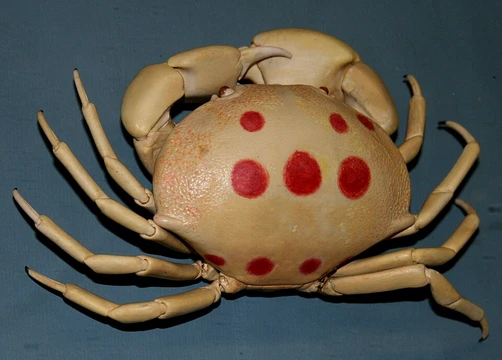
Xantho hydrophilus
A nocturnal omnivorous crab from western Scotland to Cape Verde.

Xantho hydrophilus, called the furrowed crab or Montagu's crab, belongs to the family Xanthidae. This crab is yellowish-brown and reaches a carapace width of 70 mm (2.8 in). It is a nocturnal omnivore, living in shallow marine waters from western Scotland down to the Cape Verde Islands.
The carapace, which can be up to 22 mm (0.9 in) long, looks smooth to the naked eye but is finely granular under magnification. Its front side edges have five blunt lobes. The chelipeds are large, sturdy, and equal in size, without spines or tubercles, while the walking legs are short and stout. The body is yellowish-brown except for the black tips of the claws. This species closely resembles *Xantho pilipes* but lacks fringes of setae on the second to fifth walking legs. Other distinguishing features include wide, shallow inward-pointing depressions between the second and fourth front-side lobes, bristly rear-side edges of the carapace, and a broad, pitted groove on the inner surface of the propodus.
This crab lives under stones on sandy and stony beaches below the intertidal zone, down to 40 m (130 ft) deep, though it can appear in rock pools at low tide. It feeds mainly on algae but also scavenges, and is most active at night. When threatened, it spreads its large chelipeds to appear bigger. Mating occurs in spring, with females carrying fertilized eggs on their pleopods from March to July; larvae are found in plankton through most of summer.
Its range includes the Mediterranean Sea, Cape Verde Islands, Azores, and Canary Islands in the south, extending north to western and southern coasts of the British Isles, with its northern limit in western Scotland.
Some researchers have treated Mediterranean populations as a separate subspecies (*Xantho hydrophilus granulimanus*) or species (*Xantho granulimanus*). However, genetic studies show wide differences between northeastern Atlantic (Brittany) and eastern Mediterranean (Greece) populations, but intermediate forms in the southeastern Atlantic (Portugal) and western Mediterranean (Ibiza), suggesting gene flow. These authors consider *X. hydrophilus* a monotypic species, not recognizing *X. hydrophilus granulimanus* as distinct.
Quick Facts
- Taxon
- Xantho hydrophilus
Facts from the source article.
Lore & Background
Xantho hydrophilus has a carapace that reaches a width of 70 mm and a length of up to 22 mm. The dorsal surface appears smooth but is finely granular under close examination, and the antero-lateral edge bears five blunt lobes. Its chelipeds are large, robust, and equal in size, lacking spines or tubercles, while the walking legs are relatively short and stout. The crab is yellowish-brown except for the black tips of the chelae. It closely resembles Xantho pilipes but can be distinguished by the absence of fringes of setae on the second to fifth pairs of walking legs, along with other key features such as wide, shallow depressions between the second to fourth antero-lateral lobes and a bristly postero-lateral margin.
The species lives under stones on sandy and stony beaches below the intertidal zone, up to a depth of 40 metres, though it can also be found in rock pools at low tide. It is an omnivore that feeds chiefly on algae but also scavenges, and is mostly active at night. When disturbed, it spreads out its large chelipeds to appear larger. Mating occurs in spring, with females carrying fertilised eggs on their pleopods from March to July; larvae are found in plankton over most of the summer.
Taxonomically, the Mediterranean populations have been recognised as a separate taxon, either as the subspecies Xantho hydrophilus granulimanus or the species Xantho granulimanus. However, genetic studies show wide differentiation between northeastern Atlantic and eastern Mediterranean populations, with intermediate forms in southeastern Atlantic and western Mediterranean, suggesting gene flow. These authors do not recognise X. hydrophilus granulimanus as a separate taxon, regarding X. hydrophilus as a monotypic species.
Reader's Guide
Xantho hydrophilus holds significance as a well-studied crab species within the family Xanthidae, notable for its wide geographic range from western Scotland to the Cape Verde Islands and its presence in both Atlantic and Mediterranean waters. Its ecological role as a nocturnal omnivore that feeds chiefly on algae and scavenges contributes to the dynamics of shallow marine and intertidal communities. The species is also notable for its defensive behavior of spreading its large chelipeds when disturbed. Taxonomically, X. hydrophilus has a complex history: originally described as Cancer hydrophilus by Herbst in 1790, it was later redescribed under multiple names including Cancer floridus by Montagu and Cancer incisus by Leach, and has been confused with other taxa such as Xantho poressa and Xantho pilipes. The ongoing debate over whether Mediterranean populations constitute a separate subspecies or species, with genetic evidence showing both differentiation and gene flow, highlights the species' importance in studies of speciation and population connectivity. Its northern limit in western Scotland marks a biogeographic boundary, and its larvae appearing in plankton over summer contribute to its dispersal. The species' legacy includes clarifying taxonomic confusion and serving as a model for understanding genetic variation across a fragmented marine range.
Frequently Asked Questions
What is Xantho hydrophilus?
Xantho hydrophilus, commonly known as the furrowed crab or Montagu's crab, is a small nocturnal omnivore in the family Xanthidae. It has a yellowish-brown body with black-tipped claws and lives in shallow coastal waters.
Where does Xantho hydrophilus live?
This species ranges from the western coast of Scotland all the way down to the Cape Verde Islands. It typically occupies shallow marine habitats, staying within roughly 40 metres (130 ft) of the surface.
How big does Xantho hydrophilus get?
Adults reach a carapace width of about 70 mm (2.8 in), while the carapace itself measures up to 22 mm (0.9 in) in length. Despite its modest size, the crab carries a pair of large, sturdy, equally sized claws that are smooth and free of spines.
What does Xantho hydrophilus eat and when is it active?
It is a nocturnal omnivore, meaning it forages after dark and will take both plant and animal matter. Its short, stout walking legs and powerful chelipeds are well suited to grabbing and processing a varied diet on the seabed.
Who first described Xantho hydrophilus and under what name?
The species was originally described by Johann Friedrich Wilhelm Herbst in 1790 under the name Cancer hydrophilus. It was later reclassified into its current genus, Xantho, reflecting its true placement within the Xanthidae family.
More in Reef Crabs 1-24
Spotted an error? Know more?
Reader corrections go straight into our review queue. Suggest an edit · How this site is sourced