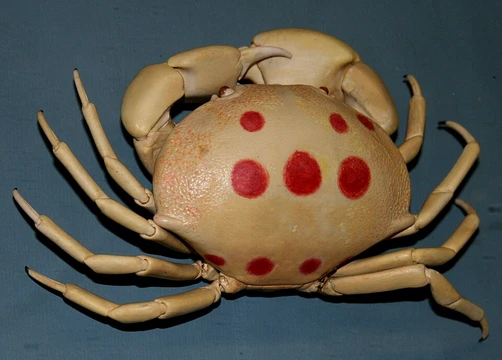
Lybia tessellata
Small crab that carries sea anemones in its claws.

Lybia tessellata is a species of small crab in the family Xanthidae, found in shallow parts of the tropical Indo-Pacific Ocean. It is notable for its habit of carrying a sea anemone in each claw, which gives it the common names pom-pom crab, cheerleader crab, or boxer crab.
Quick Facts
- Genus
- Lybia
- Species
- tessellata
Facts from the source article.
Lore & Background
Lybia tessellata is a small crab growing to a width of about 2.5 cm. Its carapace is trapezoid with a tooth-shaped projection on either side behind the short-stalked eye. The carapace surface is marked into several differently colored geometric regions by a network of dark lines, giving it a stained-glass appearance. The chelipeds are slim, lacking broad chelae, and each has a fine finger bearing eight or nine spines. The front pair of walking legs is smaller than the other three pairs, but all are much larger than the chelipeds. The legs are banded with dark transverse lines, speckled with white spots, and clad in sparse short hairs; the claws at their ends are long and thin.
It is found in shallow water in the tropical Indo-Pacific, from the Red Sea and East African coast to Indonesia and New Guinea, on sandy and gravelly seabeds where it is well camouflaged, and on live corals where it clings with its long thin legs. It carries a small sea anemone, usually Bunodeopsis spp. or Triactis producta, in each chela, holding its chelipeds out horizontally while moving. If attacked, it threatens with an anemone armed with cnidocytes. It cannot feed itself with its chelae and uses the anemone tentacles to collect food particles, which it removes with its mobile maxillipeds. The red eggs are carried on the female's abdomen and brooded.
Reader's Guide
Lybia tessellata is well suited to being kept in a reef aquarium, though its small size and cryptic appearance may make it better suited to a small tank where it can be better observed. It is compatible with most other tank inhabitants but may be attacked by predatory fish. It is a shy species and easier to find at night when the tank lights are off. Its significance lies in its unique symbiotic relationship with sea anemones, which it uses for defense and feeding, a behavior that distinguishes it from many other crabs. The species is also notable for its stained-glass-like carapace pattern and its role in the shallow-water ecosystems of the Indo-Pacific, where it inhabits sandy and gravelly seabeds and live corals. Its legacy is tied to its popular common names—pom-pom crab, cheerleader crab, or boxer crab—which reflect its distinctive appearance and behavior. The species is documented in the Sealife Collection and in video clips showing its movement.
Did You Know?
- Lybia tessellata carries a sea anemone in each claw, using them like pom-poms or boxing gloves.
- Its carapace is marked into geometric regions by dark lines, resembling stained glass.
- The crab cannot feed itself with its chelae; it uses anemone tentacles to collect food.
- The female broods red eggs on her abdomen.
A Stained-Glass Carapace and Unusual Limbs
Lybia tessellata is a compact crab whose carapace spans roughly 2.5 centimeters from side to side. Its shell takes on a trapezoidal outline, and just behind the short-stalked eyes on either side, a distinct tooth-like projection breaks the otherwise smooth margin. What makes this species visually striking is the pattern on its carapace: a network of dark lines partitions the surface into multiple geometric patches of differing hues, producing an effect that closely resembles a piece of stained glass. The chelipeds deviate sharply from the broad, crushing claws one expects in most decapod crabs. Instead, they are slender and each terminates in a fine finger armed with eight or nine small spines. The front pair of walking legs is slightly shorter than the remaining three pairs, yet all four pairs of legs dwarf the chelipeds in size. These legs display dark transverse banding, are dotted with tiny white specks, and are covered in sparse, short hairs. At their tips sit long, thin claws that the crab uses to grip onto live coral structures.
A Wide Tropical Range and Camouflaged Lifestyle
Lybia tessellata inhabits the shallow waters of the tropical Indo-Pacific, with its distribution stretching from the Red Sea and the eastern coast of Africa across to Indonesia, New Guinea, Northern Japan, and the Northern and Eastern Hawaiian Islands. This broad range reflects the crab's preference for warm, near-shore environments rather than deep open ocean. On the seafloor, it favors sandy and gravelly substrates, where its stained-glass coloration and banded legs provide effective camouflage against the surrounding sediment. It is equally at home on living coral, where it clings to the structure using its long, thin terminal claws. The species' small body size and cryptic appearance mean it blends seamlessly into both habitat types, making it a creature that is often overlooked by casual observers. Despite its modest dimensions, the crab occupies a distinctive ecological niche in these shallow tropical settings, combining the mobility of a sandy-bottom dweller with the structural attachment of a coral-associated invertebrate.
Anemone Partners: Defense and Feeding
The most remarkable behavioral trait of Lybia tessellata is its intimate partnership with sea anemones, a habit that has earned the genus nicknames such as pom-pom crab, cheerleader crab, and boxer crab. The crab grips a small anemone, typically a species of Bunodeopsis or Triactis producta, in each of its slender chelae and holds them out horizontally as it moves through the water. When a predator approaches, the crab presents the anemone as a threat; the tentacles are densely armed with cnidocytes, the stinging cells that deliver a potent chemical defense. Beyond protection, the anemones serve as a feeding apparatus. Because the crab's chelae are too narrow and spiny to manipulate food directly, it relies on the anemone's tentacles to trap and gather food particles from the surrounding water. The crab then extracts these captured bits using its mobile maxillipeds, effectively outsourcing the first stage of feeding to its symbiotic partners. This arrangement makes the omnivorous crab a fascinating example of mutualistic foraging in the shallow tropical Indo-Pacific.
Brooding Eggs and Life in the Reef Tank
Reproduction in Lybia tessellata follows a pattern familiar to many small marine crustaceans: the female carries her red eggs attached to her abdomen, where they are brooded until they are ready to hatch. This maternal care ensures the developing young remain in a relatively safe, sheltered position close to the mother's body. In the aquarium trade, this species has found a niche as a reef-tank inhabitant. Its small stature and cryptic coloration, while beautiful in the wild, can make it easy to miss in a large community tank; hobbyists often recommend a smaller setup where the crab's stained-glass markings and anemone-carrying behavior can be properly appreciated. It generally coexists peacefully with most other tank residents, though larger predatory fish may view it as prey. The crab is notably shy, tending to hide during the day and becoming more active and visible after the tank lights are switched off, when it can be observed moving through the substrate with its anemone pom-poms held aloft.
Frequently Asked Questions
What is Lybia tessellata?
It is a tiny crab in the Xanthidae family, most widely recognized by its nicknames: pom-pom crab, boxer crab, or cheerleader crab. It is one of the most visually striking small crabs you'll encounter in a tropical reef community.
Why is Lybia tessellata so famous?
The crab grips a small sea anemone in each front claw and waves them around like pom-poms, which is the behavior that gave it its popular names. That signature display is what makes it a favorite subject for reef-keepers and underwater photographers.
Where can I find Lybia tessellata?
Its range spans the shallow tropical Indo-Pacific, from the Red Sea and East African coast through Indonesia and New Guinea up to Northern Japan and the Hawaiian Islands. It typically hangs out on sandy or gravelly bottoms near live coral in relatively shallow water.
How big does Lybia tessellata get?
The carapace measures roughly 2.5 centimeters (about one inch) across, making it a very small crab. The anemones it carries in its claws can make it appear noticeably larger than its actual body size.
What does Lybia tessellata eat and how does it reproduce?
It is an omnivore, scavenging and picking up assorted food items from the seabed. When it comes to breeding, its eggs are a distinctive bright red, a detail that reef hobbyists often look for when observing reproductive activity.
More in Reef Crabs 1-24
Spotted an error? Know more?
Reader corrections go straight into our review queue. Suggest an edit · How this site is sourced