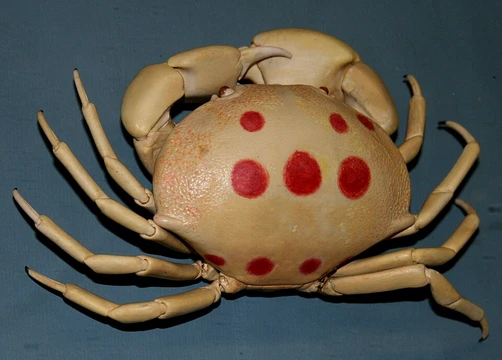
Platypodia eydouxi
A red-eyed crab crucial to Indo-Pacific reef biodiversity.

The red-eyed xanthid crab, scientifically known as *Platypodia eydouxi*, is a member of the Xanthidae family. This species lives in coral reefs and shallow marine waters throughout the Indo-Pacific, including Hawaii, and plays a key role in supporting marine biodiversity.
Its most noticeable feature is a pair of bright red eyes, which stand out against its brownish, oval shell. The body is broad and flat, with a tough carapace that offers protection. While both sexes share a similar build, males usually have larger, more prominent claws. These physical traits help the crab blend into its coral reef surroundings, which aids in both hiding from predators and catching prey.
The crab is widespread across the Indo-Pacific, with populations in Japan, Indonesia, and Australia. It favors warm-water habitats such as coral reefs, mangroves, and rocky shores, where it can find shelter and plenty of food. To survive, it depends on warm water temperatures and a reliable supply of small marine organisms, serving as both predator and prey in its ecosystem.
Quick Facts
- Genus
- Platypodia
- Species
- eydouxi
Facts from the source article.
Lore & Background
Platypodia eydouxi is characterized by its distinctive red eyes, which contrast with its brownish, oval-shaped carapace. The species typically has a broad and flattened body, with a sturdy carapace that provides protection. Males tend to have slightly larger and more pronounced claws compared to females, though both genders share similar body structures. These physical traits allow the species to blend into its coral reef environment, aiding in both defense and predation.
This species thrives in marine habitats like coral reefs, mangroves, and rocky shores, where it finds shelter and abundant food sources. To survive, Platypodia eydouxi relies on warm water temperatures and a steady supply of small marine organisms, which support its ecological role as both predator and prey in these environments.
Reader's Guide
Platypodia eydouxi is notable for its role in maintaining marine biodiversity within coral reefs and shallow marine environments across the Indo-Pacific, including Hawaii. As both predator and prey, it contributes to the ecological balance of its habitats, which include coral reefs, mangroves, and rocky shores. Its physical adaptations—such as a broad, flattened body, sturdy carapace, and red eyes that contrast with a brownish carapace—aid in camouflage, defense, and predation. Males have slightly larger claws than females, but both genders share similar body structures. The species depends on warm water temperatures and a steady supply of small marine organisms to survive. Its presence in regions such as Japan, Indonesia, and Australia underscores its widespread distribution. The crab's ecological significance lies in its dual role within the food web, helping to sustain the health and diversity of the reef ecosystems it inhabits.
Did You Know?
- Platypodia eydouxi is also called the red-eyed xanthid crab.
- It belongs to the family Xanthidae.
- Its distinctive red eyes contrast with its brownish, oval-shaped carapace.
Physical Form and Sexual Dimorphism
Platypodia eydouxi, commonly known as the red-eyed xanthid crab, is a member of the family Xanthidae whose most immediately striking feature is a pair of vivid red eyes set against a brownish, oval carapace. The overall body plan is notably broad and flattened, giving the animal a low profile that suits its reef-dwelling lifestyle. A sturdy, protective carapace covers the dorsal surface, shielding the crab from physical threats in its environment. While males and females share broadly similar body structures, a subtle but consistent difference exists in the chelipeds: males develop slightly larger and more pronounced claws than their female counterparts. This dimorphism in claw size may relate to competitive or defensive behaviors, though both sexes retain the same fundamental oval shape and flattened build. The combination of the bold red eyes and the muted brownish shell creates a visual contrast that is both distinctive and, paradoxically, functional within the complex textures of coral communities.
Geographic Range and Habitat Preferences
Populations of this xanthid crab are distributed across a wide swath of the Indo-Pacific, with confirmed presence in the waters surrounding Japan, Indonesia, and Australia, as well as in Hawaii. The species is not restricted to a single type of seafloor; rather, it occupies a variety of shallow marine settings including living coral reefs, mangrove root systems, and rocky shorelines. Each of these habitats offers the crab both physical shelter and a reliable source of small marine organisms that form the basis of its diet. Survival in these environments depends on consistently warm water temperatures, which the crab requires to maintain its metabolic functions. The broad geographic spread across multiple countries and habitat types suggests a degree of ecological flexibility, yet the species remains tied to the warm, shallow waters of the tropical and subtropical Indo-Pacific. In Hawaii, the crab is recognized as playing a vital role in sustaining the diversity of marine life on local reefs, underscoring its importance beyond mere presence.
Ecological Role in Marine Ecosystems
In the food webs of Indo-Pacific coral reefs, mangroves, and rocky shores, Platypodia eydouxi occupies a dual trophic position that makes it ecologically significant. As a predator, it feeds on small marine organisms that are abundant in these warm, shallow habitats, helping to regulate populations of invertebrates and other tiny fauna. Simultaneously, the crab itself serves as prey for larger marine animals, passing energy upward through the food chain. This dual role as both consumer and resource means that the presence or absence of the red-eyed xanthid crab can ripple through multiple levels of the ecosystem. In Hawaii, the species is specifically noted as crucial to maintaining marine biodiversity, a designation that highlights how even a single crab species can contribute to the structural integrity of a reef community. The steady supply of small organisms it depends on, and the larger predators that in turn depend on it, create a tightly linked web in which the crab's continued presence helps sustain the overall balance of species richness in its habitat.
Camouflage and Survival Strategies
The visual design of Platypodia eydouxi reflects a careful balance between conspicuousness and concealment. The bold red eyes are unmistakable, yet the brownish, oval carapace and the broad, flattened body shape allow the crab to merge seamlessly with the textured surfaces of coral reefs, mangrove substrates, and rocky outcrops. This cryptic coloration serves a dual purpose: it helps the crab avoid detection by larger predators while simultaneously enabling it to approach smaller prey without alerting them. The sturdy carapace adds a layer of physical defense, making it difficult for would-be predators to crush or dislodge the animal once it has tucked itself into a crevice. Males, with their slightly larger and more pronounced claws, may use these appendages in defensive posturing or intraspecific competition, while females rely on the same protective shell and body shape. Together, these morphological traits form an integrated survival toolkit that allows the red-eyed xanthid crab to persist across the diverse and often competitive environments of the Indo-Pacific.
Frequently Asked Questions
What is Platypodia eydouxi?
Platypodia eydouxi is the scientific name for the red-eyed xanthid crab, a broad, flat-bodied species belonging to the family Xanthidae. It is instantly recognizable by its dull brownish oval shell paired with a striking set of bright red eyes.
Where does Platypodia eydouxi live in the wild?
This crab occupies coral reefs and shallow marine habitats throughout the Indo-Pacific, with documented populations in Hawaii, Japan, Indonesia, and Australia.
What is the most distinctive feature of Platypodia eydouxi?
Its vivid red eyes stand out sharply against the otherwise muted brownish, oval-shaped carapace, making them the go-to field mark for spotting the species. The tough, broad shell also helps it camouflage among coral structures.
Why is Platypodia eydouxi important to reef ecosystems?
As a xanthid crab thriving on Indo-Pacific coral reefs, it is considered a key contributor to local marine biodiversity. Its presence is viewed as a meaningful indicator of a healthy, functioning reef community.
How do male and female Platypodia eydouxi differ physically?
Both sexes share the same broad, flat body shape and tough carapace, but males typically grow noticeably larger, more prominent claws than females.
More in Reef Crabs 1-24
Spotted an error? Know more?
Reader corrections go straight into our review queue. Suggest an edit · How this site is sourced