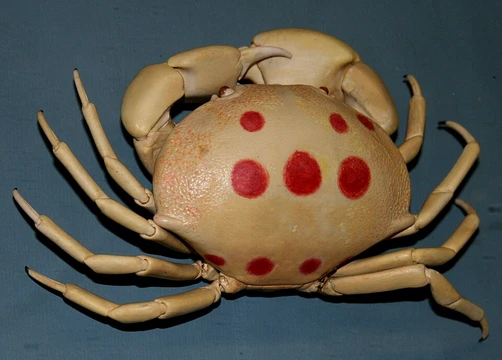
Guinotellus
Rare monotypic xanthid crab endemic to Philippine waters.

Guinotellus is a genus of crabs in the family Xanthidae, containing only the single species Guinotellus melvillensis. It is notable for being a rare and unusual benthic crab with an ovate carapace, recorded exclusively in the Western Central Pacific, specifically the Philippines. The genus is distinguished by its oval-shaped carapace, shallow sub-hepatic cavities, and a modified claw with a reduced merus that aligns with its first leg.
Quick Facts
- Genus
- Guinotellus
- Species
- melvillensis
Facts from the source article.
Lore & Background
Guinotellus melvillensis was first described by Raoul Serène in 1971, initially from a single juvenile male. At least 13 additional specimens were later reidentified from museum collections in the National Museum of the Philippines and the Museum national d'Histoire naturelle. The species was originally placed solely in Xanthidae, but was revised to the subfamily Euxanthinae in 1984. Its most distinctive features include an oval carapace broader than long (ratio roughly 1:1.2), shallow sub-hepatic cavities divided by a prominent crest, and a modified claw with a reduced merus that is coapted with the first walking leg. The purpose of this modification is unknown. The species lacks an external tooth and has a distinctive gastrointestinal tract with a hook-shaped dorsal lobe, reminiscent of other Xanthidae but unlike other Euxanthinae. It is visually similar to Hypocolpus, Carpoporus, and Hepatoporus, but can be distinguished by carapace ratio and gut morphology. Sexual dimorphism is notable: females have a less broad carapace, smaller claws, and a distinctive vulva. Coloration is undocumented but assumed to be colorful like other xanthids.
Reader's Guide
Guinotellus melvillensis is significant as the sole representative of its genus, highlighting the unique biodiversity of Philippine coral reefs. Its rarity—recorded from only four locations (Balabac Island, Sibutu Island, Putic Island, and southern Luzon)—underscores the need for further study. The species' modified claw and reduced merus, coapted with its first leg, remain functionally unexplained, presenting a puzzle for future research. Its morphological similarities to Hypocolpus and other euxanthines suggest evolutionary relationships that are not yet fully understood. The species' diet is inferred from related Xanthidae, likely including algae, brittle stars, gastropods, and bivalves, and it may contain toxins from its diet. Its larval stages, though not directly observed, are presumed to include four zoeal stages and a megalopa stage, with pelagic dispersal. The limited knowledge of its reproductive behavior, based on Decapoda, indicates indirect sperm transfer after female molting. As a benthic crab found in intertidal and subtidal zones, it contributes to the ecological complexity of reef flats and coral habitats. Its rediscovery from museum collections emphasizes the value of historical specimens in documenting cryptic species.
Did You Know?
- Guinotellus melvillensis is the only species in its genus, Guinotellus.
- Its modified claw has a reduced merus that is coapted with its first walking leg, a feature of unknown purpose.
- The species has been found at depths ranging from 2 to 73 meters in four Philippine locations.
- Its carapace is broader than long, with a width-to-length ratio of roughly 1:1.2.
Taxonomic Standing & Discovery
Guinotellus melvillensis occupies a singular position in the tree of life. It is the sole representative of its genus, Guinotellus, making it a monotypic lineage within the family Xanthidae—the group that encompasses the familiar mud crabs. Placed in the subfamily Euxanthinae under the infraorder Brachyura and order Decapoda, this species stands apart from its relatives in both structure and rarity. The genus and species were formally described in 1971 by the crustacean specialist Raoul Serène (1909–1980), who worked from a single juvenile male specimen. For decades afterward, the species remained remarkably obscure in the scientific literature. However, subsequent taxonomic reviews uncovered at least thirteen additional individuals that had been misfiled in the collections of the National Museum of the Philippines and the Museum national d'Histoire naturelle, each reidentified as G. melvillensis. Despite these recoveries, the crab remains one of the least-studied members of its family, with much of its fundamental biology still wrapped in uncertainty.
Anatomy & Morphological Oddities
The body plan of G. melvillensis is immediately striking. Its carapace is distinctly ovate, broader than it is long at a ratio of roughly 1:1.2, and lacks the regional differentiation seen in many other crabs. Beneath the liver region, the sub-hepatic cavities are notably shallow and partitioned by a prominent central crest, with additional crests running along their lateral edges. Perhaps the most enigmatic feature is the modified chela: the upper arm segment, or merus, is dramatically reduced, and the shortened claw sits flush against the first and longest walking leg in a coapted arrangement whose functional purpose remains unknown. The species also possesses a unique gastrointestinal tract whose dorsal lobe terminates in a hook shape—a configuration unlike other Euxanthids but echoing broader Xanthidae patterns. Sexual dimorphism is evident, with females displaying a narrower carapace, smaller claws, and a distinctive vulva. Size spans from 2.0 to 200 mm, and juveniles show a proportionally smaller width-to-length ratio. Coloration has never been documented, though a colorful palette is presumed based on close relatives.
Range & Reef Habitat
Every confirmed record of G. melvillensis comes from the Western Central Pacific, and more specifically from the Philippines. To date, specimens have been collected from just four sites: Balabac Island, Sibutu Island, Putic Island, and the southern reaches of Luzon. These locations are renowned for their extraordinary density of marine life, hosting numerous other Brachyura species alongside a rich assemblage of invertebrates. The crab itself is a benthic inhabitant of tropical reef environments, having been gathered at depths ranging from a mere 2 meters to as deep as 73 meters. Its preferred microhabitats include coral structures and reef flats surrounded by extensive seaweed beds, and it is postulated to occupy both intertidal and subtidal zones. Adult Xanthids in general favor shallow waters, a pattern consistent with the depth range observed here. Despite the richness of the surrounding ecosystem, G. melvillensis remains scarce, and its restricted geographic footprint—confined to a handful of Philippine sites—underscores how little is still known about its true distribution and population dynamics across the broader Western Central Pacific.
Reproduction, Diet & Life Cycle
Because direct observation of G. melvillensis in the wild is exceedingly rare, much of its life history is inferred from close relatives. Like most decapods, it is gonochoric, with separate male and female individuals. Mating is believed to follow a courtship sequence, with copulation occurring only in the narrow window immediately after the female molts, and sperm transfer proceeding indirectly. The larval phase, while not directly documented for this species, is expected to mirror the Xanthidae pattern of five successive stages—four zoeal molts followed by a megalopa stage—during which the young are pelagic, drifting in open water before settling to the benthos. Diet remains only partially understood, but by analogy with similar Xanthids such as P. vespertilio, it is likely an opportunistic omnivore with a strong lean toward herbivory, grazing algae from encrusted coral substrates and supplementing with brittle stars, gastropods, and bivalves. There is also a possibility that, like some xanthid relatives, it accumulates dietary toxins, making it potentially poisonous to predators.
Frequently Asked Questions
What is Guinotellus?
Guinotellus is a monotypic genus of benthic crabs in the family Xanthidae (subfamily Euxanthinae), represented solely by the species Guinotellus melvillensis. It is a rare, oval-bodied reef crab known exclusively from Philippine waters in the Western Central Pacific.
What sets Guinotellus apart from other xanthid crabs?
The genus is distinguished by its notably ovate carapace, shallow sub-hepatic cavities, and a uniquely modified claw whose reduced merus aligns with the first walking leg. These morphological quirks make it straightforward to separate from its xanthid relatives.
Where can you find Guinotellus in the wild?
Guinotellus melvillensis is endemic to the Philippines, making it exclusive to the Western Central Pacific region. No records exist from any other location, underscoring how geographically restricted this species truly is.
Who described Guinotellus and when was it first named?
The genus was formally described by the French malacologist Raoul Serène in 1971. Since that original publication, no additional species have been added, leaving it as a single-species genus to this day.
Why do reef-crab enthusiasts consider Guinotellus noteworthy?
As a rare, monotypic genus confined to one country's waters, Guinotellus represents a small but distinct evolutionary branch within the Xanthidae. Its unusual claw morphology and extremely limited distribution make it a prized find for anyone cataloguing Philippine benthic fauna.
More in Reef Crabs 1-24
Spotted an error? Know more?
Reader corrections go straight into our review queue. Suggest an edit · How this site is sourced