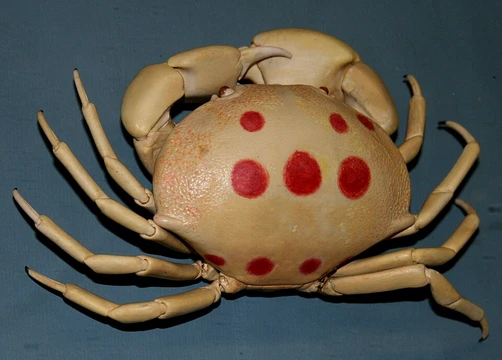
Atergatis roseus
A toxic reef crab that migrated from the Red Sea to the Mediterranean.

Atergatis roseus, commonly known as the pancake crab, is a species of reef crab belonging to the family Xanthidae. Its natural range extends from the Red Sea to Fiji, and it has colonised the eastern Mediterranean via Lessepsian migration through the Suez Canal. The crab is notable for its toxic flesh, a characteristic shared with many other species in its family.
Quick Facts
- Taxon
- Atergatis roseus
Facts from the source article.
Lore & Background
Atergatis roseus has a wide, smooth, oval carapace with convex, almost entire margins and bluntly crested anterolateral margins. The pereiopods are laterally compressed with distal crests on the upper and lower margins. The carapace is reddish brown, the legs have black tips, and younger specimens are paler, more reddish orange, with white margins to the carapace. They grow to 6 cm in carapace length.
Its distribution spans the Indo-Pacific from the Red Sea and eastern Africa, south to KwaZulu-Natal, east along the Indian Ocean coasts into the Pacific as far as Fiji. In the eastern Mediterranean, it was first recorded from Israel in 1961, then from Lebanon and the southern coasts of Turkey and Syria. It reached the Aegean Sea in 2005 and was found as far as Rhodes by 2009.
The crab inhabits coral reefs and rocky substrata from the low tide mark to a depth of 30 metres, preferring shallow reef-rich areas with abundant hiding places. It is mainly nocturnal and slow moving, staying near security to retreat when threatened. It is omnivorous, with a large part of its diet consisting of plant material, though specimens have been recorded feeding on fish.
Reader's Guide
Atergatis roseus is significant as a species that has successfully colonised the eastern Mediterranean via Lessepsian migration through the Suez Canal, expanding its range from the Indo-Pacific. Its first recorded appearance in Israel in 1961 marks the beginning of its establishment in the region, with subsequent spread to Lebanon, Turkey, Syria, the Aegean Sea by 2005, and Rhodes by 2009. The crab's toxicity is a key biological feature: its meat, like that of many Xanthidae crabs, is toxic due to toxins synthesised by symbiotic bacteria of the genus Vibrio. These poisons include tetrodotoxin, similar to that found in puffer fish, and paralytic shellfish poison. This toxicity likely deters predators and contributes to its survival in new environments. Its preference for shallow, hiding-rich reef habitats and nocturnal, slow-moving behaviour further define its ecological role. The species' migration and establishment in the Mediterranean illustrate a notable example of range expansion via human-modified waterways.
Did You Know?
- The flesh of Atergatis roseus is toxic, containing tetrodotoxin and paralytic shellfish poison.
- It was first recorded in the eastern Mediterranean in Israel in 1961.
- It grows to a carapace length of 6 cm.
Physical Form & Coloration
The pancake crab earns its common name from a carapace that is broad, smooth, and distinctly oval in outline. The shell sits convex and nearly unbroken, lacking the regional divisions seen in many other crabs, while its anterolateral margins carry blunt crests that give the edges a subtly ridged character. The walking legs are flattened from side to side and bear small distal crests along both their upper and lower edges. In colour, mature individuals display a reddish-brown carapace paired with legs tipped in black. Juveniles, by contrast, appear noticeably paler, shifting toward a warmer reddish-orange hue, and their carapace is edged with a thin white margin. The species reaches a maximum carapace length of roughly six centimetres, measured from the front of the head to the posterior edge. As a member of the family Xanthidae, Atergatis roseus shares this flattened, disc-like body plan with several other reef-dwelling crabs, a morphology that likely aids in slipping into crevices and maintaining a low profile among coral structures.
Indo-Pacific Range & Mediterranean Expansion
Native to the warm waters of the Indo-Pacific, Atergatis roseus occupies a remarkably broad stretch of coastline. Its natural distribution begins in the Red Sea and along the eastern African shore, extends southward to KwaZulu-Natal, and then sweeps east along the Indian Ocean rim before reaching the Pacific as far as Fiji. Beyond this core range, the crab has also established itself in the eastern Mediterranean through a process known as Lessepsian migration, in which species pass through the Suez Canal into a new basin. The first documented sighting in the Mediterranean came from Israeli waters in 1961. Over the following decades, records accumulated from Lebanon and the southern coasts of Turkey and Syria. The pace of expansion accelerated in the twenty-first century: the species appeared in the Aegean Sea by 2005, and by 2009 individuals had been collected as far north as the island of Rhodes. This stepwise northward progression illustrates how a single canal connection can serve as a corridor for marine colonisation across an entire sea.
Habitat, Nocturnal Rhythms & Feeding
Atergatis roseus is a creature of shallow, structured environments. It favours coral reefs and rocky substrata, ranging from the low-tide mark down to depths of about thirty metres. Within that zone it seeks out areas where the reef is rich in crevices and overhangs, because its lifestyle demands constant access to a nearby retreat. The crab is predominantly nocturnal and moves slowly, so it positions itself close to a hiding spot where it can withdraw the moment a threat appears. This cautious, sedentary strategy suits its flattened body, which can slide into tight spaces that larger or more active predators cannot follow. Dietarily, the species is omnivorous, yet a substantial portion of what it consumes is plant material. Despite this plant-heavy preference, there are documented cases of individuals feeding on fish, showing that animal prey is not entirely excluded from its menu. The combination of slow movement, nocturnal activity, and a preference for sheltered microhabitats paints a picture of a crab that relies on concealment and timing rather than speed for survival.
Symbiotic Toxins & the Danger of Consumption
Perhaps the most consequential biological fact about Atergatis roseus is that its flesh is poisonous, a trait it shares with numerous other members of the family Xanthidae. The toxins are not produced by the crab's own tissues but are synthesised by bacteria belonging to the genus Vibrio, which live in a symbiotic relationship within the animal. Among the compounds generated by this microbial partnership are tetrodotoxin—the same potent neurotoxin responsible for the danger posed by puffer fish—and paralytic shellfish poison. Both substances act on the nervous system, and their presence renders the crab's meat unsafe for human consumption. The fact that these poisons originate from a bacterial symbiont rather than from the host's own biochemistry is a striking example of how interspecies interactions can produce defensive chemistry. For anyone foraging in the Indo-Pacific or eastern Mediterranean reef systems, the pancake crab's attractive reddish-brown colouration and accessible shallow habitat make it a species that should be firmly avoided as a food source, regardless of its seemingly harmless appearance.
Frequently Asked Questions
Who is Atergatis roseus?
Atergatis roseus, widely nicknamed the pancake crab, is a reef-dwelling species classified within the Xanthidae family. It is one of the more recognizable members of that family across Indo-Pacific waters.
Where does Atergatis roseus naturally live?
Its native range stretches from the Red Sea all the way across to Fiji, covering a vast stretch of tropical and subtropical waters. Within that range, it can be found from the low tide mark down to roughly 30 metres depth.
How did Atergatis roseus end up in the Mediterranean?
The crab made its way into the eastern Mediterranean through Lessepsian migration, meaning it passed through the Suez Canal from the Red Sea. The first confirmed sighting in the region was recorded off Israel in 1961, and it gradually spread further, reaching the Aegean Sea by 2005 and the waters around Rhodes in 2009.
Is Atergatis roseus safe to eat?
No — like most other members of the Xanthidae family, Atergatis roseus carries toxins in its flesh, making it dangerous for humans to consume. This is one of the key reasons it is generally avoided by both fishers and casual beach-goers.
How big does Atergatis roseus get?
The species reaches a carapace length of about 6 centimetres, giving it a relatively compact, flattened build that suits its life among reef crevices. Its low, broad profile is what earned it the "pancake crab" nickname among enthusiasts.
More in Reef Crabs 1-24
Spotted an error? Know more?
Reader corrections go straight into our review queue. Suggest an edit · How this site is sourced