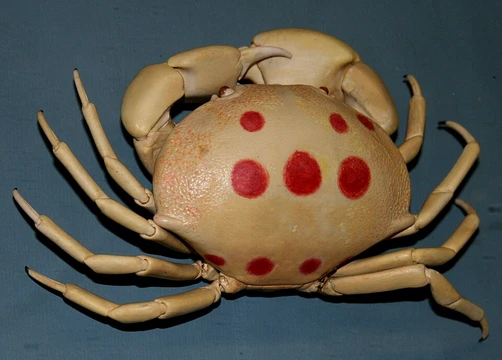
Lybia edmondsoni
A Hawaiian crab that carries stinging sea anemones in its claws.

Lybia edmondsoni is a small crab in the family Xanthidae, endemic to the Hawaiian Islands. It is commonly known as the pom-pom crab or boxer crab due to its habit of carrying a sea anemone in each claw, which resemble pom-poms or boxing gloves. Its Hawaiian name is kūmimi pua, meaning 'inedible flower crab.' In ancient times, this animal was used by men claiming to be sorcerers.
Quick Facts
- Genus
- Lybia
- Species
- edmondsoni
Facts from the source article.
Lore & Background
The carapace of L. edmondsoni can reach 0.5 inches in width and displays unusual polygonal patterns in pink, brown, or yellow. Its chelipeds are fine and delicate, with a flexible propodal-carpal joint and several backward-pointing spines, unlike the heavily armoured claws of most crabs. The walking legs are banded in dark purple, and on its favorite substrates—thin sand or rubble—the crab is almost invisible. The common name 'pom-pom crab' comes from its symbiotic practice of brandishing a stinging sea anemone (usually Triactis producta) in each claw to defend against predators and possibly to stun prey. Its alternative common name, 'boxer crab,' comes from its pugnacious response to threats. Lybia edmondsoni is endemic to Hawaii but is very similar in size and behavior to its sister species, L. tessellata, which is more widespread in the tropical Indo-Pacific. It is found in shallow water down to about 20 m, hiding under rocks or among coral debris, and also on sandy and gravelly flats where it is well camouflaged, as well as on live corals where it clings with its long, slender legs.
Reader's Guide
Lybia edmondsoni has relatively unarmoured chelae and is neither able to defend itself well nor feed itself efficiently as do other crabs. The sea anemones it holds are grasped delicately with its chelae and held in place by several small spines. The anemones are used defensively and also gather food particles with their tentacles, which the crab scrapes off for its own use. The crabs often molt at night, and by morning, though their shell is not yet fully hardened, they have already grasped their anemones. The sea anemone T. producta can undergo asexual reproduction by fission. In a research study, two crabs that only had one anemone each when caught, and two others that each had one anemone removed, were all found to have a partial anemone in each claw within a few days, which developed into normal individuals. One crab was observed pulling an anemone in half by holding it with both chelae and drawing them apart. Research in 1997 by I. Karplus and others investigated how these crabs responded to other crabs of the same species. Of 50 crabs used, 48 had two anemones each when first caught; the remaining two had just one. When two well-matched crabs met on neutral ground, agonistic activity involved threateningly extending a leg holding an anemone toward the other crab. If contact occurred, the grapple was between the hindmost walking legs, with anemones held out to the rear. Three hypotheses were put forward for the non-use of anemones during encounters: that T. producta is very toxic to the other crab, that it is not toxic, or that the anemone is too valuable to risk. Results were inconclusive. The fighting behavior is largely ritualised with much weapon-waving but little contact. Duerden observed in 1905 that boxer crabs missing a single anemone would tear the other in two. A 2017 study observed this behavior, along with theft of anemone fragments from other boxer crabs. Torn anemones soon grow to the size of the original, explaining why nearly all wild boxer crabs carry two anemones.
Did You Know?
- Its Hawaiian name kūmimi pua means 'inedible flower crab.'
- In ancient times, this crab was used by men claiming to be sorcerers.
- The crab's carapace can reach 0.5 inches (13 mm) in width.
- When missing an anemone, the crab may tear its remaining one in half to have one for each claw.
The Anemone as Lifeline: Symbiosis and Daily Management
Lybia edmondsoni, like all members of the boxer crab genus, is defined by its obligate partnership with sea anemones. These tiny crabs, reaching only one to two centimetres in adulthood, almost always carry an anemone in each of their two claws, giving them the cheerful pom-pom appearance that earned them their common name. The relationship runs deep: the crab's claws are equipped with small hooks whose sole observed purpose is gripping the symbiont, and the crabs have been seen to alter their anemone's long-term morphology, often reducing its size and discouraging column outgrowths to make handling easier. When an anemone is lost, the crab can trigger a splitting event, tearing the remaining one into two regenerating fragments. If both are gone, it may attempt to steal one from a rival. Even during moulting, the crab carefully retrieves its anemones from the shed exoskeleton one at a time, and during grooming it temporarily secures one with a walking leg to free the claw for cleaning. This level of daily management underscores just how central the anemone is to the crab's existence.
The Boxing Match: Intraspecific Contests Without Claws
Despite their diminutive size, Lybia edmondsoni engages in intraspecific contests that have earned the genus its other popular name: boxer crab. Rather than locking claws as many crabs do, these animals wave or extend their anemone-laden claws toward an opponent, with the claw farthest from the rival doing most of the displaying. Physical contact, when it occurs, is primarily between walking legs, and the anemones themselves rarely touch the opposing crab. The result is a motion that closely resembles a boxing match, with the anemones serving as oversized gloves. Researchers have proposed several explanations for this unusual strategy. One suggests the anemones may be toxic, posing a danger to both combatants. Another argues the opposite: that the anemones are harmless to the crab and therefore useless as weapons. A third hypothesis holds that the anemones are simply too valuable or fragile to risk in direct combat. Notably, males and females display similar fighting behaviours, a pattern that makes sense given that both sexes possess claws equally specialised for anemone gripping rather than for combat.
Feeding Strategies and the Anemone as Tool
The anemone carried by Lybia edmondsoni is not merely a defensive ornament; it functions as a versatile feeding instrument. The earliest recorded observation of anemone-carrying behaviour, made by Mobius in 1880 on Lybia tesselata, already suggested a link between the symbiont and food collection. In Lybia edmondsoni, the documented strategy involves a mopping motion: the crab sweeps its anemone so that food particles adhere to the polyp's surface, then uses its walking limbs to gather those particles off the anemone. In some instances the crab reaches further, extracting ingested food directly from the anemone's pharynx. This stands in contrast to other Lybia species that use their anemones to stun small fish or invertebrates via cnidocytes, or that hold the anemone away from the food source to maximise their own access. Schnytzer and colleagues in 2013 described an unusual form of kleptoparasitism in which the larger crab exploits the anemone for food at the symbiont's expense, reversing the typical direction of such relationships. Meanwhile, Gries and colleagues in 2023 proposed that the anemone-waving motion may serve to deter predators rather than to feed.
A Purpose-Built Claw and the Genus in Context
Lybia edmondsoni is a small crab, its adult carapace measuring just one to two centimetres, and its most striking anatomical feature is a pair of claws that appear to serve a single, highly specific purpose. Each chela bears a set of small hooks that grip the anemone symbiont, and these claws lack virtually every feature one would expect in a typical crab claw. They have never been observed being used for burrowing, defence, or prey capture. All of those tasks, along with food gathering and social interactions, fall to the crab's walking limbs. The chelae are notably delicate, and no sexual dimorphism has been recorded in them, reinforcing the impression that they exist almost exclusively as anemone-holding apparatus. In some species, such as Lybia leptochelis, the crab will swap a smaller anemone for a larger one but never the reverse, suggesting a size preference that the claw's hook structure accommodates. Across the genus, variations in carapace shape, colouration, claw form, and hook arrangement serve as the primary diagnostic tools for distinguishing the eight extant species, all of which inhabit warm, shallow waters across the Indo-Pacific, from Hawaii to Africa, and whose ranges are ultimately tied to the distribution of their particular anemone partners.
Frequently Asked Questions
What is Lybia edmondsoni?
It's a tiny crab belonging to the family Xanthidae, found exclusively in Hawaiian waters. At a maximum carapace width of about 13 mm (0.5 inches), it's one of the smaller reef crabs in the region.
Why is it nicknamed the pom-pom crab or boxer crab?
The crab grips a small sea anemone (Triactis producta) in each of its claws, giving it an appearance that fans compare to holding fuzzy pom-poms or padded boxing gloves. This distinctive behavior is the source of both common names.
Where does Lybia edmondsoni live?
The species is endemic to the Hawaiian Islands, so you won't encounter it in any other ocean. It ranges from the shallowest reef waters down to roughly 20 meters (66 feet).
What does the Hawaiian name kūmimi pua mean?
The name translates to 'inedible flower crab,' a reference to both its visual appearance and the fact that it isn't considered a food source. It's the local term used specifically for this Xanthidae species.
What role did Lybia edmondsoni play in ancient Hawaiian culture?
Historical references indicate that men who claimed to be sorcerers made use of this crab in their practices. Its distinctive anemone-carrying behavior likely contributed to its symbolic or ritual significance in those traditions.
More in Reef Crabs 1-24
Spotted an error? Know more?
Reader corrections go straight into our review queue. Suggest an edit · How this site is sourced