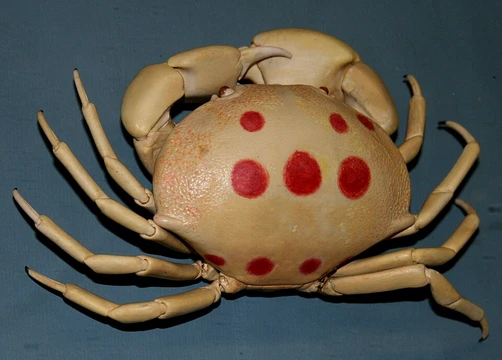
Cymo melanodactylus
A small obligate commensal of Acropora corals in the Indo-Pacific.

Cymo melanodactylus, commonly known as the furry coral crab, is a small species of crab in the family Xanthidae found in the Indo-Pacific Ocean. It lives in crevices and on the surface of corals in the genus Acropora, and is notable for its obligate commensal relationship with these corals, as well as its distinctive fur-like appearance and black-clawed fingers.
Quick Facts
- Genus
- Cymo
- Species
- melanodactylus
Facts from the source article.
Lore & Background
Cymo melanodactylus has a carapace and limbs that appear covered with short fur, and grows to about 1.3 cm wide. It has large pale blue, stalked eyes and a spiny carapace with a shallow groove down the middle. Its claws typically have black fingers, but this trait is unreliable for distinguishing it from the similar Cymo andreossyi, as some individuals have white finger tips or white fingers with black bases. A more reliable distinguishing feature is the orange granulations on its carapace.
This crab is an obligate commensal of Acropora spp. corals. On the large table coral Acropora cytherea, usually one or two crabs inhabit each coral head. They feed mostly on coral mucus, but also consume zooplankton, suspended particles, and occasionally nibble living coral tissue, though the coral seems little harmed. In 2010 in the Chagos Archipelago, infestations of up to 47 crabs were found on individual coral heads, which exhibited dead and dying tissue; it was unclear whether the crabs caused the damage or moved in to exploit already dying tissues.
A more recent study showed that Cymo melanodactylus is attracted to acroporid corals suffering from white band disease, and that the disease advances much slower when the crabs are present than when they are absent. In the Seychelles, this crab was found living on Acropora formosa, with a single coral head supporting a mated pair, a single female, and some juveniles.
Reader's Guide
Cymo melanodactylus is significant primarily as an obligate commensal of Acropora corals, a relationship that highlights the complex interdependencies within reef ecosystems. The species feeds mostly on coral mucus but also consumes zooplankton and suspended particles, and occasionally nibbles living tissue without apparent harm to the coral. However, in the Chagos Archipelago in 2010, infestations of up to 47 crabs per coral head were associated with dead and dying tissue, though it remained uncertain whether the crabs caused the damage or exploited pre-existing damage. More recently, a study found that Cymo melanodactylus is attracted to acroporid corals with white band disease, and that the disease progresses much slower when the crabs are present, suggesting a potential protective role. This crab's legacy lies in its dual nature—as both a commensal and a possible mitigator of coral disease—and in the taxonomic challenge it presents: it is difficult to distinguish from Cymo andreossyi based solely on claw color, requiring examination of orange granulations on the carapace for reliable identification. Its distribution across the Indo-Pacific, from the Red Sea to French Polynesia, underscores its wide ecological footprint.
Did You Know?
- Cymo melanodactylus is also known as the furry coral crab due to its fur-like appearance.
- It is an obligate commensal of Acropora corals, feeding mostly on coral mucus.
- In the Chagos Archipelago, up to 47 crabs were found on a single coral head in 2010.
- White band disease advances much slower on corals when this crab is present.
Physical Appearance and Identification
The furry coral crab is a compact member of the Xanthidae family, reaching only about 1.3 centimetres (roughly half an inch) across its carapace. Its most striking visual trait is the dense covering of short, hair-like setae that gives both the shell and the walking legs a distinctly fuzzy texture. The carapace itself is spiny and bears a shallow longitudinal groove running down its centre, while a pair of large, pale blue eyes sit atop prominent stalks, giving the animal an alert, watchful expression. The claw fingers are typically black, but this single feature is unreliable for telling Cymo melanodactylus apart from the closely related Cymo andreossyi, because some individuals display white fingertips or white fingers with dark bases. The more dependable diagnostic mark is a scattering of orange granulations across the carapace, a feature that consistently separates the two species in the field.
Geographic Range and Habitat
Cymo melanodactylus occupies a broad swath of the Indo-Pacific Ocean, with its known range stretching from the Red Sea and the waters around Madagascar eastward to New Caledonia, French Polynesia, and the remote islands of Wallis and Futuna. Within this vast expanse, the crab is not a free-swimming or open-water species; instead it is tightly tied to the hard substrates of living coral. It takes up residence in the crevices and on the exposed surfaces of corals belonging to the genus Acropora, using the intricate architecture of the colony for shelter and foraging. This narrow habitat preference means that wherever Acropora thrives within the Indo-Pacific, the furry coral crab is likely to be found tucked among the branches, its small size and fuzzy appearance helping it blend into the textured coral surface. The species' dependence on a single coral genus across such a wide geographic span underscores how specialised its ecological niche truly is.
Symbiotic Life on Acropora
The furry coral crab is an obligate commensal, meaning its entire lifestyle revolves around living in association with corals of the genus Acropora. On the large table coral Acropora cytherea, a typical colony head hosts just one or two individuals, keeping the population density low enough that the host is barely affected. The crabs derive most of their nutrition from mucus that the coral secretes, supplementing this with zooplankton, suspended organic particles, and occasional nibbles of living coral tissue. In the Seychelles, researchers documented a single head of the related species Acropora formosa supporting a mated pair, an additional solitary female, and several juveniles, illustrating the social structure that can develop on a single colony. Under normal conditions the coral appears to suffer little from this intimate tenancy, suggesting a stable, low-impact relationship that has likely been refined over many generations of coexistence.
Disease, Infestation, and Ecological Complexity
While the crab-coral relationship is generally benign, extreme circumstances reveal a more complicated dynamic. In 2010, surveys in the Chagos Archipelago uncovered individual Acropora heads infested with as many as forty-seven furry coral crabs, and those particular colonies displayed patches of dead and dying tissue. The crabs clustered near the damaged areas, yet it remained uncertain whether their feeding had triggered the die-off or whether they had simply colonised tissue that was already failing. A more recent investigation has shed additional light: Cymo melanodactylus is specifically attracted to Acropora colonies afflicted with white band disease, a devastating coral pathology. Remarkably, the progression of white band disease proceeds at a significantly slower pace when these crabs are present on the affected colony compared to when they are absent. This finding suggests the crabs may play an unintended but meaningful role in moderating disease spread, adding a layer of ecological nuance to what was once viewed as a simple commensal arrangement.
Frequently Asked Questions
Who is Cymo melanodactylus?
Cymo melanodactylus, widely known as the furry coral crab, is a small xanthid crab species native to the Indo-Pacific. It is an obligate commensal that relies entirely on Acropora corals for its habitat and survival.
What does Cymo melanodactylus look like?
This crab sports a spiny carapace marked with a shallow midline groove and scattered orange granulations, along with large pale blue stalked eyes. Its most striking feature is the black coloration on its claw fingers, though some individuals display white tips or white fingers with dark bases.
Where can you find Cymo melanodactylus in the wild?
Its range stretches from the Red Sea and Madagascar across the Indo-Pacific to New Caledonia, French Polynesia, and Wallis and Futuna. Within that range, it is almost always tucked into crevices or crawling over the surfaces of Acropora colonies.
What is Cymo melanodactylus's relationship with coral?
It forms an obligate commensal bond with Acropora corals, meaning the crab depends on the coral for shelter and foraging space while causing no measurable harm to its host. This tight association is what defines the species' ecological niche.
How big is Cymo melanodactylus?
The furry coral crab is tiny, reaching only about 1.3 cm (roughly half an inch) in carapace width. That compact build is what lets it slip into the narrow crevices of its Acropora host colonies.
More in Reef Crabs 1-24
Spotted an error? Know more?
Reader corrections go straight into our review queue. Suggest an edit · How this site is sourced