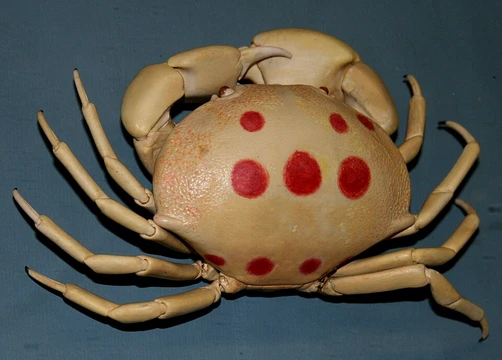
Gothus (crab)
Small xanthid crabs with Go-board-like carapace patterns.

Gothus is a genus of small, brightly colored crabs belonging to the family Xanthidae, found across the Indo-West Pacific. It contains two species: Gothus consobrinus and the type species, Gothus teemo.
The genus gets its name from the game Go, because the patterns and granules on the carapace resemble a Go board and its stones. The suffix "-thus" is common among xanthid genera.
These crabs are tiny, with a carapace width under 10 millimeters. The carapace is vividly colored and covered in small, round granules and tufts of setae. Its regions are clearly marked, and the front is split by a V-shaped notch. Each side of the carapace’s anterolateral margin has four teeth, though the first is flattened and sometimes hard to see. Morphologically, Gothus is most similar to the genus Rhizaltus, but Rhizaltus lacks defined teeth on its carapace.
The genus has two known species. Gothus teemo was described at the same time as the genus itself. Gothus consobrinus was first described as Actaea consobrina in 1873, then moved to Actaeodes in 1967. Molecular studies confirm that the two species form a single clade. Within Xanthidae, Gothus is tentatively placed in the subfamily Euxanthinae, though molecular work has questioned whether that subfamily is monophyletic. The genus’s position is unstable; depending on the analysis, it clusters with Liomerinae or with Xanthias and parts of Euxanthinae.
Both species live in crevices within shallow coral reefs. Gothus consobrinus was originally described from Upolu in present-day Samoa and is widely recorded across the Indo-West Pacific, including Japan, the Philippines, Vietnam, and Australia. Gothus teemo has only been found in the Paracel and Spratly Islands in the South China Sea.
Quick Facts
- Taxon
- Gothus
- Type Species
- Gothus teemo
- Type Species Authority
- Yuan, Jiang, and Sha, 2024
Facts from the source article.
Lore & Background
The genus Gothus is named after the game of Go, referencing the similarity of the carapace patterns and granules with a Go board and stones. The suffix -thus is common in xanthid genera. Individuals are small, less than 10 mm in carapace width, with a vibrantly colored carapace covered in small, round granules and tufts of setae. The carapace regions are clearly defined, with the front divided by a V-shaped notch, and the anterolateral margin bears four teeth on each side, the first flattened and not always clearly defined. Morphologically, Gothus is closest to Rhizaltus, though the latter's carapace lacks defined teeth.
The genus comprises two known species. The type species, Gothus teemo, was described alongside the genus. The other species, Gothus consobrinus, was originally described as Actaea consobrina in 1873, before being transferred to Actaeodes in 1967. Molecular phylogeny confirms that the two species form a clade. Within Xanthidae, Gothus has tentatively been placed in the subfamily Euxanthinae, although molecular phylogeny has questioned the monophyly of that subfamily. The position of Gothus is not stable, with the genus variously clustering with Liomerinae or with Xanthias and parts of Euxanthinae depending on the analysis.
Species in the genus inhabit crevices inside shallow coral reefs. G. consobrinus was originally described from Upolu in modern-day Samoa and is widely known from the Indo-West Pacific, with specimens reported in Japan, the Philippines, Vietnam, and Australia, among other places. G. teemo has only been found in the Paracel and Spratly Islands of the South China Sea.
Reader's Guide
Gothus contributes to the understanding of xanthid crab diversity and evolutionary relationships in the Indo-West Pacific. Its carapace pattern, reminiscent of a Go board, provides a distinctive morphological marker. The genus's taxonomic history illustrates the shifting classification within Xanthidae: G. consobrinus was originally placed in Actaea, then Actaeodes, before molecular phylogeny confirmed its placement in Gothus. The uncertain subfamilial position of Gothus—variously clustering with Liomerinae or with Xanthias and parts of Euxanthinae—highlights the ongoing debate about the monophyly of Euxanthinae. The restricted distribution of G. teemo to the Paracel and Spratly Islands contrasts with the wider range of G. consobrinus, suggesting different ecological or historical factors. The genus's small size and cryptic habitat in coral crevices make it a typical but specialized component of reef ecosystems. Its description alongside the type species and the subsequent transfer of G. consobrinus reflect the iterative process of taxonomic revision driven by both morphology and molecular data.
Did You Know?
- Gothus is named after the game of Go, due to the similarity of its carapace patterns and granules to a Go board and stones.
- The genus comprises only two species: Gothus teemo and Gothus consobrinus.
A Name Borrowed from a Board Game
The naming of Gothus stands out as one of the more whimsical choices in crustacean taxonomy. Rather than honoring a naturalist or referencing a geographic feature, the genus takes its name from the ancient strategy game of Go. The reasoning is visual: the carapace of these tiny crabs, with its pattern of small round granules scattered across a defined surface, evokes the look of a Go board dotted with black and white stones. This resemblance was deemed striking enough to inspire the genus name. The suffix -thus, appended to the root, follows a convention already well established among other genera within the family Xanthidae, lending the name a familiar taxonomic rhythm. The result is a genus name that immediately sparks curiosity in anyone who encounters it in a scientific paper, bridging the worlds of marine biology and one of humanity's oldest competitive games. For a group of crabs rarely exceeding a centimeter in width, the cultural resonance of the name gives them a distinct identity in the literature.
A Tiny, Vivid Architecture
At under ten millimeters of carapace width, members of Gothus are among the smallest crabs one might encounter in a coral reef survey. Despite their diminutive scale, their bodies are far from plain. The carapace displays vivid coloration and is densely textured with small, round granules interspersed with tufts of fine setae, giving the surface a richly tactile quality. The overall architecture is sharply delineated: distinct regions of the carapace are clearly separated, and the anterior edge is split by a pronounced V-shaped notch. Along the anterolateral margins, four teeth project on each side, though the first of these is flattened and can be difficult to discern. Morphologically, Gothus sits closest to the genus Rhizaltus, yet the two differ in a key respect—Rhizaltus lacks the clearly defined lateral teeth that characterize Gothus. This combination of vibrant patterning, granular texture, and precise structural detail makes even a specimen barely visible to the naked eye a subject of considerable descriptive richness in the taxonomic literature.
Two Species, One Unsettled Placement
The genus contains exactly two recognized species, and their taxonomic histories illustrate both stability and flux in crustacean classification. The type species, Gothus teemo, was described simultaneously with the genus itself, establishing the foundational name. Its companion, G. consobrinus, has a longer and more circuitous past: first described in 1873 under the name Actaea consobrina, it was later reassigned to the genus Actaeodes in 1967 before ultimately finding its current home. Modern molecular phylogenetic analyses confirm that these two species do form a genuine clade, validating their grouping. However, placing that clade within the broader family Xanthidae proves trickier. Gothus has been tentatively assigned to the subfamily Euxanthinae, yet molecular data have cast doubt on whether Euxanthinae is even a monophyletic group. Depending on the particular analysis, the genus clusters with Liomerinae or with Xanthias alongside portions of Euxanthinae, leaving its precise position within the family tree unresolved and subject to revision as new data emerge.
Coral Crevices Across the Indo-West Pacific
Both species of Gothus share a narrow ecological niche: they are known to live within the crevices of shallow coral reefs, a habitat that offers shelter among the complex architecture of living reef structures. Their geographic ranges, however, differ markedly. G. consobrinus enjoys a broad distribution across the Indo-West Pacific. Its original description came from specimens collected on Upolu, an island in what is now Samoa, and since then records have accumulated from a wide arc of locations including Japan, the Philippines, Vietnam, and Australia, among others. This wide spread suggests a degree of ecological flexibility or long-standing dispersal across the region. In stark contrast, G. teemo is known exclusively from the Paracel and Spratly Islands in the South China Sea, a far more restricted range. The contrast between a widely distributed species and one confined to a single archipelago group within the same genus offers a small but interesting window into how closely related organisms can occupy very different biogeographic spaces.
Frequently Asked Questions
What is Gothus (crab)?
Gothus is a tiny genus of vividly colored crabs in the family Xanthidae, native to the Indo-West Pacific. It comprises exactly two species: Gothus consobrinus and the type species, Gothus teemo.
Why is the genus called Gothus?
The name is a nod to the board game Go, since the granules and markings on the carapace mimic stones laid out on a Go board. The trailing '-thus' ending mirrors a naming pattern seen in several other xanthid genera.
How large do Gothus crabs get?
They are extremely small, never exceeding 10 millimeters (roughly 0.39 inches) in carapace width. Their shells are brightly hued and dotted with tiny round granules interspersed with small tufts of setae.
Where can I find Gothus crabs in the wild?
They tuck into crevices within shallow coral reefs throughout the Indo-West Pacific. Their sub-centimeter size lets them slip into tight gaps in the reef framework where larger crabs cannot fit.
What makes Gothus stand out from other small reef crabs?
The Go-board-like patterning across the carapace is the genus's signature visual feature. Paired with their sub-10-mm size and bold coloration, they are among the most eye-catching micro-crabs in the Xanthidae.
More in Reef Crabs 1-24
Spotted an error? Know more?
Reader corrections go straight into our review queue. Suggest an edit · How this site is sourced