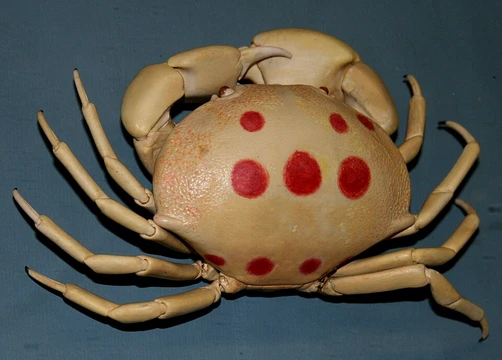
Lybia
Small crabs that carry sea anemones in their claws.

Lybia is a genus of eight small marine crab species in the family Xanthidae. Often called boxer crabs or pom-pom crabs, they are best known for their partnership with small aquatic invertebrates, especially sea anemones, which they grip in specially adapted claws for protection and, in some cases, to help them feed.
These crabs are tiny, reaching only 1–2 cm (0.39–0.79 in) as adults. Each claw has small hooks that let the crab hold onto an anemone. The claws are so specialized for this task that they appear useless for anything else—they are not used for digging, defense, or catching prey when anemones are absent. Instead, the crab relies on its walking legs for gathering food, burrowing, interacting with others, and collecting new anemones. The claws are delicate and show no obvious differences between males and females. The size, color, and shape of the carapace, claws, and hooks are the main traits used to tell the eight species apart.
The eight living species of Lybia are spread across the Indo-Pacific, from Hawaii and Indonesia to Japan, Australia, and Africa. They live in warm, shallow marine waters, often hiding under rocks or coral. Each species’ range depends on where its specific anemone partner is found.
Lybia crabs are nicknamed pom-pom crabs because they look like cheerleaders, usually carrying one anemone in each claw. But there are variations: if an anemone is too big, the crab may use its walking legs to help hold it; sometimes a crab carries more than two anemones, using its walking legs for the extras. If a crab loses one anemone, it can split the remaining one into two pieces, which then regenerate into whole anemones. If both are lost, it may try to steal one from another crab.
During molting, crabs temporarily let go of their anemones, then retrieve them from the shed shell one by one. While grooming, they also release one anemone, tucking it under the first walking leg on that side, and use the free claw to clean their face. Some species, like *Lybia leptochelis*, will swap a small anemone for a larger one but never the reverse.
The bond between Lybia crabs and sea anemones is a form of obligate symbiosis for the crab—they almost always carry anemones. This close interaction can change the anemone’s long-term shape; the anemone pom-poms often end up smaller than free-living ones, and their column outgrowths may be altered.
Quick Facts
- Taxon
- Lybia
- Type Species
- Grapse tessellata
- Type Species Authority
- Latreille in Milbert, 1812
Facts from the source article.
Lore & Background
Lybia crabs are small, achieving a maximum size of 1–2 cm in adulthood. Each chela (claw) is equipped with a set of small hooks that aid in grasping anemones; these claws are so specialized that they appear to have no other function. When anemones are absent, the chelae are not used for burrowing, defense, or prey capture. Instead, the crab's walking limbs perform food gathering, burrowing, intraspecific relations, and anemone collection. Size, coloration, and shape of the carapace, chelae, and associated hooks are common diagnostic features for distinguishing species.
The eight extant species are distributed across the Indo-Pacific, including Hawaii, Indonesia, Japan, Australia, and Africa, residing in warm, shallow marine waters often hidden beneath rocks or coral. The specific range of each species depends on the distribution of its specific anemone symbiont. A fossilized carapace attributed to a species of Lybia has been retrieved from Megami Limestone, Japan, and dated to the early Middle Miocene.
Reader's Guide
Lybia crabs are notable for their obligate symbiosis with sea anemones, which they carry in their claws for defense and feeding. The crabs exhibit varied anemone-holding behaviors: they may use walking legs to assist with large anemones, carry more than two anemones, or induce splitting of a remaining anemone if one is lost. During moulting, they temporarily release their anemones and later retrieve them from the shed exoskeleton. Some species, such as Lybia leptochelis, exhibit swapping behavior, replacing smaller anemones with larger ones.
Fighting in Lybia is poorly documented, but Lybia edmondsoni displays anemones rather than making direct contact during contests. Physical engagement primarily involves walking legs, with anemones rarely touching. Hypotheses for this strategy include potential toxicity of anemones to crabs, their harmlessness, or their value and fragility. Feeding strategies include prey stunning using cnidocytes, grasping food from the anemone's surface, and holding anemones away from food sources. These interactions are considered kleptoparasitic, restricting the anemone's food access and keeping it at reduced size.
The number of species within Lybia may be contentious; two species have moved to the genus Tunebia, and Lybia leptochelis and Lybia pugil may be synonyms. Mitochondrial genomics suggests the anemone-holding habits evolved during the Eocene, about 43 million years ago.
Did You Know?
- Lybia crabs are also known as boxer crabs and pom-pom crabs.
- If a Lybia crab loses both anemones, it may try to steal one from rival crabs.
- The species Lybia tessellata has been observed carrying its eggs within the abdominal apron.
- A fossilized carapace attributed to Lybia was found in Megami Limestone, Japan, dating to the early Middle Miocene.
Stained-Glass Armor and Unusual Limbs
Lybia tessellata is a compact crab whose carapace spans roughly 2.5 centimeters across, giving it a modest presence on the reef. Its most striking visual feature is the shell itself: a trapezoid plate whose surface is divided into patches of differing color by a web of dark lines, producing an effect often compared to a pane of stained glass. Just behind the short-stalked eyes, the carapace margin bears a small tooth-like projection on each side, adding to its angular silhouette. Unlike the broad, powerful pincers one expects from most decapod crabs, this species sports remarkably slender chelipeds, each tipped with a delicate finger armed with eight or nine tiny spines. The walking legs tell their own story: the front pair is slightly shorter than the remaining three, yet all four pairs dwarf the chelipeds in size. Their surfaces are decorated with dark transverse bands, scattered white speckles, and a light dusting of short hairs, while the terminal claws are elongated and thin. Together these traits give the pom-pom crab a lacy, almost ornamental appearance that sets it apart from its bulkier relatives.
Anemone Partners: Defense and Dining
The most celebrated behavior of Lybia tessellata is its lifelong partnership with small sea anemones, typically species of Bunodeopsis or Triactis producta. The crab grips one anemone in each of its slender chelipeds and holds them extended horizontally as it scuttles across the substrate, presenting a pair of swaying, tentacled orbs that have earned it nicknames like pom-pom crab and boxer crab. This arrangement is not merely decorative. When a predator closes in, the crab raises an anemone as a threat display, relying on the dense population of stinging cnidocytes in the tentacles to deter the aggressor. The relationship also solves a practical problem: because the crab's chelipeds are too thin and spiny to manipulate food, it instead uses the anemone's tentacles as a collection net, sweeping up particles from the water and then extracting them with its mobile maxillipeds. As an omnivore, it draws sustenance from whatever the tentacles capture. Reproduction follows a familiar decapod pattern, with the female brooding her batch of red eggs on her abdomen until they hatch.
A Wide Tropical Range and Camouflaged Lifestyle
Lybia tessellata occupies a broad swath of the tropical Indo-Pacific, stretching from the Red Sea and the eastern coast of Africa eastward through Indonesia and New Guinea, and as far north as Japan and the Hawaiian islands of the north and east. Within this vast range, the crab consistently favors shallow waters, where light penetrates and reef structures are abundant. It is most often encountered on sandy or gravelly seabeds, where its geometric, multi-toned carapace and banded legs provide effective camouflage against the dappled substrate. On live coral formations, it clings tightly using its long, thin terminal claws, anchoring itself to the complex three-dimensional surface. The species' small size, barely an inch across, means it can exploit microhabitats that larger crabs cannot, slipping into crevices and sheltering beneath coral overhangs. Its cryptic coloration and compact body make it easy to overlook even when present, a trait that likely aids in avoiding detection by the many fish and invertebrate predators sharing these shallow reef environments.
A Shy Inhabitant of the Reef Tank
For hobbyists, Lybia tessellata offers a rewarding but understated presence in the reef aquarium. Its small stature and cryptic, stained-glass patterning mean it can easily vanish into the background of a large, busy tank; a smaller setup is generally recommended so the crab can be more readily observed. It coexists peacefully with the majority of other aquarium residents, making it a compatible addition to a community reef system. However, its diminutive size and slow, deliberate movements leave it vulnerable to larger predatory fish, which may view it as an easy target. The species is notably shy, tending to retreat and remain still during the active daytime hours when tank lighting is on. Observers who switch off the lights and watch in the quiet of the night cycle will find the crab far more active, slowly extending its anemone-topped chelipeds as it explores the substrate. This nocturnal shift in behavior, combined with its gentle temperament, makes it a fascinating subject for patient aquarists who appreciate subtlety over spectacle.
Frequently Asked Questions
What is Lybia?
Lybia is a small genus containing eight recognized species of marine crabs in the Xanthidae family. Hobbyists and marine biologists often refer to them as "boxer crabs" or "pom-pom crabs" because of their signature behavior of wielding a tiny sea anemone in each claw.
What do Lybia's claws do?
The claws of a Lybia crab are fitted with minute hooks that let it firmly grasp a small anemone for self-defense. They are so narrowly adapted to this single purpose that the crab essentially cannot use them for digging, fighting, or grabbing food.
How large is a Lybia crab?
Fully grown individuals are remarkably tiny, spanning just one to two centimeters (roughly 0.4 to 0.8 inches). Despite their minuscule size, they are a popular sight in nano reef aquariums and shallow tide-pool explorations.
Where do Lybia crabs live?
Their range covers the warm waters of the Indo-Pacific, stretching from the coasts of Africa and Australia to island groups like Hawaii, Japan, and Indonesia. They favor shallow coral reef habitats where small anemones are plentiful.
When was Lybia first described, and how old is the genus?
Henri Milne-Edwards originally described the type species, Lybia tessellata, back in 1834. Fossil records push the lineage's history back to at least the early Middle Miocene, making it a fairly ancient group of reef dwellers.
More in Reef Crabs 1-24
Spotted an error? Know more?
Reader corrections go straight into our review queue. Suggest an edit · How this site is sourced