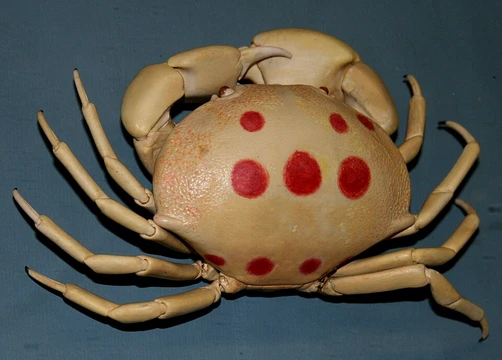
Pleistacantha kannu
Largest spider crab known in the Indian Ocean.

Pleistacantha kannu is a spider crab belonging to the family Oregoniidae. It lives along the coast of Southern India in the Bay of Bengal, at depths ranging from 129 to 530 meters. This species holds the record as the largest spider crab ever found in the Indian Ocean.
The crab’s carapace is pear-shaped and about as long as it is wide, reaching up to 150 mm in length and 138 mm in width. Its upper surface is covered in short, broad-based spines and sharp tubercles. The branchial region is strongly inflated, a feature that sets it apart from similar species like *P. moseleyi*, *P. pungens*, and *P. ori*. The dorsal carapace is orange to orange-red, while the chelipeds and walking legs are reddish-brown with white fingers in males, and orange and white in females. The underside is dirty white. The walking legs end in a horn-like tip covered in setae and are dotted with short tubercles and granules. The abdomen lacks spines but is covered in many blunt and sharp tubercles.
First described in 2017 by carcinologists Peter Kee Lin Ng, Raveendhiran Ravinesh, and S. Ravichandran, the species is named after Indian carcinologist T. Kannupandi of Annamalai University. It is thought to be the same species as a crab collected in 1997 from the Gulf of Aden.
Quick Facts
- Genus
- Pleistacantha
- Species
- kannu
Facts from the source article.
Lore & Background
Pleistacantha kannu has a pyriform carapace whose dorsal surface is covered with short, conical, broad-based spines and sharp tubercles. Its carapace is about as long postrostrally as it is wide, measuring up to 150 mm long and up to 138 mm wide. Its branchial region is strongly inflated, distinguishing it from similar Pleistacantha species such as P. moseleyi, P. pungens, and P. ori. The carapace ranges from orange to orange-red on the dorsal surface, its chelipeds and walking legs are reddish-brown with white fingers in males and orange and white in females, and its ventral surfaces are dirty white. Its walking legs end in a horn-like tip covered in setae, and they are covered in short tubercles and granules. Its abdomen lacks spines but is covered in numerous blunt and sharp tubercles.
The species was described in 2017 by carcinologists Peter Kee Lin Ng, Raveendhiran Ravinesh, and S. Ravichandran. It is named after T. Kannupandi, an Indian carcinologist at the Annamalai University. It is considered likely conspecific with a crab collected in 1997 from the Gulf of Aden.
Reader's Guide
Pleistacantha kannu holds significance as the largest spider crab known to inhabit the Indian Ocean, a distinction based on its carapace dimensions of up to 150 mm in length and 138 mm in width. Its description in 2017 by carcinologists Peter Kee Lin Ng, Raveendhiran Ravinesh, and S. Ravichandran added a new species to the genus Pleistacantha, with its strongly inflated branchial region serving as a key diagnostic feature separating it from related species such as P. moseleyi, P. pungens, and P. ori. The species is named after Indian carcinologist T. Kannupandi of Annamalai University, honoring his contributions. Its known distribution is restricted to the coast of Southern India from the Bay of Bengal at depths of 129–530 m. A note of uncertainty exists: the species is considered likely conspecific with a crab collected in 1997 from the Gulf of Aden, suggesting that further research may clarify its range and taxonomic boundaries. The detailed description of its coloration—orange to orange-red carapace, reddish-brown chelipeds and walking legs with white fingers in males and orange and white in females, and dirty white ventral surfaces—provides a basis for field identification. Its walking legs, ending in a horn-like tip covered in setae and bearing short tubercles and granules, along with an abdomen lacking spines but covered in blunt and sharp tubercles, further characterize this deep-water spider crab.
More in Reef Crabs 1-24
Spotted an error? Know more?
Reader corrections go straight into our review queue. Suggest an edit · How this site is sourced