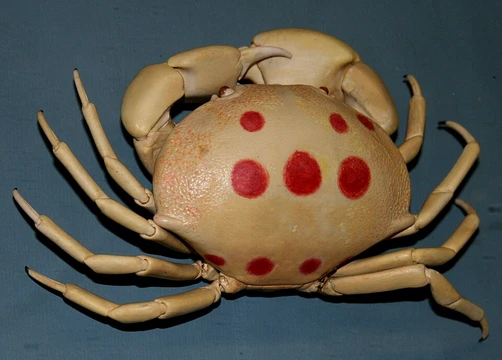
Oregonia gracilis
A decorator crab that uses hooked setae for camouflage.

The graceful decorator crab (*Oregonia gracilis*) is a member of the family Oregoniidae. Like its relatives, it regularly covers its back with other living things. It uses hooked bristles, which function like Velcro, to attach sessile organisms such as algae, sponges, bryozoans, and hydroids. This covering serves as both visual and chemical camouflage, lowering the risk of being eaten. Its main predators include Pacific halibut, octopus, and sea otters. The crab’s diet consists mostly of floating kelp and algae, which it catches by waiting in place to stay hidden.
The crab’s body has three sections—head, thorax, and abdomen—but the head and thorax are fused into a cephalothorax, covered by a single shell called a carapace. This carapace is heart-shaped, brown, tan, or gray, and about 5 centimeters long. It has four pairs of long, thin walking legs (pereiopods) and a fifth pair with pincers (chelipeds). The chelipeds are used for feeding, defense, and attaching decorations. In males, the chelipeds are longer than the walking legs; in females, they are shorter. The mouth has three pairs of feeding appendages called maxillipeds. Two long, stalked compound eyes stick out from the cephalothorax, and behind each eye is a large, curved spine. Juveniles and adult females decorate themselves heavily, while adult males do so sparsely.
*O. gracilis* lives in the intertidal zone down to depths of 436 meters. Its range includes the Bering Sea, the North Pacific Coast, and Japan.
These crabs are solitary for most of their lives, coming together only to mate. They find partners using chemical signals. During mating, the male uses his first and second abdominal appendages to transfer sperm packets (spermatophores) to the female. The sperm fertilizes eggs, which the female carries on her bristles. Newly laid eggs are orange-red; those nearly ready to hatch are reddish-brown. The young hatch in an advanced larval stage called zoea, already having compound eyes and a spiny carapace. They drift toward the surface, then pass through a megalopa stage before becoming adults.
Quick Facts
- Taxon
- Oregonia gracilis
Facts from the source article.
Lore & Background
Oregonia gracilis has three body segments: head, thorax and abdomen, with the head and thorax combined into a cephalothorax covered by a continuous exoskeleton called a carapace. The carapace is heart shaped, brown, tan or grey, and 5 cm in length, with four pairs of long thin walking legs (pereiopods) and a fifth pair with pincers called chelipeds. The chelipeds are used for feeding, defense, and decorating the body; they are longer than the walking legs in males and shorter in females. The mouth has three pairs of feeding appendages called maxillipeds, and two long stalked compound eyes protrude from the cephalothorax, with a large curved postorbital spine behind each eye. Using fine hooked setae on the carapace, the crab decorates itself with algae, sponges, bryozoans and hydroids. Juveniles and adult females decorate heavily, whereas adult males are sparse in their decoration.
Reader's Guide
Oregonia gracilis is notable for its use of hooked setae to attach sessile organisms to its carapace, providing both visual and chemical camouflage that reduces predation risk. Its major predators include Pacific halibut, octopus, and sea otters. The crab's main food source is floating kelp and algae, which it captures using a waiting strategy to maintain cryptosis. The species lives in the intertidal zone up to 436 meters deep, ranging across the Bering Sea, the North Pacific Coast, and Japan. For most of their lives, individuals live alone except during mating season, when mates are found using chemical cues. During mating, the male uses abdominal appendages to transfer spermatophores to the female, and fertilized eggs are carried on the female's setae. Eggs change color from orange-red when recently hatched to reddish-brown when nearly ready to hatch. The larvae hatch in an advanced stage called zoea, with compound eyes and a spiny carapace, then drift toward the surface before advancing to the megalopa phase and finally reaching adult form.
Did You Know?
- The carapace of Oregonia gracilis is heart shaped and up to 5 cm in length.
- Chelipeds are longer than walking legs in males but shorter in females.
- Juveniles and adult females decorate heavily, while adult males decorate sparsely.
- Recently hatched eggs are orange-red; eggs nearly ready to hatch are reddish-brown.
More in Reef Crabs 1-24
Spotted an error? Know more?
Reader corrections go straight into our review queue. Suggest an edit · How this site is sourced