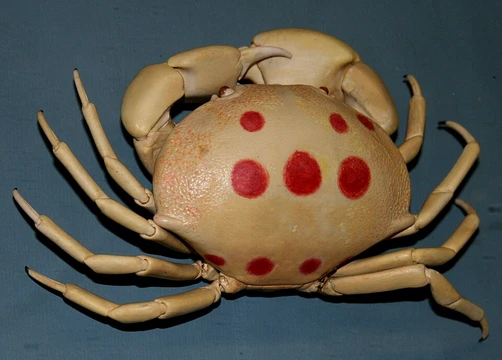
Oregonia (crab)
A genus of spider crabs with two living and one fossil species.

Oregonia is a genus of crabs classified in the family Oregoniidae under the spider crab superfamily Majoidea. It comprises two extant species and one fossil species, notable for their distinctive carapace features and elongated male chelipeds.
Quick Facts
- Taxon
- Oregonia
- Type Species
- Oregonia gracilis
- Type Species Authority
- Dana, 1851
Facts from the source article.
Lore & Background
The members of Oregonia are characterized by subtriangular or suboblong carapaces moderately covered with small protrusions called tubercles. They have large spines on the rear margins of the eye orbits, known as the postorbital spine, situated quite far from the eyestalks. The male chelipeds are elongated, and the palms of the claws are long, compressed, and widen on the outer ends. The walking legs are slender and decrease in length regularly towards the back, and the abdomen has seven segments.
Three species are currently recognized: Oregonia bifurca (the split-nose crab, found in deep waters of the northern Pacific Ocean from the Bering Sea to waters off British Columbia), Oregonia gracilis (the graceful decorator crab, found in shallow waters of the northern Pacific from off Japan to waters off California), and the fossil species †Oregonia spinifera from the Oligocene El Cien Formation of Baja California, Mexico. Previously described species O. longimana, O. mutsuensis, and O. hirta have all been subsumed into O. gracilis; O. hirta was misidentified due to sexual dimorphism exhibited by majoid crabs, as they were actually the females of O. gracilis.
Reader's Guide
The genus Oregonia holds significance as a representative of the spider crab superfamily Majoidea within the family Oregoniidae. Its two extant species, Oregonia bifurca and Oregonia gracilis, occupy distinct ecological niches in the northern Pacific Ocean, with O. bifurca inhabiting deep waters from the Bering Sea to British Columbia and O. gracilis found in shallow waters from Japan to California. The fossil species †Oregonia spinifera from the Oligocene El Cien Formation of Baja California provides evidence of the genus's long evolutionary history. The taxonomic history of the genus includes the subsumption of three previously described species into O. gracilis, notably O. hirta, which was misidentified as a separate species due to the sexual dimorphism common in majoid crabs—these were actually females of O. gracilis. This highlights the importance of understanding sexual dimorphism in crustacean taxonomy. The genus is also linked to the concept of decorator crabs, as noted in the article's 'See also' section, reflecting their behavioral ecology.
Did You Know?
- The fossil species †Oregonia spinifera is from the Oligocene El Cien Formation of Baja California, Mexico.
- The species O. hirta was misidentified as separate because it was actually the female of O. gracilis, due to sexual dimorphism.
- The abdomen of Oregonia crabs has seven segments.
More in Reef Crabs 1-24
Spotted an error? Know more?
Reader corrections go straight into our review queue. Suggest an edit · How this site is sourced