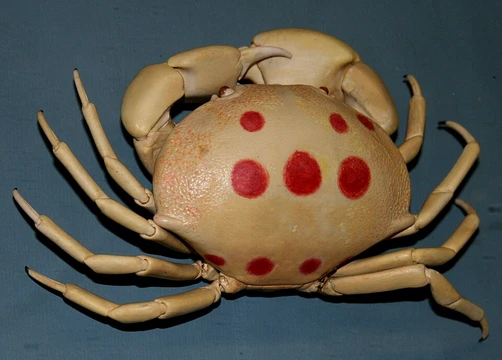
Oregonia bifurca
A rare deep-water decorator crab with a split rostrum.

Oregonia bifurca, commonly known as the split-nose crab or the split-nose decorator crab, is a rare deep-water species of crab in the family Oregoniidae. It inhabits the tops of seamounts and guyots in the northeastern Pacific Ocean, from the Aleutian Islands and Bering Sea to the Hawaiian–Emperor seamount chain and waters off British Columbia. It is notable for its divided rostrum, which gives it the common name, and for being one of only two extant species in the genus Oregonia.
Quick Facts
- Taxon
- Oregonia bifurca
Facts from the source article.
Lore & Background
Oregonia bifurca was first described by American carcinologist Mary J. Rathbun in 1902, based on a single female type specimen collected at a depth of about 500 metres north of the Rat Islands in the Aleutian chain. It belongs to the family Oregoniidae under the superfamily Majoidea (spider crabs). The species is sexually dimorphic: males are larger than females, with a carapace length of about 33.7 mm in males versus 29 mm in females. The entire body and long slender legs are densely covered with curving yellow hair. The rostrum is divided into two short, flat, tapering horns, hence the common name 'split-nose'. These horns measure about 5 mm in males and 3.4 mm in females. The carapace is somewhat oblong, about three-fourths as wide as long, with two small postorbital spines at the posterior margin of the eye orbit. The abdomen consists of seven distinct segments. Males have longer chelipeds (about 62 mm) than females (about 37 mm), and the first pair of pleopods in males are enlarged at the tips with rows of long filaments. The walking legs decrease in length from front to back in both sexes. Oregonia bifurca can be distinguished from its close relative Oregonia gracilis by its shorter rostral horns that curve away from each other, triangular postorbital spines closer to the eyes and pointing more forward, a wider front end of the carapace, longer and slender dactyli on the walking legs, and finer tuberculation.
Reader's Guide
Oregonia bifurca is a rare deep-water species, usually found at depths of 500 to 1,400 metres on the surfaces of seamounts and guyots, in habitats of sand, broken shell, and foraminiferous mud. Its habitat is mutually exclusive with that of the more common shallow-water Oregonia gracilis, which occurs only to about 400 metres. The species has been documented in the waters around the Aleutian Islands, the Bowers Bank of the western Bering Sea, the Nintoku Seamount of the central Pacific Hawaiian–Emperor seamount chain, and off the coast of British Columbia. As one of only two extant species in the genus Oregonia, it represents a deep-water counterpart to the better-known graceful decorator crab. Its rarity and specialized deep-sea habitat make it a species of interest for understanding the distribution and evolution of decorator crabs in the northeastern Pacific. The original type specimen, a female collected by the USS Albatross, remains a key reference for the species.
Did You Know?
- The common name 'split-nose' comes from the rostrum being divided into two short, flat, tapering horns.
- The entire body and legs are densely covered with curving yellow hair.
More in Reef Crabs 1-24
Spotted an error? Know more?
Reader corrections go straight into our review queue. Suggest an edit · How this site is sourced