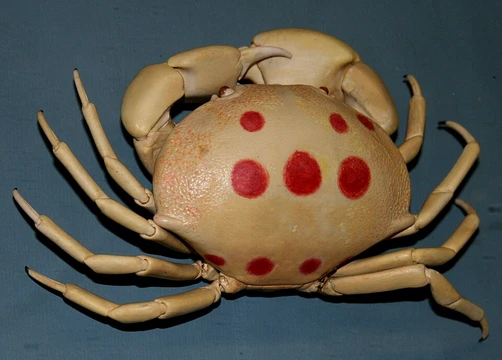
Omalacantha
A genus of reef crabs with hooked setae and pear-shaped carapace.

Omalacantha is a genus of crustaceans in the family Mithracidae. Members of this genus are notable for their distinctive pear-shaped carapace and the presence of hooked setae on the rostrum and walking legs.
Quick Facts
- Taxon
- Omalacantha
- Type Species
- Omalacantha hirsuta
- Type Species Authority
- Streets, 1871
Facts from the source article.
Lore & Background
Species in Omalacantha have carapaces that are longer than wide and pear shaped, with a rough top covered in graininess, tubercles, and patches of hooked bristles (setae). The rostrum bears two strong, slightly downward-curving horns and two rows of hooked setae along their entire lengths. The basal segments of the antennae are very broad, forming the floors of the orbits from which the eye stalks protrude, and above each orbit there is a strong spine. The walking legs decrease in size from front to rear, and their segments are varyingly covered with setae.
According to the GBIF map of georeferenced records, Omalacantha naturally occurs in western Atlantic and Gulf of Mexico waters from about North Carolina south to southern Brazil. Genetic analysis of the superfamily Majoidea within the family Mithracidae placed Omalacantha in the same clade as the genus Microphrys, with which it is very similar morphologically, and that clade was sister to the genus Teleophrys. The analysis also confirmed that Omalacantha is a valid genus.
As of 2025, Omalacantha comprises three species: Omalacantha antillensis, Omalacantha bicornuta, and Omalacantha interrupta.
Reader's Guide
Omalacantha holds significance within the family Mithracidae as a morphologically distinct genus confirmed by genetic analysis. Its placement in a clade with Microphrys, and as sister to Teleophrys, clarifies evolutionary relationships among these reef crabs. The genus is notable for its consistent anatomical features, such as the pear-shaped carapace, hooked setae on the rostrum, and the broad basal antennal segments that form the orbit floors. Its distribution along the western Atlantic and Gulf of Mexico, from North Carolina to southern Brazil, defines its ecological range. The three recognized species—Omalacantha antillensis, Omalacantha bicornuta, and Omalacantha interrupta—represent the known diversity of the genus as of 2025. The genetic validation of Omalacantha as a valid genus underscores its taxonomic importance, resolving earlier uncertainties about its status within the Mithracidae.
Did You Know?
- The carapace of Omalacantha is longer than wide and pear shaped.
- The genus occurs from North Carolina to southern Brazil in the western Atlantic and Gulf of Mexico.
- Genetic analysis placed Omalacantha in the same clade as Microphrys, with Teleophrys as its sister genus.
More in Reef Crabs 1-24
Spotted an error? Know more?
Reader corrections go straight into our review queue. Suggest an edit · How this site is sourced