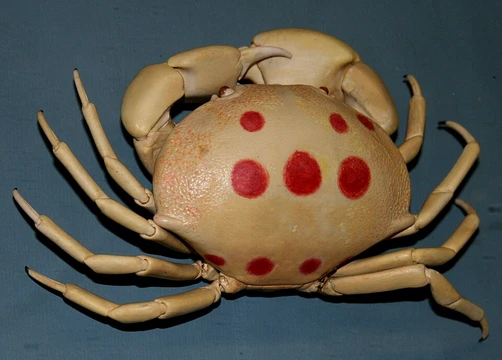
Omalacantha bicornuta
A decorator crab with spotted claws and hooked setae for camouflage.

Omalacantha bicornuta, called the speck-claw decorator crab, belongs to the family Mithracidae. Its carapace is longer than wide and pear-shaped, like other members of its genus. The upper surface feels rough due to graininess, tubercles, and patches of hooked bristles known as setae. Two strong, slightly downward-curving horns sit on the rostrum, with two rows of hooked setae running their full length. The basal segment of each antenna is very broad, forming the floor of the eye socket, and a strong spine sits above that socket. The walking legs get smaller from front to back, and their segments are variably covered with setae. Among the three accepted Omalacantha species, this one is by far the most frequently recorded by citizen scientists on iNaturalist, and it is the only species with noticeably spotted claws.
This crab lives in the Western Atlantic, from the coast of North Carolina and Bermuda south through the Gulf of Mexico and the Caribbean, including the Antilles, and down to Panama, Colombia, Venezuela, and Brazil. In Guadeloupe, it occurs on rocky shores, among coral and mangrove roots, and offshore at depths up to 15 meters, with reports also reaching 70 meters. One individual was photographed in a shallow tidal pool at low tide on a Caribbean beach in Mexico’s Quintana Roo state. A study on a Caribbean fringing reef found that two algal species serve as both the crab’s main food and its primary decorative material. The algae attached to the crab also act as a food reserve when usual food is scarce.
As a decorator crab, Omalacantha bicornuta is nearly invisible in its habitat because of its self-decoration camouflage. Even when told that the crab occupies about one-twentieth of an image and sits just right of center, it is hard to spot. The most visible parts are two small, sand-colored, slender, sharp “fingers” at the leg tips, pointing toward the top-right corner. Like many decorator crabs in the family Mithracidae, it actively decorates itself by snagging material from its surroundings onto the hooked setae covering its body. This behavior reduces its visibility to predators by as much as 50%.
The species was first assigned to the genus Microphrys in 1825, then moved to Omalacantha in 2014. Genetic analysis shows it is closely related to eastern Pacific congeners, though minor but consistent differences exist.
Quick Facts
- Genus
- Omalacantha
- Species
- bicornuta
Facts from the source article.
Lore & Background
Omalacantha bicornuta was first described in 1825 by Latreille under the name Pisa bicornuta, though the text presented the genus as Pise. The collection locality was given as Nouvelle Hollande (Australia), but this is presumed to be an error for Antilles; an erratum was published in December 1828. The species was later assigned to Microphrys and then transferred to Omalacantha in 2014. Genetic analysis shows it is closely related to eastern Pacific congeners, with minor but consistent differences.
The carapace is rough with graininess, tubercles, and patches of hooked setae. The rostrum bears two strong, downward-curving horns and two rows of hooked setae. The antennae's basal segment is very broad, forming a floor for the orbit, above which is a strong spine. Walking legs decrease in size from front to rear and are variably covered with setae.
As a decorator crab, Omalacantha bicornuta actively tethers material from its environment onto its hooked setae, making it almost invisible in its native habitat. This camouflage reduces visibility to predators by as much as 50%. A study on a Caribbean fringing reef found that two algal species serve as both its principal food and its main decorative resource; algae adorning the crab also act as a food reserve when usual food is unavailable.
Reader's Guide
Omalacantha bicornuta is significant as the most commonly documented species among the three accepted Omalacantha, based on citizen science observations on iNaturalist. Its striking spotted claws distinguish it from its congeners. The species exemplifies decorator crab behavior within Mithracidae, actively camouflaging itself with environmental material to reduce predation risk by up to 50%. Its hooked setae are key to this adaptation. The taxonomic history includes an early misattribution of locality (Australia instead of Antilles) and subsequent reassignments from Pisa to Microphrys to Omalacantha. Genetic analysis confirms its close relationship to eastern Pacific species while maintaining consistent morphological differences. The species occurs across a wide Western Atlantic range, from North Carolina and Bermuda through the Gulf of Mexico and Caribbean to South America, inhabiting rocky shores, coral, mangrove roots, and depths to 70 meters. Its diet and decoration both rely on two algal species, with the decoration serving as a food reserve. The etymology of the genus name Omalacantha means 'smooth spine,' and the species name bicornuta means 'two-horned,' referring to the rostrum's two prominent horns.
Did You Know?
- Omalacantha bicornuta is the only one of the three Omalacantha species with strikingly spotted claws.
- Its hooked setae allow it to tether decorative material from its environment, reducing visibility to predators by up to 50%.
More in Reef Crabs 1-24
Spotted an error? Know more?
Reader corrections go straight into our review queue. Suggest an edit · How this site is sourced