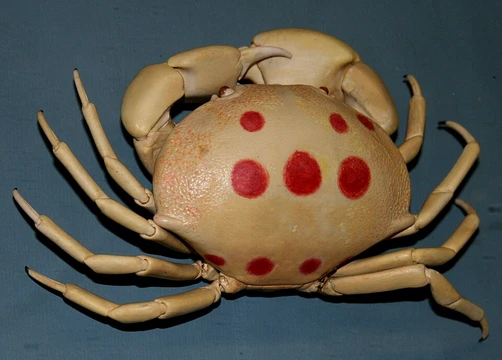
Hyastenus hilgendorfi
A decorator crab and Lessepsian migrant from the Indo-Pacific.

Hyastenus hilgendorfi is a spider crab belonging to the family Epialtidae and the sub-family Pisinae. Its native range spans the Indo-Pacific region, but it has also been recorded in the Suez Canal and, on a few occasions, in the eastern Mediterranean, classifying it as a Lessepsian migrant.
The carapace of this crab is roughly pear-shaped, convex, and covered in small tubercles and a downy coat. It features a small epibranchial plug, along with prominent projections on the gastric, heart, and gut regions. A pair of post-gastric tubercles sit close to the orbits, while six mesobranchial tubercles are positioned sub-equally along the sides of the midline. Two divergent rostral spines extend from the front; in males, these spines reach about two-thirds the length of the carapace, but they are much shorter in females. The retractable eyestalks are small. The chelipeds match the carapace in length, with nodules on the proximal part of the merus and a smooth, hairless claw. The merus of the pereopods also bears nodules, and the posterior border of the dactyl is spiny, with spines increasing in size toward the tip. The gap between the rostral spines is U-shaped or keyhole-shaped. The overall colour is brownish.
The species is found from the Red Sea across the Indian Ocean to the western Pacific, reaching as far as Hawaii and south to Australia. It has been reported throughout the Suez Canal, and the first Mediterranean record came from off Israel in 1960, followed by records in 1977 and 2004, suggesting a small population may exist in the southeastern Mediterranean.
Hyastenus hilgendorfi inhabits seabeds of coarse sand, debris, and gravel at depths between 2 and 93 metres. It is a decorator crab, covering its body with other organisms. In a study from the Suez Canal, the barnacle *Amphibalanus amphitrite*, the tunicate *Microcosmus* sp., and the tube worm *Hydroides elegans* were the most frequent epibionts, with up to 49 species of epibionts recorded for this crab in that area. The decoration appears to serve as camouflage, helping to disguise the crab’s shape.
Quick Facts
- Taxon
- Hyastenus hilgendorfi
Facts from the source article.
Lore & Background
Hyastenus hilgendorfi has a roughly pear-shaped carapace that is convex, bearing small tubercles and a downy coat, with a small epibranchial plug. Prominent projections occur on the gastric region, heart, and gut, and a pair of post-gastric tubercles are close to the orbits. Six mesobranchial tubercles are sub-equal to the sides of the midline. The crab has two divergent rostral spines, which are two-thirds the length of the carapace in males but much smaller in females. Its retractable eyestalks are small, and the chelipeds are the same length as the carapace, with nodules on the proximal portion of the merus and a smooth, glabrous claw. The merus of the pereopods also bear nodules, and the posterior border of the dactyl is spiny, with spines becoming larger distally. The separation of the rostral spines is U-shaped or keyhole-shaped. The crab is brownish in colour.
This species occurs from the Red Sea through the Indian Ocean to the western Pacific, Hawaii, and south to Australia. It is reported throughout the Suez Canal, and the first Mediterranean record was off Israel in 1960, with subsequent records in 1977 and 2004, possibly indicating a small population in the southeastern Mediterranean. It is found on seabeds of coarse sand, debris, and gravel between 2 and 93 metres depth. As a decorator crab, it uses other organisms to cover its body; in a Suez Canal study, the barnacle Amphibalanus amphitrite, the tunicate Microcosmus sp., and the tube worm Hydroides elegans were the most frequent epibionts, and up to 49 species of epibionts have been recognized for this species in the Suez Canal. The decoration serves to camouflage the crab and disguise its shape.
Reader's Guide
Hyastenus hilgendorfi is significant as a Lessepsian migrant, having moved from the Red Sea through the Suez Canal into the eastern Mediterranean, with the first record off Israel in 1960 and subsequent records in 1977 and 2004, suggesting a possible small population in that region. Its distribution spans from the Red Sea across the Indian Ocean to the western Pacific, Hawaii, and Australia, indicating a broad native range. The species is a decorator crab, using epibionts such as the barnacle Amphibalanus amphitrite, the tunicate Microcosmus sp., and the tube worm Hydroides elegans to camouflage itself, with up to 49 epibiont species recorded in the Suez Canal. Its physical characteristics include a pear-shaped carapace with tubercles, divergent rostral spines that are longer in males, and chelipeds equal in length to the carapace. The crab inhabits coarse sand, debris, and gravel seabeds at depths of 2 to 93 metres. Its legacy lies in its role as an example of marine species dispersal via the Suez Canal and its unique decorating behavior, which helps disguise its shape from predators.
Did You Know?
- Hyastenus hilgendorfi is a decorator crab that uses epibionts like barnacles and tube worms for camouflage.
- Up to 49 species of epibionts have been recognized on this species in the Suez Canal.
- The first Mediterranean record of this crab was off Israel in 1960.
More in Reef Crabs 1-24
Spotted an error? Know more?
Reader corrections go straight into our review queue. Suggest an edit · How this site is sourced