Eurynolambrus
A cryptic New Zealand crab, sole member of its genus.

Eurynolambrus is a genus of small crab, with the only species being Eurynolambrus australis, commonly known as the triangle crab or by its Māori name riangi. It is widespread throughout New Zealand and notable for being the sole member of its genus.
Quick Facts
- Grandparent Authority
- Števčić, 1994
- Genus
- Eurynolambrus
- Species
- australis
Facts from the source article.
Lore & Background
Eurynolambrus australis, the triangle crab, is a small species found throughout New Zealand. It is the only species in the genus Eurynolambrus. Its habitat includes stones and under rocks in the lower and sub tidal intertidal zone, reaching depths of up to 80 m, and it is often found in rock pools with coralline turf.
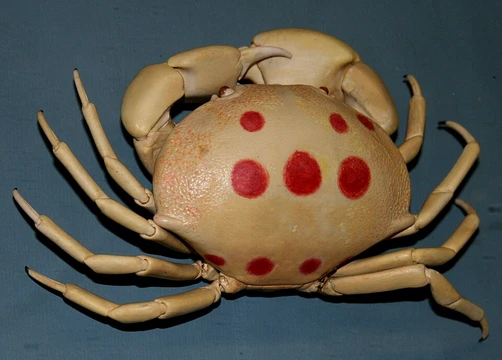
Adults measure between 50–65 mm and have a broad triangle-shaped carapace that extends over the leg base. The carapace can be white, pink, or bright red with white, grey-brown, and yellow markings. The legs are short and flat with irregular crests, mottled with orange, dark red, and white, and fold neatly underneath the carapace. Chelipeds have a rough, pitted surface, curve inwards, and are purple with a white inner surface. The antennules are usually pale yellow, and the eyestalks are red.
The triangle crab is a scavenger feeder, mostly on coralline alga, which is thought to cause its bright red pigmentation. It also feeds on red and green algae, as well as amphipods, isopods, and decapods. It is a cryptic species that defends itself from predation with camouflage. Some divers and amateur observers suggest it is more active at night and may be nocturnal.
Reader's Guide
Eurynolambrus is significant as a monotypic genus, containing only Eurynolambrus australis, the triangle crab. Its distribution throughout New Zealand and its presence in the lower and sub tidal intertidal zone, down to 80 m depth, mark it as a widespread but specialized inhabitant of rocky substrates and coralline turf. The species' scavenging diet, primarily on coralline alga, is linked to its bright red pigmentation, illustrating a direct dietary influence on appearance. Its cryptic nature and reliance on camouflage for defense, along with possible nocturnal activity noted by divers and amateur observers, highlight its adaptive strategies. The triangle crab's distinct morphology—a broad triangular carapace, short flat legs, and purple chelipeds—further distinguishes it within its habitat. As the sole representative of its genus, Eurynolambrus holds a unique taxonomic position among New Zealand reef crabs.
Did You Know?
- Its bright red pigmentation is thought to be caused by feeding on coralline alga.
- The triangle crab can be found at depths of up to 80 m.
- Some divers and amateur observers suggest it may be nocturnal.
More in Reef Crabs 1-24
Spotted an error? Know more?
Reader corrections go straight into our review queue. Suggest an edit · How this site is sourced