Lobactis
A solitary, free-living mushroom coral of the Indo-Pacific.

Lobactis is a genus of mushroom or plate coral belonging to the family Fungiidae. It is monotypic, containing only the species Lobactis scutaria, which lives in the Indo-Pacific. This coral is solitary and free-living, meaning it does not remain attached to the seafloor once mature.
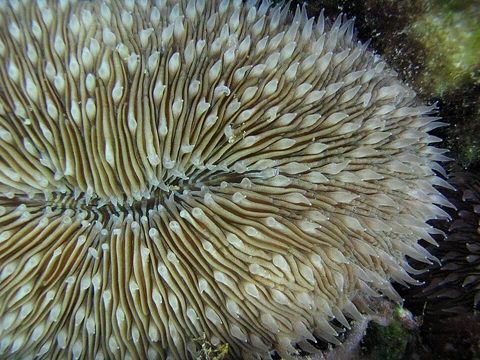
The polyp of Lobactis scutaria can reach up to 17 centimeters in length and is set within a cup-like depression called a corallite, which is surrounded by calcium carbonate. Inside the corallite, narrow ridges known as septa have tall, tentacle-like lobes near their center. The septa also feature unlobed teeth and additional tentacular lobes where they split. Outside the corallite, these ridges continue as costae, which are lined with tiny spines. The underside of the coral shows a scar from where it detached from the seabed as a juvenile. Its color varies, often appearing brown, yellowish, or blue, with tentacular lobes that contrast in hue. The polyp has a central, slit-shaped mouth and a few short, tapering tentacles.
This species is found in the Indian Ocean on upper reef slopes, especially where wave action creates strong water movement. It typically lives on sand or beds of coral rubble and is often seen alongside other Fungia species.
Lobactis scutaria is carnivorous, using its tentacles to catch plankton, shrimp, and fish. It is a hermaphrodite, releasing eggs and sperm through its mouth. After fertilization, the eggs develop into planktonic planula larvae, which eventually settle on the seabed and metamorphose. Juveniles attach to the substrate, feed, and grow their hard skeletons. Later, they detach and drift along the seafloor. The polyps feed both during the day and at night.
Quick Facts
- Taxon
- Lobactis scutaria
Facts from the source article.
Lore & Background
Lobactis scutaria is a solitary, non-colonial coral that is free living and not attached to the seabed. It is discoid or elongated in shape and can grow to a very large size. The polyp can be up to 17 centimeters long and is embedded in a cup-shaped hollow known as a corallite, surrounded by calcareous material. Lining this are narrow ribs known as septa, each having a tall tentacular lobe near its origin in the centre. The septa bear unlobed teeth and further tentacular lobes at intervals where the septa divide. Outside the corallite the ribs continue, now known as costae, bearing rows of tiny spines. The underside of the coral bears a scar resulting from its detachment from the sea bed as a juvenile. The colour varies, often being brown, yellowish or blue with contrasting tentacular lobes. The polyp has a central, slit-like mouth and a small number of short, tapering tentacles.
Reader's Guide
Lobactis scutaria occurs in the Indian Ocean on upper reef slopes especially where there is considerable movement of the water as a result of wave action. It is usually found on sand or beds of coral fragments. It is often associated with other species of Fungia. The coral is a carnivore and catches plankton, shrimps and fish with its tentacles. It is a hermaphrodite; eggs and sperm are ejected through the mouth and after fertilisation, develop into planula larvae which form part of the plankton. After some time these settle on the seabed and undergo metamorphosis. The juveniles attach themselves to the substrate and start feeding, extruding their hard skeletons and growing. At a later stage they become detached from their base and drift around on the sea bed. The polyps feed by day as well as by night. Its significance lies in its unique life cycle as a free-living coral that detaches from the substrate as it matures, and its role as a carnivorous predator in reef ecosystems.
Did You Know?
- Lobactis scutaria is the only species in the genus Lobactis.
- The polyp can grow up to 17 centimeters long.
- It is a hermaphrodite that ejects eggs and sperm through its mouth.
- Juveniles attach to the seabed but later become detached and drift.
Frequently Asked Questions
What is Lobactis?
Lobactis is a monotypic genus in the family Fungiidae, meaning it holds only a single species, Lobactis scutaria. It is a mushroom or plate coral native to the Indo-Pacific region.
How large can Lobactis scutaria grow?
Its polyp can reach up to 17 centimeters (roughly 6.7 inches) in length. The polyp is housed in a cup-shaped corallite that is encased in calcium carbonate.
Where does Lobactis scutaria live?
This species is found on upper reef slopes across the Indo-Pacific, including the Indian Ocean, where wave action is present. It settles on sandy bottoms or loose coral fragments rather than solid rock.
What makes Lobactis's septa distinctive?
The narrow ridges inside the corallite develop tall, tentacle-like lobes near their midpoint, a feature that sets them apart from simpler septal structures. They also bear unlobed teeth along their length.
Does Lobactis stay attached to the reef?
No—once mature, Lobactis scutaria is a solitary, free-living coral that does not cement itself to the seafloor. It rests on sand or broken coral debris and can shift position rather than growing in a fixed spot.
More in Plate and Mushroom Corals 1-24
Spotted an error? Know more?
Reader corrections go straight into our review queue. Suggest an edit · How this site is sourced