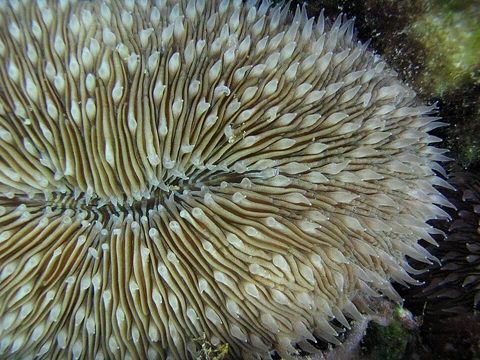
Cycloseris cyclolites
A solitary disc coral that can move and float on sediment.

Lyle Vail · CC BY 3.0
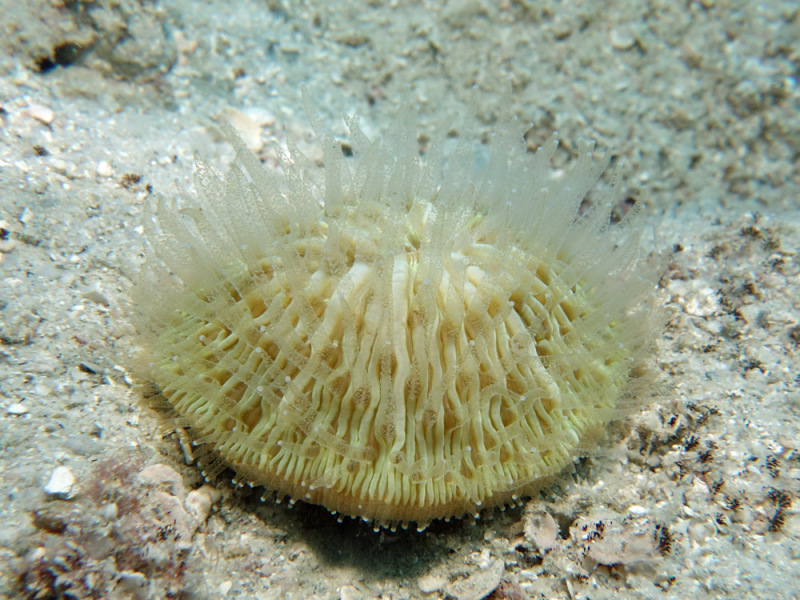
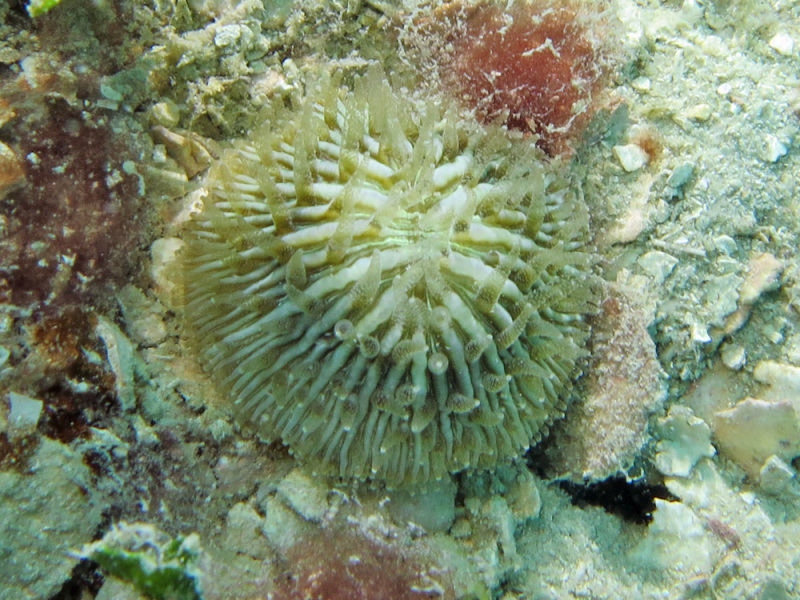
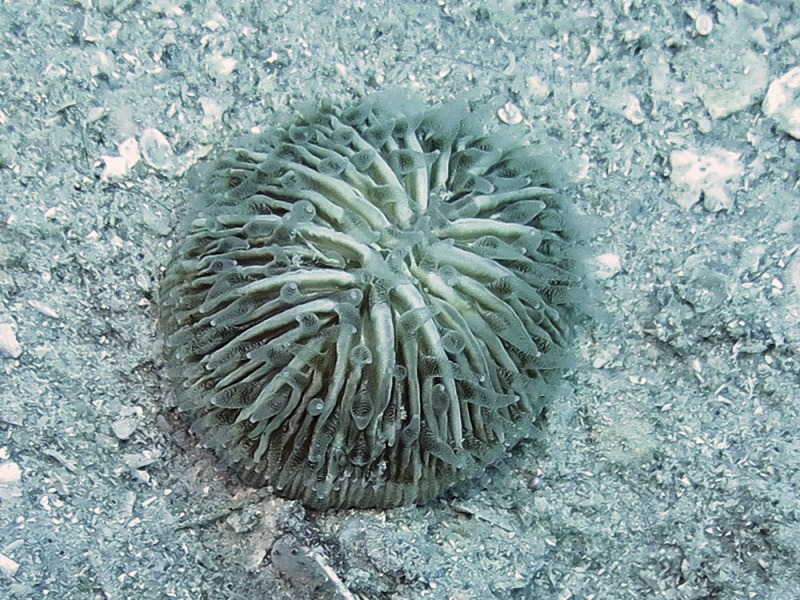
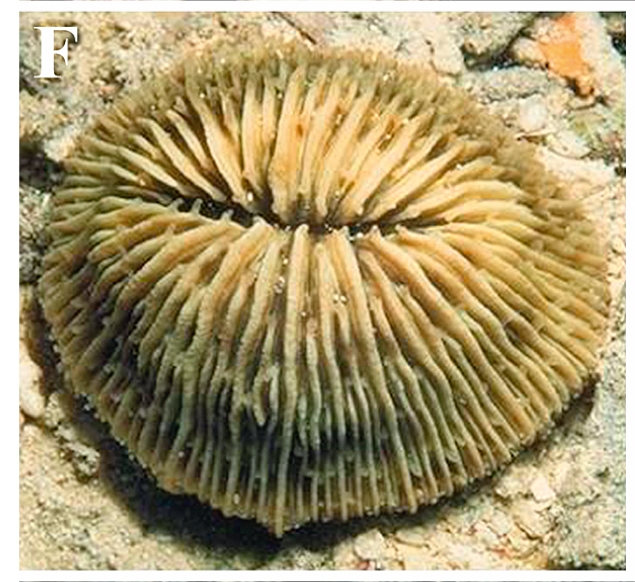
Cycloseris cyclolites, a disc coral from the family Fungiidae, lives as a solitary, unattached individual. First described in 1815 by French naturalist Jean-Baptiste Lamarck, it is found across the tropical and subtropical Indo-Pacific. Its round or slightly oval body forms a dome up to 4 cm wide, with a hollow underside. Thick, straight primary septa are present, and larger specimens may have up to four additional whorls of septa. Color varies, typically whitish or greenish, though shallow-water individuals can be brightly colored, and the primary septa often have white margins.
This coral’s range stretches from Madagascar, the East African coast, and the Red Sea, through India and Malaysia, to northern Australia, Japan, and various Pacific island groups. It usually lives on soft substrate, such as muddy sand, between reefs, but occasionally occurs on the reefs themselves. It belongs to a species complex, and reports from the Western Indian Ocean likely refer to a different species.
As a zooxanthellate coral, its soft tissues host symbiotic unicellular dinoflagellates that supply nutrients. It is highly adapted to calm waters on sand or mud, and can shed sediment that threatens to cover it. Being unattached, it moves freely by inflating its tissues with water and moving its tentacles. The polyp can enlarge by 300 to 400 percent, reducing its density and allowing it to float to the surface of the sediment if buried.
Quick Facts
- Taxon
- Cycloseris cyclolites
Facts from the source article.
Lore & Background
Cycloseris cyclolites was first described by the French naturalist Jean-Baptiste Lamarck in 1815. It is a solitary disc coral, round or slightly oval, forming a dome up to 4 cm wide with a hollowed out under surface. The primary septa are thick and straight, with up to four more whorls of septa in larger specimens. Its color varies, usually whitish or greenish, but shallow water specimens are sometimes brightly colored, and the primary septa often have white margins.
Reader's Guide
Cycloseris cyclolites is found in oceans of the tropical and subtropical Indo-Pacific region, ranging from Madagascar, the East African coast, and the Red Sea through India and Malaysia to northern Australia, Japan, and various Pacific island groups. Its typical habitat is on soft substrate, often muddy sand, between reefs, though it sometimes occurs on the reefs themselves. The species is part of a species complex, and reports of this species in the Western Indian Ocean may belong to a different species. Ecologically, it is a zooxanthellate coral, hosting symbiotic dinoflagellates that provide nutrients. It is highly adapted to life on sand or mud in calm waters, capable of shedding sediment that threatens to blanket it. Being unattached, it moves freely by distending its polyp with water and moving its tentacles; the polyp can enlarge by 300 to 400 percent, reducing its density and allowing it to float to the surface of sediment in which it has become buried.
Did You Know?
- Cycloseris cyclolites was first described by Jean-Baptiste Lamarck in 1815.
- It can enlarge its polyp by 300 to 400 percent to reduce density and float out of sediment.
Gallery
Frequently Asked Questions
What is Cycloseris cyclolites?
It is a free-living, single-individual disc coral belonging to the family Fungiidae. Unlike colonial corals, it exists as one unattached organism that settles on soft bottoms such as muddy sand between reef structures in the tropical and subtropical Indo-Pacific.
How large does Cycloseris cyclolites grow?
The dome-shaped body tops out at roughly 4 centimeters (about 1.6 inches) in width. Bigger specimens may develop as many as four extra whorls of septa beyond the primary set of thick, straight plates.
What does Cycloseris cyclolites look like?
Most individuals appear whitish or greenish, though those in shallower water can show noticeably brighter hues. The round-to-slightly-oval body has a hollow underside, and the primary septa frequently carry white-edged margins.
Where does Cycloseris cyclolites live in the wild?
This species favors soft substrates, often settling on muddy sand in the gaps between reef formations. Its distribution spans tropical and subtropical waters across the Indo-Pacific region.
Who first described Cycloseris cyclolites and when?
French naturalist Jean-Baptiste Lamarck gave the species its original scientific description in 1815. That means the coral has been formally recognized in the scientific record for more than two centuries.
More in Plate and Mushroom Corals 1-24
Spotted an error? Know more?
Reader corrections go straight into our review queue. Suggest an edit · How this site is sourced