Cycloseris
Solitary disc corals of the Indo-Pacific, free-living even as juveniles.

Diego Delso · CC BY-SA 4.0
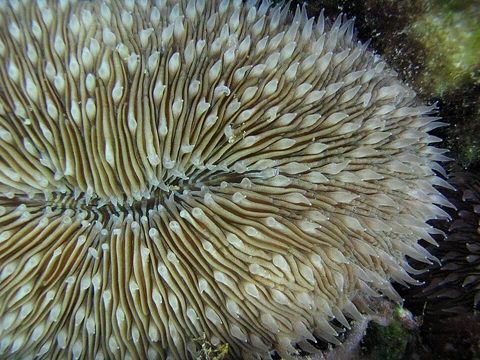
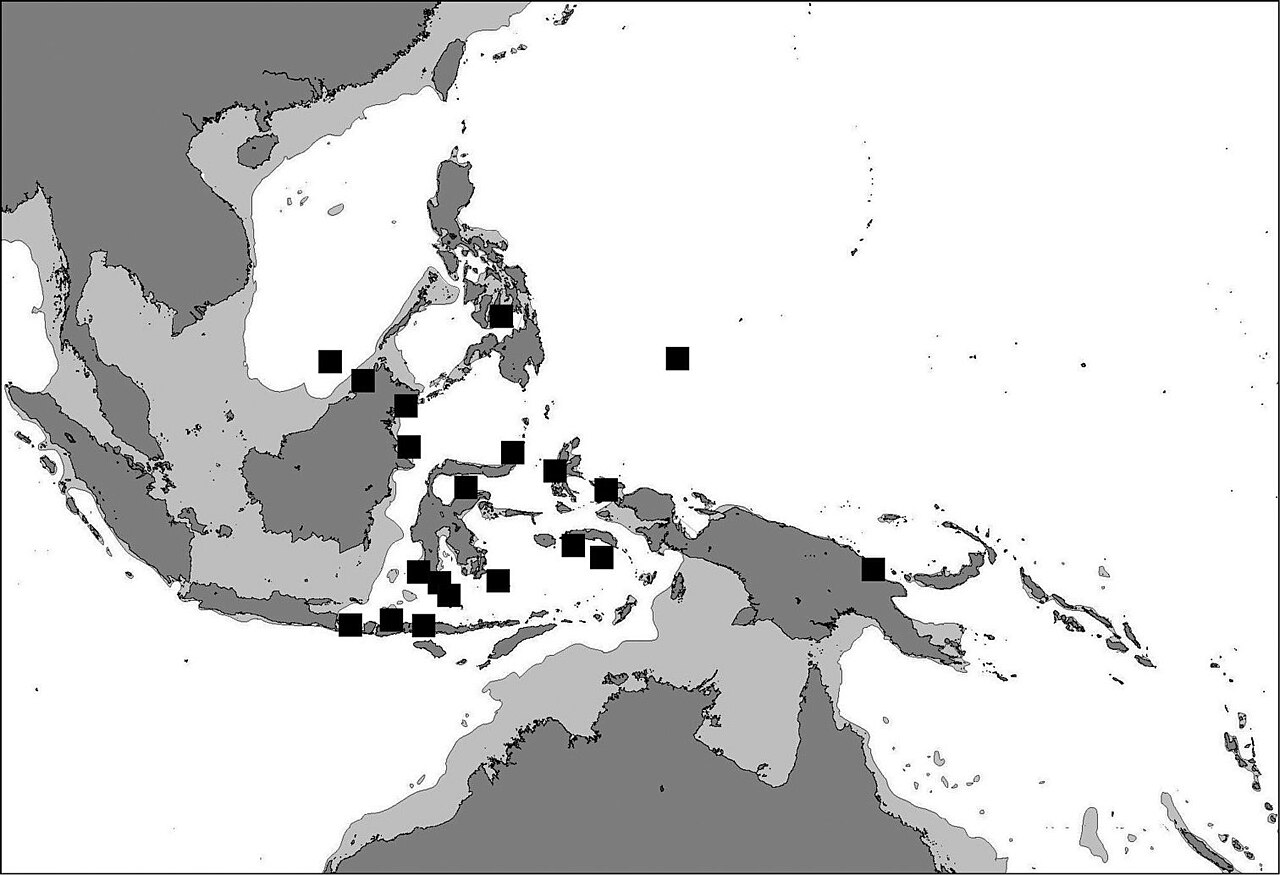
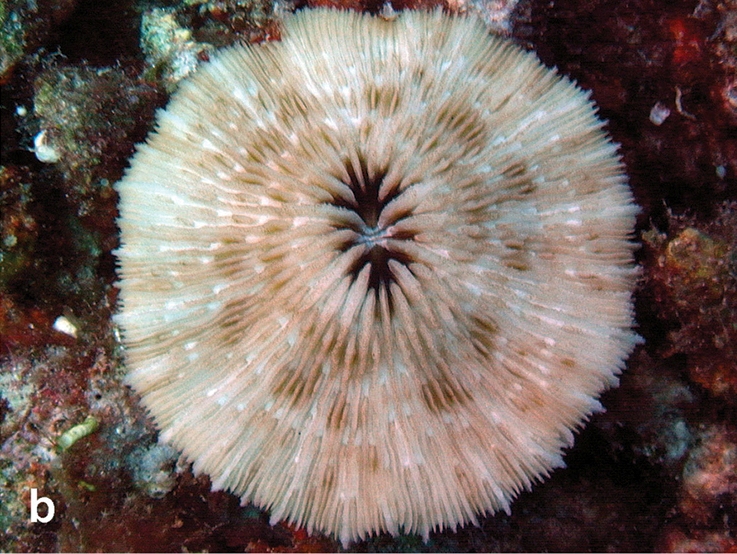
Cycloseris is a genus of solitary disc corals in the family Fungiidae, found in the Indo-Pacific. They inhabit lower reef slopes and areas between reefs with soft sediments, tolerating turbid waters. The genus is notable for being mostly free-living, even as juveniles, unlike the related genus Fungia which bears a scar from juvenile attachment.
Quick Facts
- Taxon
- Cycloseris
Facts from the source article.
Lore & Background
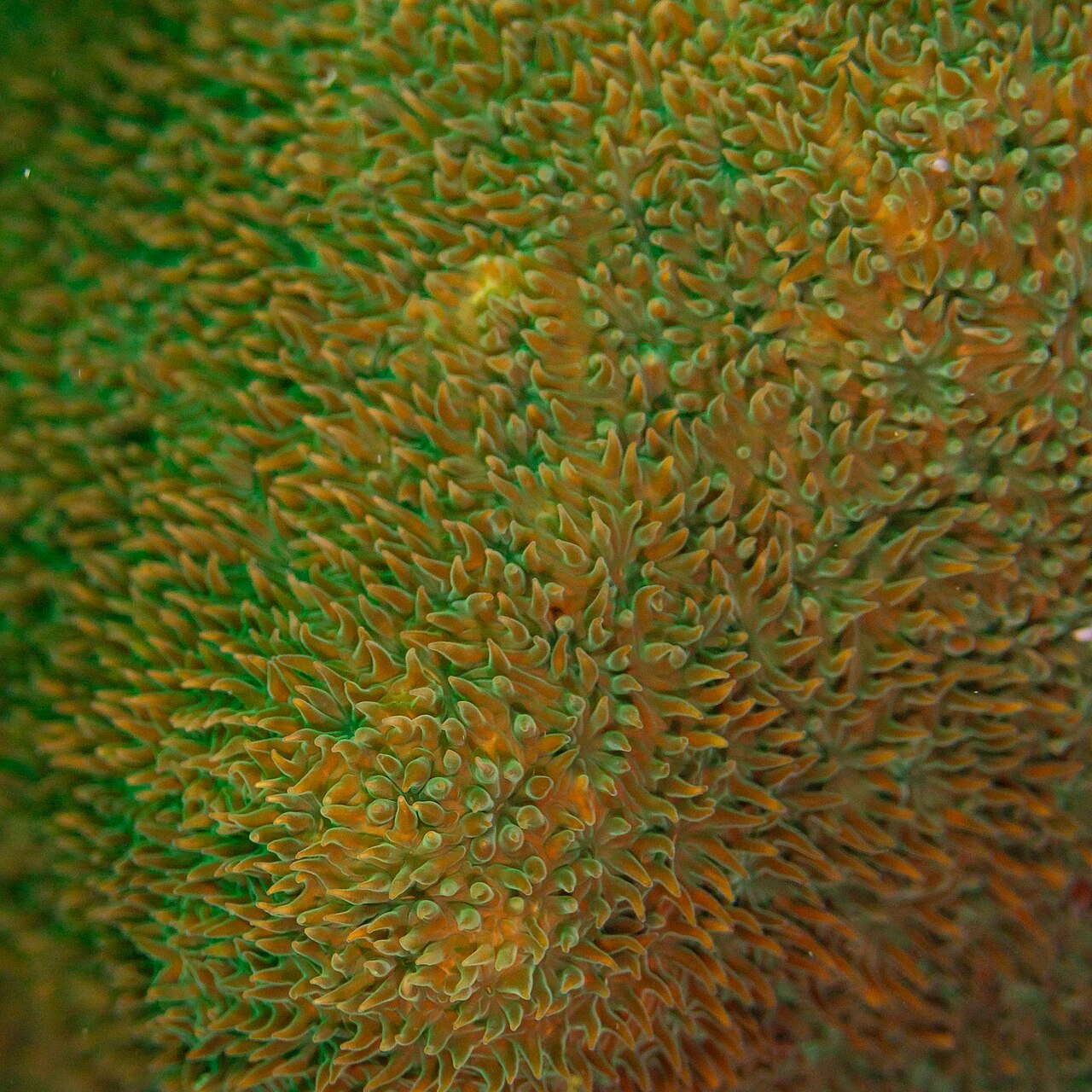
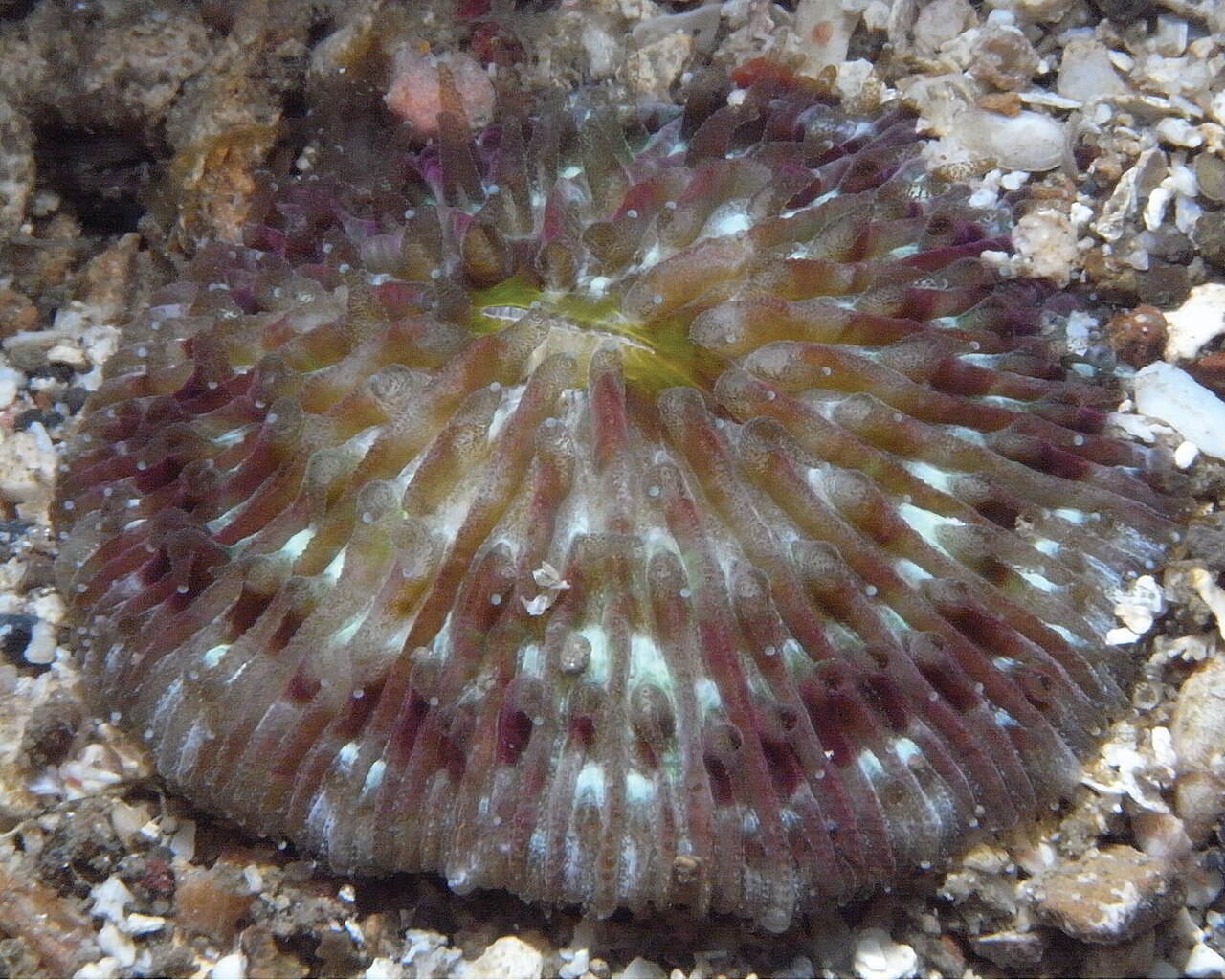
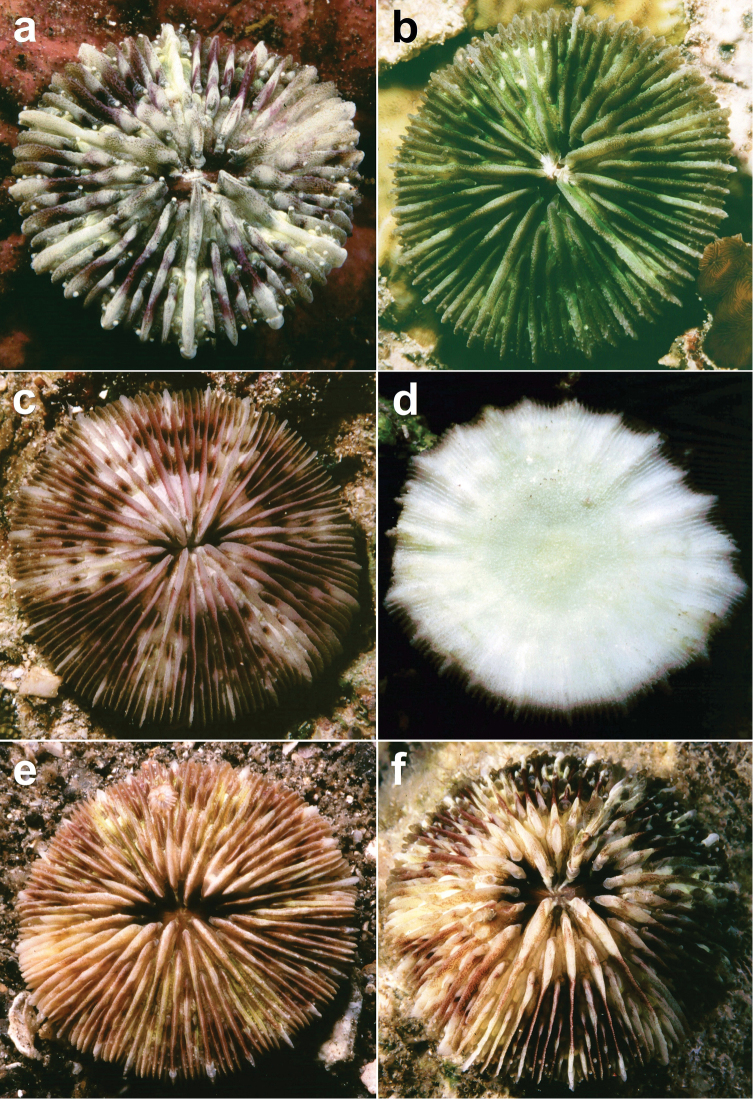
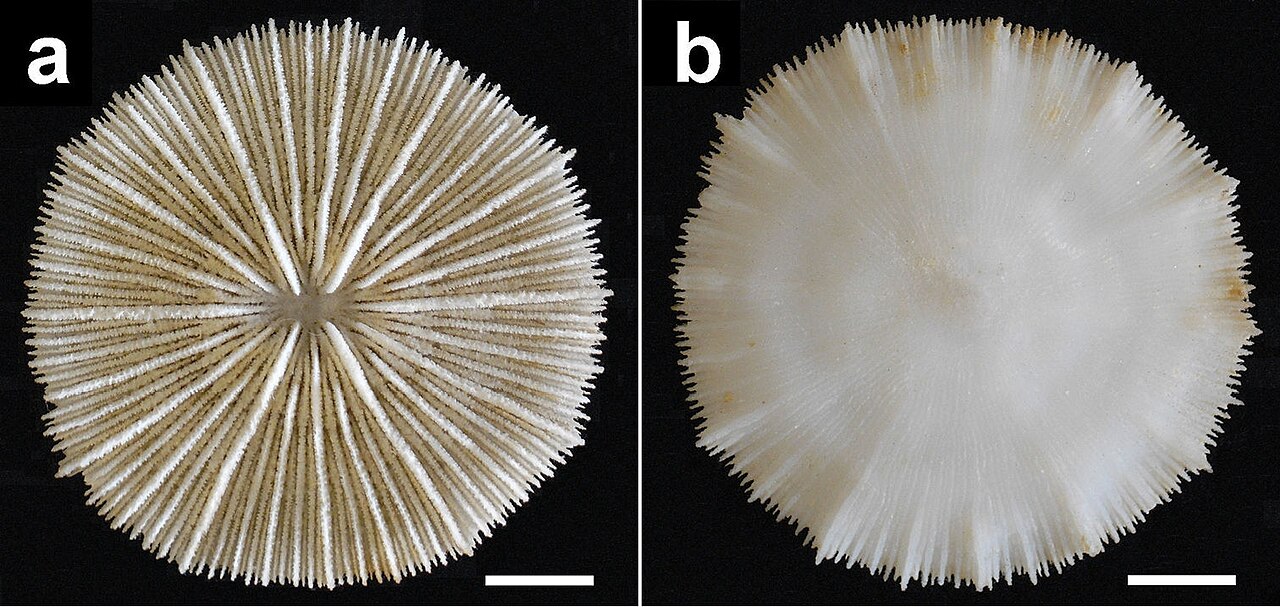
Corals in the genus Cycloseris are mostly solitary and free living, some attaining 10 centimetres in diameter. The discs are either round or oval, and the central mouth, surrounded by tentacles, may be a slit. The polyp sits in a calcareous cup, the corallite, and only extends its tentacles to feed at night. The septa are vertical skeletal elements inside the corallite wall, and the costae unite the septae at the base of the coral. In Cycloseris, both are thick but have fine teeth and are characteristic of the different species.
Cycloseris can be confused with specimens of the related genus Fungia, but the former are free living even as juveniles, while the latter bear a scar showing where they were attached when young. The genus was reclassified in 2012 to include some species that had previously been classified in the genus Coscinaraea, which are colonial with multiple mouths, in addition to the original species that are free living with a single central mouth.
The World Register of Marine Species lists 13 extant species, including Cycloseris boschmai, Cycloseris costulata, and Cycloseris cyclolites. The Encyclopedia of Life lists 8 extinct species, such as †Cycloseris brazzanensis and †Cycloseris costulata.
Reader's Guide
Cycloseris is significant as a genus of solitary disc corals that are free-living throughout their life cycle, a trait that distinguishes them from the related genus Fungia. They inhabit lower reef slopes and soft-sediment areas between reefs in the Indo-Pacific, tolerating turbid waters. The genus was reclassified in 2012 to include colonial species with multiple mouths from the genus Coscinaraea, expanding its morphological diversity. The thick septa and costae with fine teeth are characteristic features used to differentiate species. The genus includes both extant and extinct species, with 13 extant species listed by the World Register of Marine Species and 8 extinct species listed by the Encyclopedia of Life. Its legacy lies in its adaptability to turbid environments and its role in understanding coral evolution and classification, particularly the transition between solitary and colonial forms.
Did You Know?
- Cycloseris corals only extend their tentacles to feed at night.
- The septa and costae in Cycloseris are thick with fine teeth, characteristic of different species.
Taxonomic Placement & Morphological Identity
Cycloseris occupies a position within the Fungiidae, a family of Cnidaria that encompasses thirteen extant genera commonly referred to as mushroom or plate corals. Unlike its colonial relatives, Cycloseris is classified as a solitary organism, sharing that distinction with the well-known genus Fungia. This solitary architecture stands in sharp contrast to genera like Polyphyllia, where a single organism bears multiple mouths, or to Ctenactis and Herpolitha, whose classification hovers between a multi-mouthed solitary animal and a true colony of individually mouthed polyps. In most fungiid genera, including Cycloseris, the animal presents as a single polyp that emerges from the center of its skeletal structure. The skeleton itself is a defining feature of the family, giving these corals their characteristic plate-like or mushroom-like silhouette. Despite the family's name suggesting a fungal resemblance, Cycloseris and its relatives are firmly rooted in the animal kingdom as cnidarians, sharing deeper evolutionary ties with jellyfish and sea anemones than with any plant or fungus.
Nocturnal Rhythms & Benthic Locomotion
Cycloseris, like most of its fungiid kin, is a solitary marine animal that moves across the seafloor through benthic locomotion, a trait that sets it apart from the vast majority of coral species. In adulthood, the organism remains fully detached from the substrate, free to reposition itself rather than being anchored to a fixed point. During daylight hours, the coral often presents a deceptive appearance, looking bleached or even dead, with its polyp withdrawn into the protective skeleton. It is only at night that the single polyp emerges from the center of the skeletal structure to extend its tentacles and feed. This nocturnal activity pattern, combined with the daytime stillness, makes Cycloseris a creature of quiet, deliberate rhythms on the reef floor. While some fungiid relatives are immobile or form colonies, Cycloseris retains its solitary, mobile identity throughout its life cycle, a behavioral strategy that likely supports its ability to track favorable feeding conditions across the benthic landscape.
Sexual Plasticity & Evolutionary Strategy
Among the remarkable adaptive strategies observed in the Fungiidae, sexual plasticity stands out as one of the most fascinating. Certain fungiid species, including Fungia repanda and Ctenactis echinata, are capable of changing their sex over the course of their lives. While Cycloseris itself is not explicitly cited in this regard, it belongs to the same family where this phenomenon has been documented. Researchers posit that this sex-switching behavior is triggered by environmental pressures or energetic constraints, allowing the organism to optimize its reproductive output under shifting conditions. The evolutionary rationale mirrors patterns seen in some dioecious plant species, where a single individual can alternate between male and female roles to maximize fitness. For a solitary, mobile organism like Cycloseris, the capacity to adjust reproductive strategy in response to local resource availability or population dynamics would represent a significant survival advantage, reducing the risk of reproductive failure in an environment where finding a compatible partner of the opposite sex is not guaranteed.
Ecological Interactions & the Aquarium Trade
Within the broader reef ecosystem, fungiid corals like Cycloseris play understated but meaningful ecological roles. Some members of the family provide shelter to small fish species from the families Gobiidae and Labridae, while Fungia hosts a commensal pipefish, Siokunichthys nigrolineatus, that lives in close association with the coral. Other fungiids have been observed in surprising predatory roles; Danafungia scruposa, for instance, has been filmed consuming jellyfish, a behavior that underscores the family's dietary flexibility. Some elongated fungiid species closely resemble sea cucumbers, while Heliofungia actiniformis can be mistaken for a sea anemone because its tentacles remain visible even during daylight. Despite these ecological contributions, the Fungiidae hold no commercial importance. Their primary interaction with humans comes through the aquarium trade, where members of the family are collected and sold under the common name plate corals, bringing a piece of the benthic world into home aquaria.
Gallery
Frequently Asked Questions
What is Cycloseris?
Cycloseris is a genus of solitary disc corals in the family Fungiidae, native to the Indo-Pacific. It currently includes 13 living species, with an additional 8 known only from the fossil record.
Where does Cycloseris live and what conditions does it tolerate?
These corals favor lower reef slopes and the soft-sediment stretches between reefs, where they can handle murky, turbid water better than many reef-dwelling relatives. They remain free-living from the juvenile stage onward, never leaving an attachment scar on their disc.
How large can a Cycloseris disc grow?
The maximum diameter a Cycloseris specimen can reach is roughly 10 centimetres (about 4 inches), making it a modestly sized member of the fungiid group.
How does Cycloseris differ from the closely related genus Fungia?
The key distinction is that Cycloseris individuals are free-living even as juveniles, whereas Fungia bears a visible scar where it was initially cemented to the substrate before detaching. This gives Cycloseris a more independent lifestyle from its earliest life stage.
Why is Cycloseris considered notable within Fungiidae?
Its consistent free-living habit and tolerance for lower-energy, turbid environments set it apart from many other disc corals in the family. With 13 extant species spread across the Indo-Pacific, it represents a diverse and ecologically flexible branch of the group.
More in Plate and Mushroom Corals 1-24
Spotted an error? Know more?
Reader corrections go straight into our review queue. Suggest an edit · How this site is sourced