Halomitra
Solitary, free-living mushroom corals adapted to unstable reef environments.

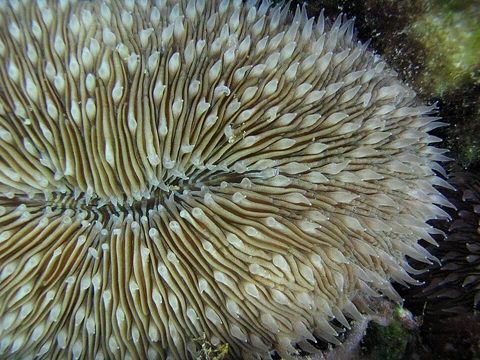
**Halomitra** is a genus of stony corals in the family Fungiidae, often called mushroom corals. Unlike most reef-building corals, which are colonial and permanently attached, Halomitra species are solitary and free-living. They rest on sandy or rubble seafloors and can move a little, which helps them thrive in unstable environments like lagoon floors and sediment-rich reef flats. The best-known species, *Halomitra pileus*, is relatively large and dome-shaped, looking something like a bowl or a mushroom cap.
**Taxonomy** James Dwight Dana first described the genus Halomitra in 1846. It belongs to the family Fungiidae, a group of solitary, free-living corals. Currently, the genus includes three recognized species: *Halomitra pileus* (Linnaeus, 1758), *Halomitra clavator* (Hoeksema, 1989), and *Halomitra meierae* (Veron and Maragos, 2000). *Halomitra philippinensis* is considered a junior synonym of *Halomitra pileus*. The type species is *Halomitra pileus*. Studying the family Fungiidae is important because it shows structural links between different coral genera. Unique skeletal features within the family, such as synapticula, have helped scientists refine classification systems for identifying Halomitra corals.
**Description** The coral’s skeleton, called a corallum, is disc-shaped or dome-like, usually circular or slightly oval, with a central mouth and radiating ridges. This flattened shape is an evolutionary adaptation for horizontal growth, typical of Fungiid corals. Some Halomitra specimens show unusual growth structures, including an "unconformable nucleus," where a new corallum seems to grow over a fragment of an older skeleton. This creates gaps between inner and outer skeletal rings, suggesting growth may happen around remnants of earlier individuals rather than from a single continuous origin. The upper surface is covered with septa—thin, blade-like skeletal structures that radiate from the center. These septa alternate in size, often have serrated or spiny edges, and support the soft tissue while increasing surface area. Synapticula, small horizontal bars connecting adjacent septa, partially bridge the gaps between them, reinforcing the skeleton and creating a semi-connected internal framework. This feature is key for classification, setting Fungiid corals apart from other families.
Quick Facts
- Taxon
- Halomitra
- Type Species
- Halomitra pileus
- Type Species Authority
- (Linnaeus, 1758)
Facts from the source article.
Lore & Background
The genus Halomitra was first described by James Dwight Dana in 1846. It belongs to the family Fungiidae, which consists of solitary, free-living corals. As of now, the genus records 3 recognised species: Halomitra pileus, Halomitra clavator, and Halomitra meierae. Halomitra philippinensis is accepted as a junior synonym of Halomitra pileus. Studying Fungiidae is particularly important because it bridges structural traits between different coral genuses. Unique skeletal features within Fungiidae, like synapticula, helped scientists refine coral classification systems that better identify Halomitra corals.
The coral has a disc-like or dome-shaped skeleton called corallum. It is typically circular or slightly oval, with a central mouth and radiating skeletal ridges extending outward. Observations of coralla within species of Halomitra have revealed unusual growth structures in some specimens. In particular, some individuals exhibit an 'unconformable nucleus', where a new corallum appears to develop over a fragment of a previous coral skeleton. This structure results in discontinuities between inner and outer skeletal rings, suggesting that growth may occur around remnants of earlier individuals rather than from a single continuous developmental origin. The upper surface is covered with septa, which are thin, blade-like skeletal structures radiating from the centre. Another important structural feature is the presence of synapticula, small horizontal skeletal bars that connect adjacent septa. The underside of Halomitra has a convex and smooth shape, which helps the coral remain stable on loose substrates and reduces sinking into sand.
Reader's Guide
Halomitra species are both autotrophic and heterotrophic, meaning two complementary ways of obtaining energy. Like most coral species, Halomitra corals host symbiotic zooxanthellae, an algae species inside its tissues. The algae performs photosynthesis to produce sugars that feed the coral. In this way, Halomitra corals contribute to reef ecosystems by stabilising substrates and providing microhabitats for small marine organisms. Halomitra corals' ability to move slowly across substrates and potentially fragment enhances their resilience in environments with shifting sediments. They can capture plankton using tentacles and trap organic particles using mucus. This dual strategy makes it highly adaptable, especially in environments where light or nutrients fluctuate. Because of its morphological characteristics, Halomitra corals are very resilient in the open water. Unlike attached corals, Halomitra corals do not rely on hard substrate. This allows it to survive in sandy or shifting environments and avoid competition for space. Its smooth, curved shape helps to shed sediment easily and prevent smothering. Although limited, Halomitra corals can inflate and deflate tissue, as well as slightly reposition itself to avoid burial or unfavourable conditions. The combination of septa and synapticula provides strength against breakage and flexibility under stress. The dominant species, Halomitra pileus, known as the bowl coral, while decreasing, is listed as Least Concern on the IUCN Red List. This classification reflects its wide distribution across the Indo-Pacific, relatively stable population trends and ability to tolerate sedimented and dynamic environments.
Did You Know?
- Halomitra species are typically solitary and free-living, not permanently attached to the reef substrate.
- Some Halomitra specimens exhibit an 'unconformable nucleus', where a new corallum grows over a fragment of a previous skeleton.
- Halomitra corals are theorised to reproduce asexually through fragmentation or spontaneous fission during adulthood.
Frequently Asked Questions
What is Halomitra?
Halomitra is a small genus of solitary, free-living stony corals belonging to the family Fungiidae. Unlike the colonial corals that build reef frameworks, each Halomitra polyp lives entirely on its own, resting on sandy or rubble-covered seafloors.
Who originally described Halomitra and when?
The genus was first named and described by the American zoologist James Dwight Dana back in 1846. It has remained a relatively small group ever since, with only three recognised species to date.
What does Halomitra pileus look like?
The type species, Halomitra pileus, is the largest and most conspicuous member of the genus. It forms a broad, dome-shaped single polyp that resembles an overturned bowl or a thick mushroom cap sitting on the substrate.
Where can you find Halomitra in the wild?
These corals are restricted to the tropical Indo-Pacific region, typically living between 1 and 30 metres depth. They favour unstable habitats such as lagoon floors and sediment-rich reef flats where their ability to shift position gives them a survival edge.
Why is Halomitra considered unusual among reef corals?
Most reef corals are colonial and cement themselves permanently to hard substrate, but Halomitra species are solitary and can actually reposition themselves on soft, shifting ground. This free-living lifestyle lets them colonise sandy environments that would be inhospitable to typical reef-builders.
More in Plate and Mushroom Corals 1-24
Spotted an error? Know more?
Reader corrections go straight into our review queue. Suggest an edit · How this site is sourced