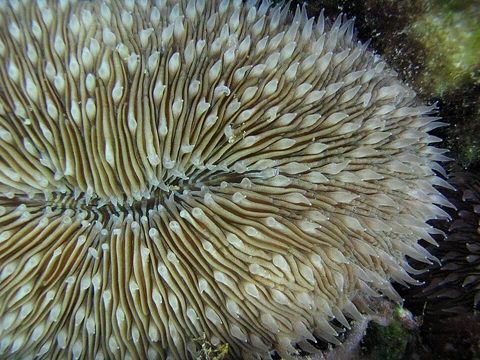
Lithophyllon repanda
A mobile mushroom coral found across the Indo-Pacific.

Ronavni · CC BY-SA 4.0
Lithophyllon repanda, a type of mushroom or disc coral belonging to the family Fungiidae, can occasionally relocate itself. The International Union for Conservation of Nature (IUCN) classifies it as a least-concern species. Originally described by James Dwight Dana in 1846, it lives at depths ranging from 1 to 30 meters (3 ft 3 in to 98 ft 5 in).
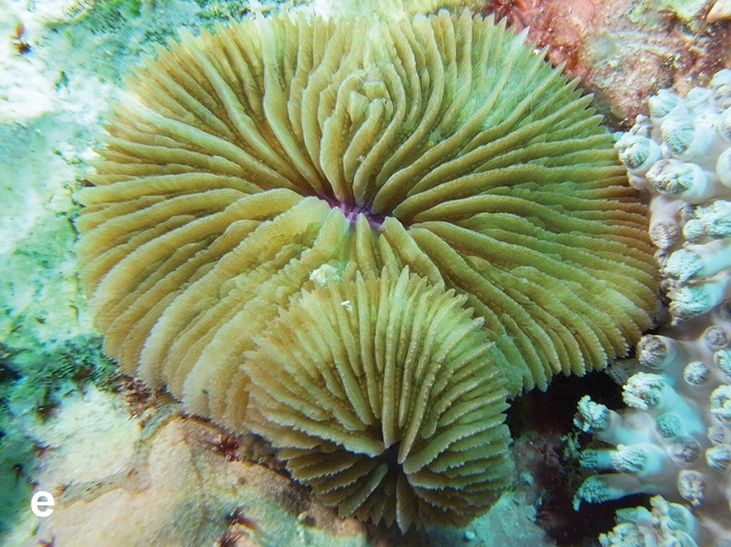
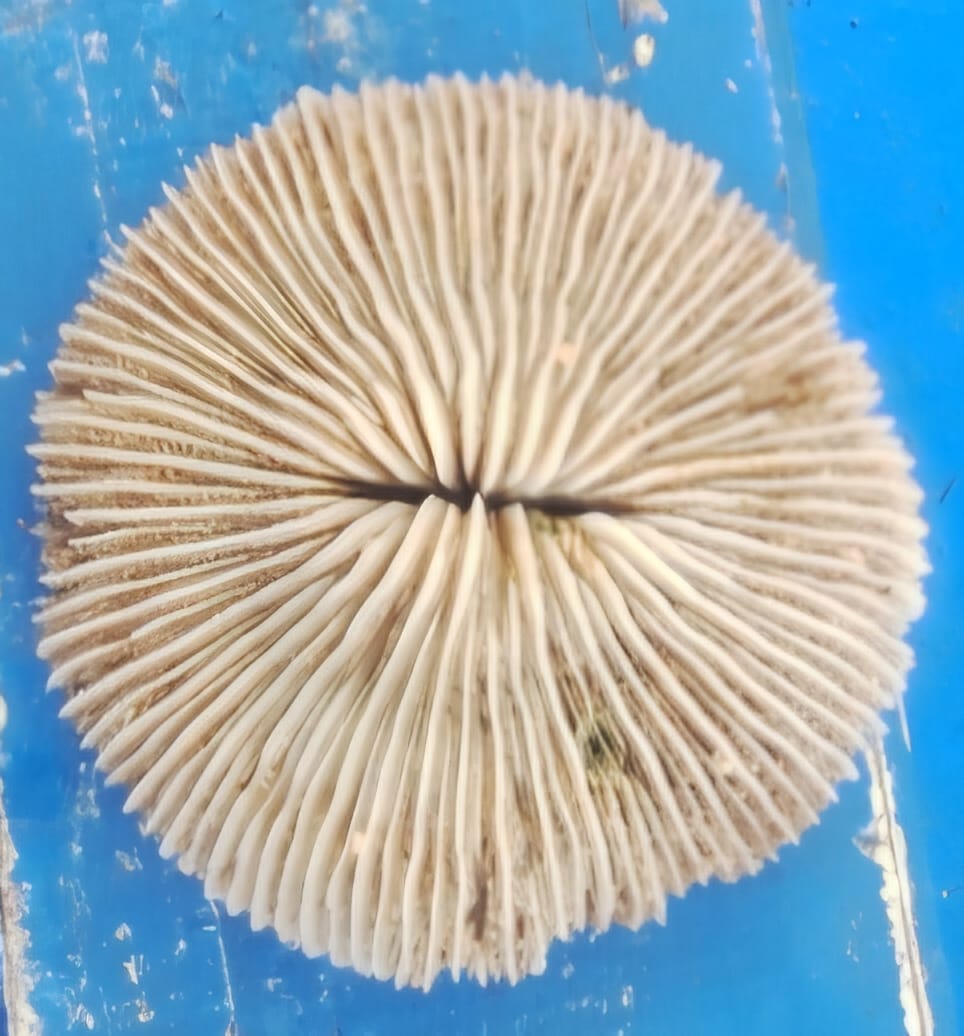
The coral’s polyps are thick and circular, reaching diameters up to 300 millimeters (12 inches), and can be either arched or flat. Its septa are roughly equal in size, with visible septal teeth. Tentacles are pale and extend during the day, but the species lacks tentacular lobes. It has granular costal spines and a brown coloration, with a maximum diameter of 23.5 centimeters (9.3 inches).
This species is widespread, found in the Gulf of Aden, the Red Sea, the southwestern and northern Indian Ocean, eastern Africa, parts of Australia (northern, eastern, and western), the East China Sea, Japan, and the western and central Pacific Ocean. Although common, no specific population figures exist, but its numbers are thought to be decreasing in line with global coral reef decline. Threats include coral disease, climate change, bleaching, predators, human activity, fishing, and parasites. A 1991 study noted that 75% of observed specimens were bleached due to rising sea temperatures. It is listed under CITES Appendix II and occurs on reef flats and slopes between 1 and 30 meters deep.
Originally named *Fungia repanda* by Dana in 1846, it remains a least-concern species according to the IUCN.
Quick Facts
- Taxon
- Lithophyllon repanda
Facts from the source article.
Lore & Background
Lithophyllon repanda was originally described as Fungia repanda by James Dwight Dana in 1846. It is a species of mushroom or disc coral in the family Fungiidae. This species is able to move to another location on occasion, a notable trait among corals.
The coral has thick and circular polyps with diameters of up to 300 millimetres (12 in), which are either arched or flat. Its septa are roughly equal and the septal teeth are visible. Its tentacles extend during the day and are pale in colour, but the species is without tentacular lobes. It has granular costal spines and the species is brown in colour. It reaches diameters of up to 23.5 centimetres (9.3 in).
It is found in the Gulf of Aden, the Red Sea, the southwestern and northern Indian Ocean, eastern Africa, northern, eastern, and western Australia, the East China Sea, Japan, and the western and central Pacific Ocean. It occurs at depths of 1 to 30 metres on flats and slopes of reefs. It is a common species and no population figures are available, but its population is believed to be declining in line with the global decline in coral reefs.
Reader's Guide
Lithophyllon repanda is significant as a common and widespread mushroom coral species across the Indo-Pacific, from the Red Sea and eastern Africa to Japan and Australia. Its listing as a least-concern species by the IUCN and inclusion in CITES Appendix II reflect its current status and the need for monitoring. The species is threatened by coral disease, climate change, bleaching, predators, human activity, fishing, and parasites. A 1991 study discovered that 75% of observed specimens were bleached due to rising sea temperatures, highlighting its vulnerability to environmental stress. Its ability to move to another location on occasion is an unusual trait among corals, though the article does not describe the mechanism or frequency of this movement. The species is found on reef flats and slopes at depths between 1 and 30 metres, and its population is believed to be declining in line with the global decline in coral reefs. No population figures are available, but the species remains common across its range.
Solitary Form and Nocturnal Feeding
Fungia repanda belongs to the Fungiidae, a family of Cnidaria that encompasses thirteen extant genera ranging from solitary organisms to colonial forms. Within this family, Fungia is classified among the solitary genera, alongside Cycloseris. Members of this group are generally solitary marine animals that possess the remarkable ability to move across the seafloor through benthic locomotion, a trait that distinguishes them from most other corals. In adulthood, most species remain fully detached from the substrate rather than cementing themselves permanently in place. To the untrained eye, these corals frequently appear bleached or lifeless, their skeletal plates resting on the ocean floor. However, during the night, a single polyp typically emerges from the center of the skeleton to extend its tentacles and feed. This nocturnal feeding behavior, combined with the daytime appearance of a bare plate, creates a deceptive impression of a dead organism. The solitary architecture of Fungia repanda contrasts sharply with other fungiids such as Polyphyllia, which bears multiple mouths on a single organism, or Ctenactis and Herpolitha, which occupy an ambiguous middle ground between solitary and colonial organization.
Sexual Plasticity and Evolutionary Strategy
One of the most striking biological traits associated with Fungia repanda is its capacity to change sex over the course of its life. This phenomenon, shared with Ctenactis echinata and other members of the Fungiidae, represents a form of sequential hermaphroditism in which an individual organism shifts between male and female reproductive roles. Scientists posit that this sex change is triggered by environmental pressures or energetic constraints, allowing the coral to allocate its limited resources toward whichever reproductive mode best suits current conditions. The evolutionary logic behind this strategy is to maximize the organism's overall fitness in a variable marine environment. Interestingly, researchers have drawn parallels between this mechanism and similar reproductive flexibility observed in certain dioecious plant species, where individuals may shift their sex expression in response to resource availability. For a benthic, largely sedentary organism like Fungia repanda, the ability to toggle reproductive strategy without the need to locate a new mate or relocate offers a significant adaptive advantage in the competitive and fluctuating conditions of shallow marine habitats.
Ecological Niche and Symbiotic Partners
Although Fungia repanda is a solitary organism, it occupies a meaningful position within its local reef community. Members of the Fungiidae family, including Fungia species, serve as structural habitat for a variety of smaller marine animals. The plates and polyps of these corals provide shelter to fish from families such as Gobiidae and Labridae, offering refuge among the tentacles and beneath the skeletal disc. Fungia species in particular host a commensal pipefish, Siokunichthys nigrolineatus, which gains protection and proximity to food sources in association with its coral partner. The broader family also supports diverse ecological interactions: Heliofungia actiniformis, with its perpetually visible tentacles, creates an anemone-like structure that can be easily mistaken for a sea anemone, while Danafungia scruposa has been documented consuming jellyfish, demonstrating a predatory capability unexpected in a coral. Some fungiids grow into elongated forms resembling sea cucumbers. These varied ecological roles underscore that even solitary corals contribute meaningfully to the complexity and biodiversity of their surrounding marine environment.
Human Encounters and the Aquarium Trade
Despite their ecological significance, members of the Fungiidae family hold no commercial importance in any industrial or economic sector. Their relationship with humans is almost entirely recreational and aesthetic. Fungia repanda and its relatives are collected for the marine aquarium trade, where they are marketed under the common name "plate corals." This trade reflects the visual appeal of these organisms: their flat, disc-like skeletons and the dramatic emergence of a polyp at night create a captivating display for hobbyists. The very traits that make them attractive to collectors—their solitary, mobile nature and their tendency to appear bleached or dead during daylight hours—also make them somewhat unusual subjects for the aquarium hobby. The family's common names, "mushroom corals" and "plate corals," capture the distinctive morphology that draws human interest. For the average observer, encountering a Fungia repanda on a reef survey or in a home aquarium presents a curious paradox: an organism that looks inert and lifeless by day yet reveals a living, feeding polyp after dark, reminding us that the ocean floor conceals as much as it displays.
Gallery
Frequently Asked Questions
What is Lithophyllon repanda?
Lithophyllon repanda is a free-living mushroom (disc) coral in the family Fungiidae, native to the Indo-Pacific region. It was first formally described by James Dwight Dana in 1846 under the name Fungia repanda before being reclassified into its current genus.
Where does Lithophyllon repanda live and how deep can it be found?
This coral inhabits shallow tropical waters across the Indo-Pacific, typically occurring between 1 and 30 metres (roughly 3 to 98 feet) below the surface. It is a benthic organism that rests on the seafloor rather than being attached to a reef structure.
How large does Lithophyllon repanda grow?
Individual polyps are thick and circular, with a typical diameter reaching up to about 300 millimetres (12 inches), though the maximum recorded size is around 23.5 centimetres (9.3 inches). The disc can appear either arched or flat, and its septa are roughly uniform in size with visible septal teeth.
Is Lithophyllon repanda threatened or protected?
The IUCN currently lists it as a least-concern species, meaning it does not face a high risk of extinction in the wild. However, it does appear on CITES Appendix II, so international trade in specimens is regulated to ensure it remains sustainable.
What makes Lithophyllon repanda stand out among other mushroom corals?
Unlike most Fungiidae, L. repanda is capable of occasionally relocating itself across the substrate, a behaviour that sets it apart from strictly sessile relatives. Its pale tentacles also extend during daylight hours, making it one of the more visible and photogenic species in its family.
More in Plate and Mushroom Corals 1-24
Spotted an error? Know more?
Reader corrections go straight into our review queue. Suggest an edit · How this site is sourced