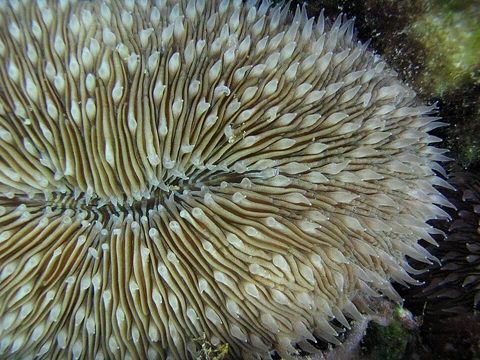
Cycloseris curvata
A solitary disc coral of the Indo-Pacific.

Cycloseris curvata is a disc coral from the Fungiidae family. This solitary, free-living scleractinian coral lives in the Indo-Pacific, often on soft seafloors and in murky waters. In the wild, it appears in shades of green and brown.
The polyp’s skeleton forms strong arches up to 90 millimeters across. Like other anthozoans, it has a large gastrovascular cavity divided by thick, outward-protruding walls called septa, which increase internal surface area. Viewed from above, these septa curve asymmetrically. Its stinging tentacles, or nematocysts, contain barbed or venomous coiled threads used for defense and capturing prey.
The body follows an oral-aboral plan, with the mouth on one side and the opposite side lacking one. It also has radial symmetry around a central axis.
Found at depths from 0 to 30 meters, Cycloseris curvata ranges widely across tropical waters between 32°N and 31°S latitude and 32°E to 77°W longitude.
Its life cycle begins with zygotes developing into planular planktonic larvae. These larvae undergo metamorphosis, forming tentacles, septa, and a pharynx before settling as polyps. The coral inhabits soft benthic substrates in inter-reef and reef environments, tolerating temperatures from 22°C to 27°C.
Anthozoans can be gonochoristic or hermaphroditic. Germ cells originate in the endoderm, move to the gastrodermis to mature, and are released through the coelenteron into the sea for external fertilization. Many gametes are produced to boost fertilization odds. Asexual reproduction occurs via budding or fragmentation.
For feeding, individuals extend tentacles to trap small zooplankton through suspension feeding. Larger cnidarians use nematocysts to catch fish and crabs. While little is known about species interactions, Cycloseris curvata appears to form symbiotic relationships with photosynthetic symbionts.
Quick Facts
- Taxon
- Cycloseris curvata
Facts from the source article.
Lore & Background
Cycloseris curvata exhibits a polyp structure composed of strong arches. Its gastrovascular cavity is divided by thick, protruding septa that curve asymmetrically when viewed from above. Like other cnidarians, it possesses nematocysts—stinging tentacles with barbed or venomous coiled threads—used for self-defense and prey capture. The species displays an oral-aboral body plan and radial symmetry. It has been observed in both green and brown colors in the field.
Reader's Guide
Cycloseris curvata is significant as a free-living disc coral adapted to soft substrates and turbid waters, distinguishing it from many reef-building corals. Its distribution across a wide tropical range (32°N–31°S, 32°E–77°W) and depths from 0 to 30 meters indicates ecological flexibility. The species reproduces externally, releasing gametes into the sea, and can also reproduce asexually through budding or fragmentation. Its life cycle begins with planular planktonic larvae that metamorphose into polyps. The coral feeds by suspension feeding on small zooplankton, and larger individuals may use nematocysts to capture prey. Symbiotic relationships with photosynthetic symbionts are noted, though interactions with other species remain poorly understood. The species tolerates temperatures between 22°C and 27°C.
Did You Know?
- Cycloseris curvata can grow up to 90 millimeters in diameter.
- It is found at depths ranging from 0 to 30 meters.
- The species can reproduce both sexually (external fertilization) and asexually (budding or fragmentation).
Frequently Asked Questions
What is Cycloseris curvata?
It is a solitary, free-living disc coral in the Fungiidae family, classified as a scleractinian (stony) coral. It is one of the well-known mushroom corals native to the Indo-Pacific.
Where does Cycloseris curvata live and what conditions does it prefer?
This coral settles on soft seafloors and in turbid waters across the Indo-Pacific, roughly between 32°N and 31°S latitude. It is typically encountered from the surface down to about 30 meters in water temperatures of 22–27 °C.
How big does Cycloseris curvata get?
A single polyp's skeleton can arch up to 90 millimeters in diameter. That makes it one of the larger solitary disc corals within the Fungiidae.
What does Cycloseris curvata look like in the wild?
In its natural setting it shows muted green and brown coloration. Seen from above, the thick septal walls that partition the gastrovascular cavity curve in an asymmetrical pattern, giving the disc a distinctive internal architecture.
How does Cycloseris curvata defend itself as a solitary coral?
It relies on nematocysts—stinging tentacles packed with barbed, venomous coiled threads—to capture small prey and deter predators. Because it lives alone on open seafloor, these stinging cells are its primary line of protection.
More in Plate and Mushroom Corals 1-24
Spotted an error? Know more?
Reader corrections go straight into our review queue. Suggest an edit · How this site is sourced