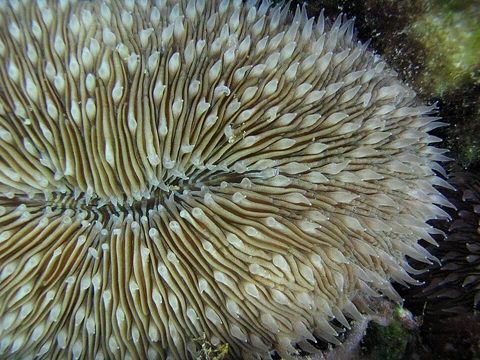
Cycloseris distorta
A free-living disc coral that can inflate and fragment itself.

Anne Hoggett · CC BY 3.0
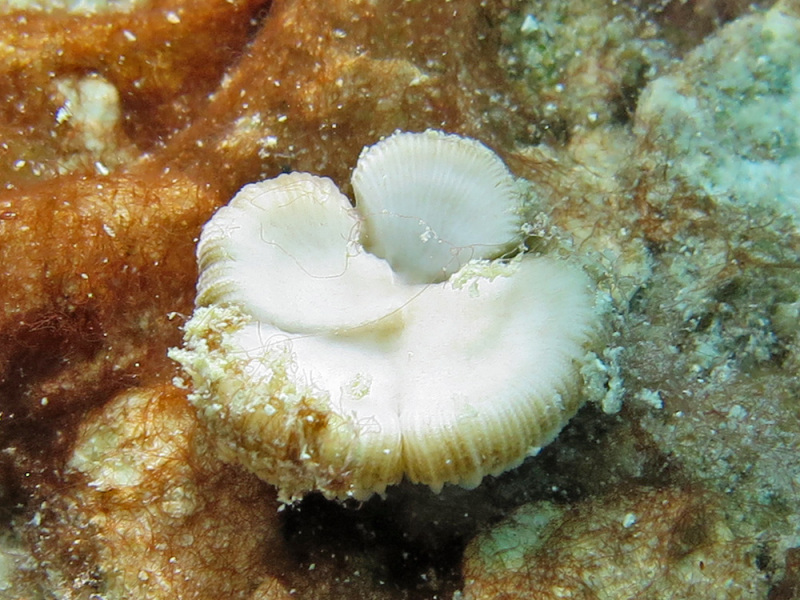
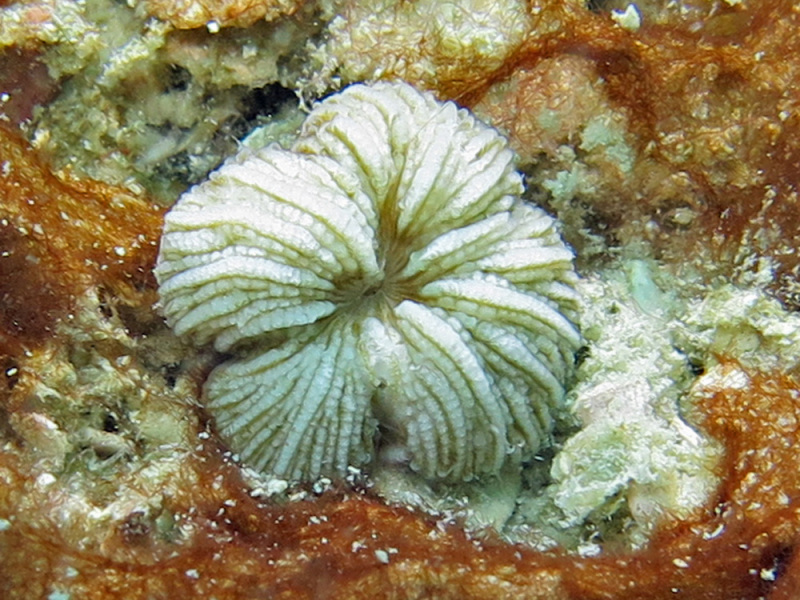
Cycloseris distorta is a free-living, solitary disc coral from the family Fungiidae. It lives on soft sediment in shallow tropical and subtropical waters of the Indo-Pacific. The coral can absorb water to inflate itself to several times its normal size, and its large polyp has an irregular shape with a central mouth and wedge-shaped segments radiating outward. The stony cup, or corallite, contains numerous beaded partitions of varying heights. When its tentacles are extended for feeding, the coral appears fuzzy. Its coloration ranges from cream to pale fawn, sometimes mottled.
This species was first described in 1842 by French naturalist Jean-Louis Hardouin Michelin de Choisy, who named it *Fungia distorta*. It was later moved to the genus *Diaseris* as *Diaseris distorta*, but molecular research in 2011 led to *Diaseris* being absorbed into the genus *Cycloseris*.
Cycloseris distorta is found across the Indian and Pacific Oceans, from the east coast of Africa and Madagascar to Sri Lanka, Malaysia, Indonesia, northern and eastern Australia, and the Galapagos Islands. It typically occurs at depths of 25 meters or less, though it can be found down to about 80 meters. In the Galapagos, a single location hosts a dense population estimated at several hundred thousand individuals, sometimes piled on top of one another. On a nearby island, large numbers of dead skeletons exist but no living corals.
Individual corals are either male or female. They reproduce through broadcast spawning four to eight times per year, and asexual reproduction by fission is also important. Fragmentation can occur from physical forces like storms, but the coral can also deliberately break itself apart through autotomy, selectively weakening parts of its skeleton.
Quick Facts
- Taxon
- Cycloseris distorta
Facts from the source article.
Lore & Background
This coral was first described by the French naturalist Jean-Louis Hardouin Michelin de Choisy in 1842, who named it Fungia distorta. It was later transferred to the genus Diaseris, becoming Diaseris distorta. In 2011, research using molecular methods resulted in Diaseris being absorbed into the genus Cycloseris. The coral is solitary and free-living, growing to a diameter of about 80 mm. Its large polyp is irregular in shape, with a central mouth from which radiate wedge-shaped segments. The corallite has numerous beaded septa of varying heights. The polyp can absorb water and inflate itself to several times its original size, and when tentacles are extended to feed, it has a fuzzy appearance. Its color is some shade of cream or pale fawn, and may be mottled.
Reader's Guide
Cycloseris distorta is significant for its unusual reproductive strategies and its dense, localized population in the Galapagos Islands. The species reproduces both sexually, through broadcast spawning four to eight times per year, and asexually via fission. It can fragment due to physical forces such as storms, but it is also capable of autotomy, deliberately breaking itself apart by selectively weakening parts of its skeleton. In the Galapagos Islands, the species is known from a single location where an estimated several hundred thousand individuals are so dense that they are sometimes piled on top of each other. On a nearby island, there is a location with large numbers of dead skeletons but no living individuals. This coral occurs on soft sediments, usually at depths of 25 m or less, but occasionally down to about 80 m. Its range extends from the east coast of Africa and Madagascar to Sri Lanka, Malaysia, Indonesia, northern and eastern Australia and the Galapagos Islands.
Did You Know?
- This coral was originally named Fungia distorta by French naturalist Jean-Louis Hardouin Michelin de Choisy in 1842.
- It can inflate itself to several times its original size by absorbing water.
- In the Galapagos Islands, a single location hosts an estimated several hundred thousand individuals, sometimes piled on top of each other.
- The coral can reproduce asexually by autotomy, deliberately breaking itself apart.
Gallery
Frequently Asked Questions
What is Cycloseris distorta?
It is a solitary, free-living disc coral belonging to the Fungiidae family. Originally named Fungia distorta by Jean-Louis Hardouin Michelin de Choisy in 1842, it is now recognized under the Cycloseris genus.
How does Cycloseris distorta inflate itself?
The coral can take in water and swell to several times its resting size, a remarkable adaptation for a sessile organism. This inflation is one of the most distinctive behaviors fans associate with the species.
Where can you find Cycloseris distorta in the wild?
It settles on soft sediment in shallow tropical and subtropical Indo-Pacific waters, typically at 25 meters or less, though it has occasionally been recorded as deep as roughly 80 meters.
How does Cycloseris distorta reproduce?
It reproduces sexually through broadcast spawning events that occur four to eight times a year, and asexually via fission and autotomy, where it breaks off fragments that grow into new individuals.
What does Cycloseris distorta look like?
Its coloration runs from cream to pale fawn, sometimes with mottling, and its large polyp has an irregular outline with a central mouth and wedge-shaped radiating segments. When the tentacles are fully extended for feeding, the whole animal takes on a distinctly fuzzy appearance.
More in Plate and Mushroom Corals 1-24
Spotted an error? Know more?
Reader corrections go straight into our review queue. Suggest an edit · How this site is sourced