Fungiidae
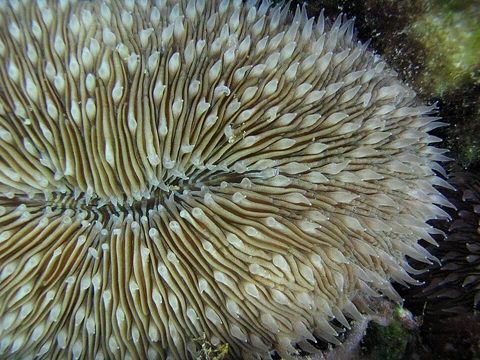
Mushroom corals are solitary or colonial cnidarians capable of locomotion.

Silke Baron · CC BY 2.0
The Fungiidae are a family of Cnidaria, commonly known as mushroom corals or plate corals. They are notable for including both solitary and colonial species, with some genera exhibiting multiple mouths per organism. Many species are capable of benthic locomotion and often appear bleached or dead.
Quick Facts
- Taxon
- Fungiidae
Facts from the source article.
Lore & Background
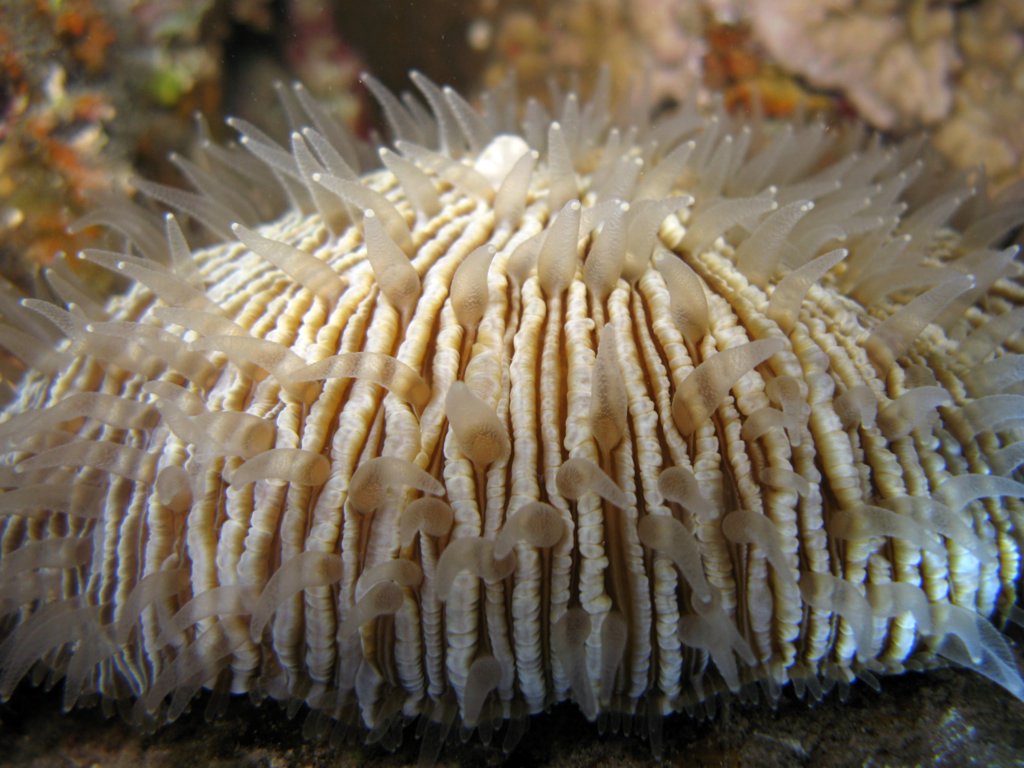
Species in the family Fungiidae are generally solitary marine animals that can move across the seafloor. In most genera, a single polyp emerges from the center of the skeleton to feed at night. Many species remain fully detached from the substrate in adulthood, though some are immobile and colonial. Some fungiids, such as Heliofungia actiniformis, have tentacles that remain visible during the day, making them easily mistaken for sea anemones. Others can be elongated and resemble sea cucumbers. The family includes thirteen extant genera, ranging from solitary organisms like Cycloseris and Fungia to forms with multiple mouths, such as Polyphyllia. The status of Ctenactis and Herpolitha is disputed—they may be solitary organisms with multiple mouths or a colony of individuals, each with its own mouth.
Reader's Guide
The Fungiidae are not commercially important but are collected for the aquarium trade, where they are sold as 'plate corals'. Their ecological significance includes providing shelter to fish species from the families Gobiidae and Labridae, as seen with Heliofungia actiniformis. Some species, such as Fungia repanda and Ctenactis echinata, are capable of changing sex, a phenomenon thought to improve evolutionary fitness in response to environmental or energetic constraints. Additionally, Danafungia scruposa has been observed eating jellyfish. A commensal pipefish, Siokunichthys nigrolineatus, lives with Fungia spp. These corals are often mistaken for dead or bleached due to their appearance, but they are active feeders at night. Their ability to move and their varied reproductive strategies make them a subject of interest in marine biology.
Did You Know?
- Some fungiid species, such as Fungia repanda and Ctenactis echinata, can change sex.
- Heliofungia actiniformis is easily mistaken for a sea anemone because its tentacles remain visible during the day.
- Fungia spp. have a commensal pipefish, Siokunichthys nigrolineatus.
Morphological Diversity Across Thirteen Genera
The Fungiidae stand out within Cnidaria for their remarkable range of body plans, spanning thirteen extant genera that defy a single structural template. At one end of the spectrum, genera like Cycloseris and Fungia exist as straightforward solitary organisms—essentially one polyp atop a single skeleton. At the other, Polyphyllia presents a single organism bearing multiple mouths, blurring the line between individual and colony. Genera such as Ctenactis and Herpolitha occupy an ambiguous middle ground, interpretable either as solitary animals with several mouths or as loose colonies of individuals, each maintaining its own mouth. This spectrum of organization—solitary, multi-mouthed, colonial, or somewhere in between—makes the family a fascinating case study in how a single lineage can explore multiple architectural strategies. Whether an organism is truly one or many, the Fungiidae demonstrate that the boundary between individuality and collectivity in marine life is far more fluid than a simple count of mouths might suggest.
Nocturnal Rhythms and Adaptive Sex Change
Despite their static, plate-like appearance on the seafloor, Fungiidae lead surprisingly active lives. Most species are capable of benthic locomotion, slowly crawling across the substrate rather than remaining permanently fixed. In the majority of genera, a single polyp retracts during daylight hours, leaving the skeleton exposed and often mistaken for a bleached or dead coral. Only at night does the polyp extend from the center of the skeleton to feed, a daily rhythm that keeps these animals hidden from casual observers. While most adult fungiids remain fully detached from the substrate, some species are both immobile and colonial, showing that the family encompasses a wide behavioral range. Perhaps most striking is the capacity for sex change observed in species like Fungia repanda and Ctenactis echinata. Researchers believe this shift is triggered by environmental pressures or energetic constraints, serving to boost the organism's evolutionary fitness—a strategy with clear parallels in certain dioecious plant species.
Ecological Interactions and Misidentified Neighbors
Fungiidae occupy a surprisingly rich niche in reef ecosystems, often playing roles that go unnoticed because of their unassuming appearance. Heliofungia actiniformis, commonly called the anemone coral, is so frequently mistaken for a true sea anemone that its identity as a stony coral comes as a surprise; its tentacles remain visible even during daylight, unlike most fungiid relatives. This species also serves as a shelter site for small reef fish, including members of the families Gobiidae and Labridae. The genus Fungia hosts a commensal pipefish, Siokunichthys nigrolineatus, which lives in close association with the coral. Some elongated fungiids bear a striking resemblance to stichopodid sea cucumbers, adding another layer of visual confusion. On the dietary front, Danafungia scruposa has been observed consuming jellyfish, a behavior that highlights the family's broader predatory versatility beyond the typical coral diet.
Human Perception and the Aquarium Trade
The Fungiidae occupy a peculiar position in human awareness: widely collected yet rarely appreciated for what they truly are. Because most species look bleached, dead, or inert during the day, they are frequently overlooked by divers and misidentified as sea anemones or sea cucumbers. This visual ambiguity has shaped how humans interact with them. Commercially, the family holds no significant economic value, yet they are actively harvested for the ornamental aquarium trade, where they are marketed under the appealing name "plate corals." This trade reflects a broader pattern in which marine organisms are valued for their aesthetic form rather than their biological complexity. The fact that a single polyp emerges only at night to feed, that some species can change sex in response to environmental stress, and that they support commensal pipefish and shelter reef fish—all of these ecological roles remain invisible to the casual aquarist gazing at a flat, disc-shaped skeleton in a glass tank. The Fungiidae remind us that the most dynamic organisms can appear the most still.
Gallery
Frequently Asked Questions
What are Fungiidae corals?
Fungiidae is a family of cnidarians commonly called mushroom corals or plate corals, named for their disc-shaped, umbrella-like body form. The family contains 13 extant genera, ranging from single polyps to organisms bearing multiple mouths.
Can mushroom corals actually move across the reef?
Yes—many Fungiidae species are capable of benthic locomotion, slowly crawling along the substrate rather than staying fixed in place like most corals. This mobility is unusual among cnidarians and lets them reposition to find better light or water flow.
What's the difference between solitary and colonial Fungiidae?
Genera like Fungia and Cycloseris consist of a single polyp, while Polyphyllia is one organism with multiple mouths, and Ctenactis or the disputed Herpolitha may represent true colonies. The distinction matters because a 'colony' in Fungiidae can be a single genetically unified individual with many mouths rather than many separate polyps.
Why do mushroom corals often look bleached or dead?
Many Fungiidae species naturally appear pale, mottled, or seemingly lifeless, and this muted coloration is simply their regular appearance rather than a sign of stress. It can make them easy to overlook on a reef until you notice them shifting position.
What is the anemone coral, Heliofungia actiniformis?
Heliofungia actiniformis is a striking Fungiidae species whose tentacles radiate outward in a starburst pattern, earning it the nickname 'anemone coral.' It stands out among its relatives because of this dramatic, sun-ray-like tentacle display.
More in Plate and Mushroom Corals 1-24
Spotted an error? Know more?
Reader corrections go straight into our review queue. Suggest an edit · How this site is sourced