Vy 1-2
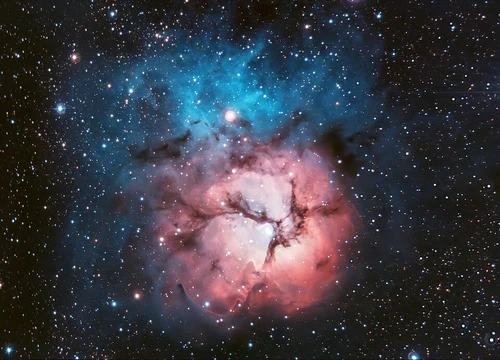
Planetary nebula with faint knots and a bright elliptical ring.

Vy 1-2 is a planetary nebula discovered in 1942 by Russian-American astronomer Alexander N. Vyssotsky. It is notable for its faint outer shell, two faint knots at a position angle of 305°, and a bright-elliptical ring-like structure. The nebula has been considered a candidate halo PN due to its high systemic velocity and distance from the galactic plane.
Quick Facts
- Epoch
- J2000
- Ra
- 17 · 54 · 22.98
- Dec
- +27 · 59 · 58.1
- Dist Ly
- 15,300-47,292
- Constellation
- Hercules
- Names
- PK 053+24 1, PN G053.3+24.0
Facts from the source article.
Lore & Background
Vy 1-2 was discovered by Alexander N. Vyssotsky in 1942. The nebula contains a faint outer shell and two much fainter knots at a position angle of 305°. The south knot lies 14.5 arcsec from the central star, and the north knot 11.5 arcsec from the central star. Their deprojected radial expansion velocity is 90–100 km/s, and their kinematic age is 5200 ± 750 yr for a distance of 9.7 kpc. A bright-elliptical ring-like structure has a minor axis of 2.4 arcsec and a major axis of 3.2 arcsec.
The distance of Vy 1-2 remains uncertain, with estimates ranging from 7.0 to 14.5 kpc calculated using a mean radius of ~1.4 arcsec. The systemic heliocentric radial velocity is Vsys = -85 ± 4 km/s. The nebula has been a candidate for a halo PN because of its high systemic velocity (~500 pc) from the galactic plane. The Zanstra temperature of the He I line is 75.4 ± 10.2 kK, while the He II line is 99.8 ± 4.3 kK. The logarithmic Hβ flux is estimated to be -11.52 ± 0.01.
The N II emission line shows a high expansion velocity of 90–100 km/s only along PA = 310°, and the He II expansion velocity is ~23–25 ± 4 km/s. Electron temperatures are Te = 10,850 ± 2100 K for N II and 10,400 ± 5400 K for O I. Electron densities are: S II Ne = 4500 ± 650 cm⁻³, Cl III Ne = 4330 ± 1600 cm⁻³, and Ar IV Ne = 4550 ± 1300 cm⁻³. The central star is unknown, possibly a WR or a strong and fast WEL nucleus, with detection of C II, C IV, and O III stellar lines supporting that scenario. Another scenario suggests the central star is a binary system, used to prove an anomaly in BD +30° 3639.
Reader's Guide
Vy 1-2 is significant as a candidate halo planetary nebula due to its high systemic velocity and distance from the galactic plane, suggesting it may belong to an older stellar population. Its kinematic age of 5200 ± 750 yr, derived from the expansion of its two faint knots, provides a relatively young age estimate for a halo object. The nebula's complex morphology—a faint outer shell, a bright elliptical ring, and two knots—offers clues to its formation and evolution. The uncertain distance (7.0–14.5 kpc) and the unknown nature of its central star (possibly a WR or WEL nucleus, or a binary system) highlight ongoing questions about its true nature. The detection of C II, C IV, and O III stellar lines supports a Wolf–Rayet or similar hot star scenario, while the binary hypothesis remains an alternative. The high expansion velocities in N II (90–100 km/s) along a specific position angle contrast with the lower He II expansion velocity (~23–25 km/s), indicating kinematic asymmetry. Electron temperatures and densities derived from multiple emission lines (N II, O I, S II, Cl III, Ar IV) provide a detailed physical picture of the nebular gas. Vy 1-2 thus serves as an important object for studying halo PNe and the late stages of stellar evolution in low-metallicity environments.
Did You Know?
- The nebula has two faint knots at a position angle of 305°, with deprojected radial expansion velocities of 90–100 km/s.
- Its kinematic age is 5200 ± 750 years, based on a distance of 9.7 kpc.
- The central star is unknown, but detection of C II, C IV, and O III lines suggests it may be a WR or fast WEL nucleus.
More in Planetary Nebulae, Part 2 1-24
Spotted an error? Know more?
Reader corrections go straight into our review queue. Suggest an edit · How this site is sourced