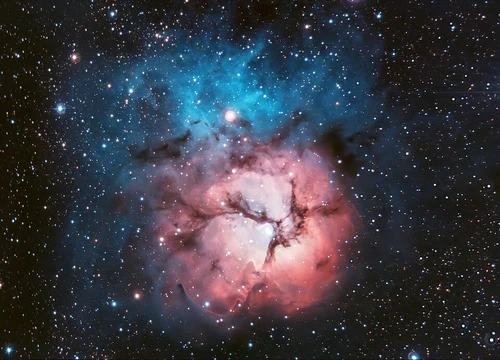
NGC 6153
A bipolar nebula with extreme elemental overabundances.

NGC 6153, a planetary nebula in the southern constellation Scorpius, was first spotted in 1883 by the English astronomer Ralph Copeland. Though it can be glimpsed through telescopes as small as 80 mm, a dense Milky Way backdrop often makes it tricky to locate. It shines at an apparent visual magnitude of 10.6 and spans about 30 arcseconds across. This nebula is roughly symmetrical and bipolar, with an expansion velocity ranging from 12.7 to 17.3 km/s. It contains knots, filaments, and likely a double-shell structure. Classified as Peimbert type I, it is rich in helium and nitrogen, and its progenitor was a thin-disk star. A 1986 spectral analysis revealed it to be unusual: nearly every element is overabundant, especially nitrogen, neon, sulfur, and argon—in some cases reaching higher abundances than any other known nebula. This oddity is thought to arise from cold, metal-rich, hydrogen-deficient knots embedded within the nebula. Data from Gaia suggests the central star might be a binary system, which could account for the abundance discrepancy. If confirmed, a white dwarf on the cooling track could undergo a final thermal pulse, swelling into a helium-burning giant that retraces much of its earlier evolutionary path.
Quick Facts
- Epoch
- J2000
- Class
- II
- Ra
- 16 · 31 · 30.57
- Dec
- −40 · 15 · 12.6
- Dist Ly
- 1.499 ±
- Appmag V
- 10.6
- Constellation
- Scorpius
Facts from the source article.
Lore & Background
NGC 6153 was discovered in 1883 by English astronomer Ralph Copeland. It is a roughly symmetrical, bipolar nebula with an expansion velocity of 12.7 to 17.3 km/s, and includes knots, filaments, and probably a double-shell structure. Its Peimbert type of I indicates it is helium and nitrogen rich, with a progenitor that was a thin disk star.
A 1986 analysis of spectra revealed this to be an unusual nebula, with nearly all elements overabundant, particularly nitrogen, neon, sulfur, and argon, in some cases higher than any other nebula. It was proposed that this discrepancy occurs due to cold, metal-rich, hydrogen deficient knots that have been included in the nebula. An analysis of Gaia data suggests the central star may be a binary system, which could explain the abundance discrepancy. While on the cooling track, a white dwarf can undergo a final thermal pulse, causing the star to swell into a helium burning giant that follows nearly the same evolutionary track as the earlier star.
Reader's Guide
NGC 6153 is significant primarily for its extreme chemical abundances, which challenge standard models of planetary nebula composition. The 1986 spectral analysis showed that nearly all elements are overabundant, with nitrogen, neon, sulfur, and argon reaching levels higher than in any other known nebula. This anomaly was attributed to cold, metal-rich, hydrogen deficient knots embedded in the nebula. Later Gaia data suggested the central star may be a binary system, offering a possible mechanism for the abundance discrepancy. The nebula's Peimbert type I classification links it to a thin disk progenitor, and its bipolar morphology with knots and filaments provides structural context. The possibility of a final thermal pulse in the white dwarf's evolution adds further complexity. Despite being observable with small telescopes, its rich Milky Way background can hinder detection. NGC 6153 remains a key object for studying chemical enrichment and binary interactions in planetary nebulae.
Did You Know?
- Nearly all elements in the nebula are overabundant, with nitrogen, neon, sulfur, and argon being particularly high.
- The central star may be a binary system, as suggested by Gaia data.
Frequently Asked Questions
Who first identified NGC 6153 and when?
English astronomer Ralph Copeland was the first to spot this object back in 1883. It sits in the southern constellation Scorpius.
What shape and structure does NGC 6153 have?
It presents a roughly symmetrical bipolar form, with visible knots and filaments threading through its glow. Observers also suspect a double-shell structure beneath the surface.
How hard is NGC 6153 to find with a small telescope?
An 80 mm scope is technically enough to catch it, but the dense star field of the Milky Way behind it makes pinpointing the faint 30-arcsecond disc genuinely tricky.
What makes NGC 6153 chemically unusual?
It carries a Peimbert type I classification, meaning its gas is heavily enriched in helium and nitrogen compared to typical planetary nebulae. These extreme elemental overabundances are a hallmark of the object.
How fast is NGC 6153 expanding?
Its outer material is racing outward at between 12.7 and 17.3 km/s. At that pace, the 30-arcsecond shell is steadily growing wider over time.
More in Planetary Nebulae, Part 2 1-24
Spotted an error? Know more?
Reader corrections go straight into our review queue. Suggest an edit · How this site is sourced