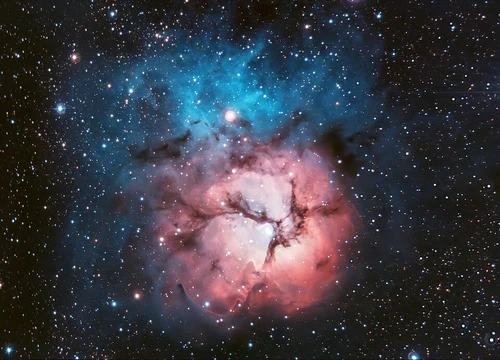
NGC 5189
A planetary nebula with an S shape and a binary central star.

NGC 5189 (also catalogued as Gum 47, IC 4274, and called the Spiral Planetary Nebula) lies in the southern constellation Musca. James Dunlop discovered it on 1 July 1826, recording it as Δ252. For decades, even into the 1960s, astronomers classified it as a bright emission nebula. It was Karl Gordon Henize who, in 1967, first identified it as a quasi-planetary nebula based on its spectral emissions.
Through a telescope, the nebula displays an S shape that resembles a barred spiral galaxy. This S shape, along with point-symmetric knots within the nebula, long suggested to researchers that a binary central star might be present. Analysis of Hubble Space Telescope images later revealed that the S shape actually consists of two dense, low-ionization regions: one moving toward the northeast and the other toward the southwest, possibly the result of a recent outburst from the central star. Observations with the Southern African Large Telescope eventually confirmed a white dwarf companion, orbiting the rare low-mass Wolf-Rayet type central star every 4.04 days.
NGC 5189 is estimated to be 546 parsecs (about 1,780 light-years) from Earth, though other measurements have yielded distances up to 900 parsecs (roughly 3,000 light-years). A very similar planetary nebula, N66, exists in the Large Magellanic Cloud and also contains a Wolf-Rayet nucleus.
- Discovered by
- James Dunlop
- Discovery date
- 1 July 1826
- Catalogued as
- Δ252
- Distance estimate 1
- 546 parsecs (1,780 light-years)
- Distance estimate 2
- up to 900 parsecs (~3,000 light-years)
- Companion orbit period
- 4.04 days
Lore & Background
NGC 5189 was discovered by James Dunlop on 1 July 1826, who catalogued it as Δ252. For many years, well into the 1960s, it was thought to be a bright emission nebula. It was Karl Gordon Henize in 1967 who first described NGC 5189 as quasi-planetary based on its spectral emissions. Seen through the telescope it seems to have an S shape, reminiscent of a barred spiral galaxy. The S shape, together with point-symmetric knots in the nebula, have for a long time hinted to astronomers that a binary central star is present. Hubble Space Telescope imaging analysis showed that this S shape structure is indeed two dense low-ionization regions: one moving toward the north-east and another moving toward the south-west of the nebula, which could be a result of a recent outburst from the central star. Observations with the Southern African Large Telescope have finally found a white dwarf companion in a 4.04 day orbit around the rare low-mass Wolf-Rayet type central star of NGC 5189. NGC 5189 is estimated to be 546 parsecs or 1,780 light years away from Earth, though other measurements have yielded results up to 900 parsecs (~3000 light-years). There is a very similar planetary nebula in the Large Magellanic Cloud, N66, which also contains a Wolf-Rayet nucleus.
Reader's Guide
NGC 5189's significance lies in its complex structure and the confirmation of a binary central star system. The S-shaped morphology, initially suggesting a barred spiral galaxy, was resolved by Hubble Space Telescope imaging into two dense low-ionization regions moving in opposite directions, likely from a recent outburst. The discovery of a white dwarf companion in a 4.04-day orbit around a rare low-mass Wolf-Rayet star, made with the Southern African Large Telescope, provides direct evidence for the binary hypothesis long inferred from the nebula's point-symmetric knots. This makes NGC 5189 a key object for studying binary interactions in planetary nebula formation. Its distance remains uncertain, with estimates ranging from 546 to 900 parsecs. The similarity to N66 in the Large Magellanic Cloud, another nebula with a Wolf-Rayet nucleus, places NGC 5189 in a broader context of such rare objects.
Did You Know?
- It was thought to be a bright emission nebula until Karl Gordon Henize described it as quasi-planetary in 1967.
- The nebula's S shape is formed by two dense low-ionization regions moving northeast and southwest.
- Its central star is a rare low-mass Wolf-Rayet type with a white dwarf companion in a 4.04-day orbit.
Frequently Asked Questions
Who discovered NGC 5189 and when?
James Dunlop first spotted the object on 1 July 1826 and logged it under the designation Δ252. It later entered other catalogues as Gum 47 and IC 4274 before receiving its NGC number.
What does NGC 5189 look like through a telescope?
The nebula presents a distinctive S-shaped structure that can remind observers of a barred spiral galaxy. It also contains point-symmetric knots of emission that have made its geometry a long-standing puzzle for researchers.
Why was NGC 5189 misclassified as an emission nebula for so long?
For decades, even into the 1960s, astronomers catalogued it simply as a bright emission nebula. It was not until Karl Gordon Henize examined its spectral emissions in 1967 that it was recognized as a quasi-planetary nebula.
What is special about the central star in NGC 5189?
Unlike most planetary nebulae with a single central star, NGC 5189 hosts a binary pair. The two stars complete one orbit around each other roughly every 4.04 days, a period that likely plays a role in shaping the nebula's unusual S-shaped morphology.
How far is NGC 5189 from Earth?
Distance estimates for this object in the constellation Musca vary, with one measurement placing it at about 546 parsecs (roughly 1,780 light-years) and another pushing it out to around 900 parsecs (approximately 3,000 light-years).
More in Planetary Nebulae, Part 2 1-24
Spotted an error? Know more?
Reader corrections go straight into our review queue. Suggest an edit · How this site is sourced