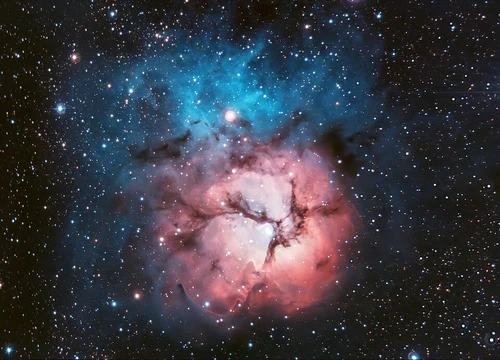
NGC 5315
Planetary nebula in Circinus with a hot, hydrogen-deficient central star.

NGC 5315 is a planetary nebula in the southern constellation Circinus, discovered in 1883 by astronomer Ralph Copeland. It is notable for its complex structure, slightly elliptical form, and a broken ring, as well as for its central star of class WC4, which is hydrogen deficient and has an effective temperature of 76–79 kK.
Quick Facts
- Credit
- HST/NASA/ESA
- Epoch
- J2000
- Constellation
- Circinus
- Ra
- 13 · 53 · 56.96097
- Dec
- -66 · 30 · 50.9155
- Dist Ly
- ~2 kpc.
- Appmag V
- 9.8
- Names
- ESO 97-9, HD 120800, NGC 5315, PN G309.1-04.3
Facts from the source article.
Lore & Background
NGC 5315 was discovered in 1883 by astronomer Ralph Copeland. It is located 5.2 degrees west-southwest of Alpha Circini and is only visible as a disc at magnifications over 200-fold. The nebula has a slightly elliptical form, a complex structure, and a ring that is somewhat broken. It shows a typical abundance of carbon and a slightly enhanced nitrogen abundance. Radial velocity studies indicate that the central star may be a member of a binary system. The nebula does not show enrichment of s-process elements, which suggests that the star's asymptotic giant branch stage may have been truncated by interaction with the companion. Alternatively, the star may be low in mass and did not undergo third dredge-up, or the star's s-process elements were heavily diluted by the envelope during the AGB phase.
Reader's Guide
NGC 5315 is significant as a planetary nebula with a complex morphology and a central star of rare spectral class WC4, which is hydrogen deficient and extremely hot (76–79 kK). Its distance is not known accurately but is estimated at around 6.5 kilolight-years. The nebula's lack of s-process element enrichment, combined with radial velocity evidence for a possible binary companion, offers clues about the evolution of its progenitor star. The article presents three alternative explanations for this absence: truncation of the asymptotic giant branch phase by a companion, low stellar mass preventing third dredge-up, or heavy dilution of s-process elements during the AGB phase. These uncertainties highlight ongoing debates in stellar evolution. The nebula's discovery by Ralph Copeland in 1883 adds historical context, and its visibility only at high magnification underscores its faintness. The nebula's slightly elliptical form and broken ring contribute to its structural interest.
Did You Know?
- NGC 5315 was discovered by astronomer Ralph Copeland in 1883.
- The central star has a spectral class of WC4 and an effective temperature of 76–79 kK.
- Radial velocity studies suggest the central star may be part of a binary system.
Identity and Classification
NGC 5315 is a planetary nebula, a category of celestial object that represents the luminous outer layers expelled by a dying star. It occupies a place of distinction within the constellation Circinus, where it is singled out as one of the most prominent deep-sky features visible in that region of the southern sky. Circinus itself is a compact and dim constellation, one that lacks any star brighter than fourth magnitude except for Alpha Circini at magnitude 3.19. Against this dim stellar backdrop, the nebula stands as a notable point of interest for observers. It shares this prominence with the open cluster NGC 5823, another featured object in the same constellation. Together, these two targets represent the highlights of what an observer can find in this compact patch of sky, which spans declinations from roughly −55° to −70° and right ascensions between 13h 38m and 15h 30m. The nebula's presence in such a faint constellation makes it a rewarding target for those who venture beyond the brighter, more familiar southern constellations.
Positional Context in the Southern Sky
NGC 5315 resides within Circinus, a constellation whose official boundaries were established by Belgian astronomer Eugène Delporte in 1930 and defined by a polygon of 14 segments. The constellation is bordered by six neighbors: Centaurus, Musca, Apus, Triangulum Australe, Norma, and Lupus. It sits adjacent to the brilliant stars Alpha and Beta Centauri, which serve as useful navigational anchors for locating the fainter region. Because Circinus occupies declinations between −50° and −70°, the entire constellation—and with it NGC 5315—is visible only to observers south of latitude 30° North. This means the nebula is accessible from much of Australia, southern Africa, and the southern portions of South America, but remains perpetually below the horizon for most of the Northern Hemisphere. The constellation reaches its highest point in the sky, or culmination, at approximately 9 p.m. on July 30, offering the optimal window for observation each year. The International Astronomical Union adopted the three-letter abbreviation "Cir" for this constellation in 1922.
The Milky Way's Path and Nebular Riches
The band of the Milky Way sweeps through the constellation of Circinus, and it is along this galactic pathway that NGC 5315 finds its celestial home. The nebula is specifically highlighted as one of the prominent objects featured within the constellation's borders, sharing that distinction with the open cluster NGC 5823. This association with the Milky Way's luminous band places NGC 5315 among the many deep-sky wonders that dot the galactic plane in the southern sky. The constellation also hosts other notable deep-sky objects, including the Circinus Galaxy, a Seyfert-type spiral galaxy discovered in 1977 that holds the distinction of being the closest such active galaxy to the Milky Way. Additionally, the Alpha Circinids meteor shower, also identified in 1977, radiates from this region. The concentration of diverse deep-sky phenomena—planetary nebulae, open clusters, spiral galaxies, and meteor activity—makes Circinus a constellation of considerable interest despite its small angular size and faint stellar population.
Cartographic Origins and the Legacy of Lacaille
The constellation that shelters NGC 5315 owes its very existence to the cartographic work of French astronomer Nicolas-Louis de Lacaille. In 1756, Lacaille introduced the constellation under the French name le Compas, depicting it as a pair of dividing compasses on his chart of the southern sky. On that same chart, he portrayed neighboring constellations as draughtsman's instruments: Norma as a set square and ruler, and Triangulum Australe as a surveyor's level. The constellation received its current Latin name, Circinus—meaning the drafting compass used for drawing circles—when Lacaille published an updated sky map in 1763 with Latin designations for all the constellations he had introduced. It is important to distinguish this compass from Pyxis, a separate constellation representing a mariner's directional compass. Lacaille also charted eight stars in the constellation, assigning them Bayer designations from Alpha through Theta. The careful work of mapping this faint southern region in the mid-eighteenth century laid the groundwork for all subsequent observations of objects like NGC 5315 within its borders.
Frequently Asked Questions
Who discovered NGC 5315 and when?
Ralph Copeland identified this nebula in 1883 during his surveys of the southern sky. It resides in the small constellation Circinus, which lies close to the celestial south pole.
What does NGC 5315 actually look like?
It presents a slightly elliptical outline with a broken ring structure that gives it a visually complex, asymmetric appearance. At an apparent magnitude of 9.8, resolving those structural details calls for a moderately sized telescope under dark skies.
What makes the central star of NGC 5315 so unusual?
The central star is classified as WC4, a carbon-rich, hydrogen-deficient type with an effective temperature between roughly 76,000 and 79,000 kelvin. That combination of extreme heat and missing hydrogen sets it apart from the far more common hydrogen-rich central stars found in typical planetary nebulae.
How far away is NGC 5315 from Earth?
It is estimated to lie about 6.5 kilolight-years in the direction of Circinus, placing it squarely in our local galactic neighborhood. Its central star, at magnitude 14.2, is faint enough that only larger amateur or professional instruments can isolate it from the surrounding glow.
Why is NGC 5315 important to planetary-nebula research?
The hydrogen-deficient WC4 central star makes it a valuable case study for tracing how a post-massive star evolves after ejecting its outer envelope. Paired with its broken-ring morphology, the nebula offers a natural laboratory for probing how exotic stellar cores shape the structure of their surrounding gas.
More in Planetary Nebulae, Part 2 1-24
Spotted an error? Know more?
Reader corrections go straight into our review queue. Suggest an edit · How this site is sourced