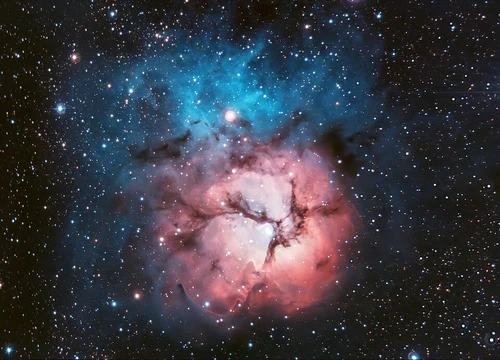
NGC 5882
A small double-shell planetary nebula in Lupus with nitrogen enrichment.

NGC 5882 is a compact planetary nebula in the southern constellation Lupus, located roughly 1.5° southwest of the star Epsilon Lupi. English astronomer John Herschel first spotted it on July 2, 1834, while observing from the Cape of Good Hope observatory. John L. E. Dreyer later described it as “very small, round, quite sharp.” The nebula lies about 7.7 kilolight-years from the Sun.
It consists of the expelled outer atmosphere of an aging star. The nebula is roughly elliptical, with several clumps of ionized material, and is enveloped by a larger region of faint emission that stretches about three times the main nebula’s diameter. It expands at an average speed of 12.5 km/s. Two shells are present: an inner elliptical shell measuring 11″ × 6″, and a rounder outer shell, expanding more rapidly, with a diameter of 15″. The inner shell shows multiple bubble-like features, while clumps in the outer shell may stem from instabilities.
The nebula’s elemental abundances closely match the Sun’s, except nitrogen is twice as abundant. This nitrogen enrichment suggests the central star did not undergo a second dredge-up. The central star has an apparent visual magnitude of 13.43, shines with 830 times the Sun’s luminosity, and has 22.7% of the Sun’s radius. It sits slightly off-center from the nebula’s symmetry.
Quick Facts
- Epoch
- J2000
- Constellation
- Lupus
- Ra
- 15 · 16 · 49.95679
- Dec
- −45 · 38 · 58.6109
- Dist Ly
- 2.362 kpc
- Names
- ESO 274-7, IC 1108, NGC 5882
Facts from the source article.
Lore & Background
NGC 5882 was discovered by English astronomer John Herschel on July 2, 1834 from the Cape of Good Hope observatory. John L. E. Dreyer described it as 'very small, round, quite sharp'. The nebula consists of the cast-off outer atmosphere of an aging star and is roughly elliptical in shape with several clumps of ionized material. It is surrounded by a larger region of low-level emission extending for three times the nominal diameter of the main nebula.
The nebula expands with an average velocity of 12.5 km/s and comprises two shells: an inner elliptical shell measuring 11″ × 6″ with multiple bubble-like shapes, and a more rapidly expanding outer rounder shell with a diameter of 15″. Clumps in the outer shell may result from instabilities. The central star is displaced slightly from the center of symmetry for the nebula.
Reader's Guide
NGC 5882's significance lies in its elemental abundances, which are very similar to those of the Sun except for a twofold enrichment of nitrogen. This nitrogen enrichment suggests that the central star did not undergo second dredge-up, a key phase in stellar evolution. The nebula's double-shell structure and clumpy outer shell provide insights into the dynamics of mass loss and instabilities in aging stars. The central star, with an apparent visual magnitude of 13.43, shines with 830 times the Sun's luminosity but has only 22.7% of the Sun's radius, indicating a compact, hot remnant. Its slight offset from the nebula's symmetry center hints at asymmetrical ejection processes. As a small but well-studied object, NGC 5882 contributes to understanding the chemical enrichment of the interstellar medium and the late stages of stellar evolution.
Did You Know?
- NGC 5882 is located about 1.5° southwest of the star Epsilon Lupi.
- The nebula has an inner shell measuring 11″ × 6″ and an outer shell 15″ in diameter.
- Its central star has 22.7% of the Sun's radius but shines with 830 times the Sun's luminosity.
- The nebula's nitrogen abundance is twice that of the Sun.
Frequently Asked Questions
What is NGC 5882?
NGC 5882 is a small, compact planetary nebula situated in the southern constellation Lupus, roughly 1.5 degrees southwest of the bright star Epsilon Lupi. It represents the shed outer layers of a dying star that has since faded to a faint central point of light.
Who discovered NGC 5882 and when?
English astronomer John Herschel first recorded the object on July 2, 1834, while working from the Cape of Good Hope observatory in South Africa. Decades later, cataloguer John L. E. Dreyer summarized its appearance in his New General Catalogue as very small, round, and quite sharp.
How far is NGC 5882 from Earth?
The nebula sits at an estimated distance of about 7.7 kilolight-years from the Sun, placing it in the relatively nearby galactic neighborhood. At that range its central star appears at an apparent magnitude of roughly 13.43, far too dim for the unaided eye.
What does NGC 5882 look like structurally?
It presents as a roughly elliptical, double-shell object with several distinct clumps of ionized gas embedded within the glow. A broader, fainter halo of emission surrounds the compact inner shell, and the whole system is expanding at a velocity of about 12.5 km/s.
What makes NGC 5882 chemically notable?
Spectral analysis reveals a significant nitrogen enrichment in its gas, indicating that the progenitor star processed material deep in its core before ejecting it. This nitrogen signature helps astronomers classify it as a small double-shell planetary nebula and trace the nucleosynthesis history of its former host star.
More in Planetary Nebulae, Part 2 1-24
Spotted an error? Know more?
Reader corrections go straight into our review queue. Suggest an edit · How this site is sourced