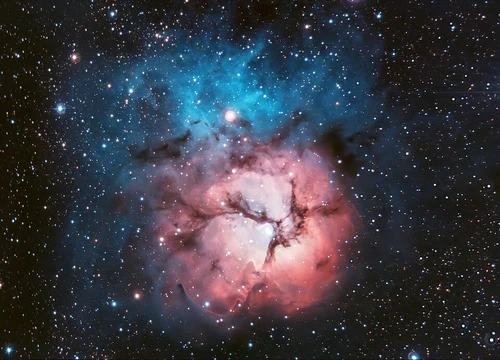
NGC 2818
A bipolar planetary nebula in Pyxis with disputed open cluster membership.

NGC 2818, a planetary nebula in the southern constellation Pyxis, is made of glowing gas expelled from a dying star. That star, once about 2.3 times the Sun’s mass, ran out of fuel for core fusion, casting off its outer layers. The core remnant will become a white dwarf. The nebula’s shape is bipolar, with two irregular, somewhat broken lobes. Filamentary structures radiate from the center, and several cometary knots lie nearby. Its total mass is roughly 0.6 solar masses, and it is around 11,000 years old. The central star is extremely hot, with an effective temperature of 130,000 K.
The nebula’s proximity to the open cluster NGC 2818A has sparked debate. Early studies, noting differences in radial velocity, suggested a chance alignment. More recent work, however, indicates that NGC 2818 likely belongs to the cluster. Open clusters, due to their low mass, hold together weakly and typically disperse within about 10 million years, though some last up to 100 million years. Planetary nebulae can form from stars between one and eight solar masses, meaning their progenitor stars are at least 40 million years old. While hundreds of open clusters fall within that age range, finding one hosting a planetary nebula is rare—the nebular phase for more massive stars lasts only thousands of years, a cosmic instant. Only one other such association is confirmed: the very distant nebula PHR 1315-6555.
Quick Facts
- Epoch
- J2000.0
- Ra
- 09 · 16 · 01.656
- Dec
- -36 · 37 · 38.76
- Dist Ly
- 10,400
- Constellation
- Pyxis
- Radius Ly
- 3.25
- Names
- NGC 2818, PLN 261+8.1 ESO 372-PN13
Facts from the source article.
Lore & Background
NGC 2818 consists largely of glowing gases from the star's outer layers ejected during the final stages of its life when it had run out of the fuel necessary to sustain its core fusion processes. The remnants of its core will remain as a white dwarf. The nebula presents a complex morphology, with an overall bipolar structure; its two lobes are somewhat broken and irregular. Filamentary structures radiate from the center, and near the center several cometary knots are present. The nebula's mass is estimated at 0.6 solar masses, and it is about 11,000 years old. The progenitor star was likely about 2.3 times the mass of the Sun, and the central star is very hot, with an effective temperature of 130 kK.
NGC 2818 appears very close to the open cluster NGC 2818A. Whether it is a member of the open cluster has been controversial: earlier papers found the radial velocity differences between the planetary nebula and open cluster to a chance alignment. However, more recent studies suggest that NGC 2818 is indeed a member of NGC 2818A. Partly because of their small total mass, open clusters have relatively poor gravitational cohesion, and they tend to disperse after a relatively short time, typically some 10 million years, though under exceptional conditions they can remain intact for up to 100 million years. Theoretical models predict that planetary nebulae can form from main-sequence stars of between 8 and 1 solar masses, which puts their age at 40 million years and older. Although there are a few hundred known open clusters within that age range, a variety of reasons limit the chances of finding a member of an open cluster in a planetary nebula phase. One such reason is that the planetary nebula phase for more massive stars belonging to younger clusters is on the order of thousands of years. Only one association has been established between open clusters and nearby nebulae, the extremely distant nebula PHR 1315-6555.
Reader's Guide
NGC 2818 is significant as a planetary nebula with a complex bipolar morphology, featuring broken lobes, filamentary structures, and cometary knots. Its estimated mass of 0.6 solar masses and age of about 11,000 years provide context for the late stages of stellar evolution. The central star's high effective temperature of 130 kK and the progenitor star's mass of 2.3 solar masses align with theoretical models of planetary nebula formation from stars between 1 and 8 solar masses. The nebula's legacy is tied to its controversial membership in the open cluster NGC 2818A. While earlier studies suggested a chance alignment based on radial velocity differences, more recent studies indicate that NGC 2818 may indeed be a member. This is notable because open clusters have poor gravitational cohesion and typically disperse within tens of millions of years, and the planetary nebula phase lasts only thousands of years, making such associations extremely rare. Only one other association between an open cluster and a planetary nebula has been established, the distant nebula PHR 1315-6555. Thus, NGC 2818 contributes to the understanding of stellar evolution within clusters and the rarity of such co-located objects.
Did You Know?
- NGC 2818 is located in the southern constellation Pyxis (The Compass).
- The nebula has a bipolar structure with broken and irregular lobes.
- Its central star has an effective temperature of 130 kK.
- Membership in the open cluster NGC 2818A remains controversial, with recent studies suggesting it is a member.
Frequently Asked Questions
What is NGC 2818 and where can I find it in the sky?
NGC 2818 is a young planetary nebula located in the southern constellation Pyxis. It consists of glowing gas that was shed by a dying star, and its total ejected mass works out to roughly 0.6 solar masses.
What does NGC 2818 actually look like through a telescope?
It presents a bipolar shape with two irregular, somewhat broken lobes extending from the center. Filamentary structures radiate outward, and a handful of cometary knots dot the surrounding region.
How old is NGC 2818, and what happened to the star that made it?
The nebula is only about 11,000 years old, making it a relatively fresh ejection. The progenitor star, which had a mass around 2.3 times that of the Sun, exhausted its core fuel and blew off its outer envelope, leaving behind a core that will settle into a white dwarf.
How hot is the central star of NGC 2818?
The exposed core is extraordinarily hot, with an effective temperature of roughly 130,000 kelvin. That intense radiation is what keeps the surrounding expelled gas ionized and visible.
Is NGC 2818 part of an open cluster?
Its membership in a nearby open cluster is disputed among observers and researchers. The nebula's bipolar morphology and filamentary knots make it a popular target for studying how cluster membership and nebular evolution interact.
More in Planetary Nebulae, Part 2 1-24
Spotted an error? Know more?
Reader corrections go straight into our review queue. Suggest an edit · How this site is sourced