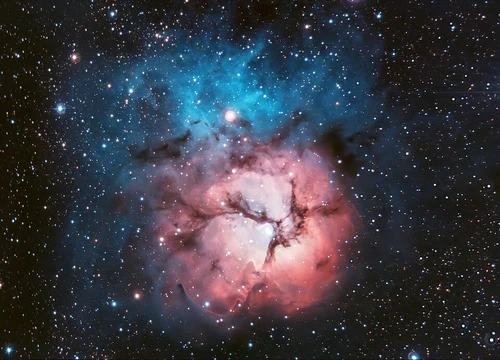
NGC 6445
Bipolar planetary nebula in Sagittarius, discovered by William Herschel.

NGC 6445, called the Little Gem Nebula or Box Nebula, is a planetary nebula located in Sagittarius. William Herschel discovered it on May 28, 1786. Its distance, based on Gaia parallax measurements (0.9740±0.3151 milliarcseconds), is estimated at just over 1,000 parsecs.
This nebula is classified as bipolar. Its helium-to-hydrogen and nitrogen-to-oxygen abundance ratios place it in the Type I category. Optical images show a bright, central ring shape with open bipolar lobes; the outer envelope emits mainly in [NII]. Wide-field images from the Nordic Optical Telescope’s ALFOSC instrument reveal an irregular central region roughly 40 by 50 arcseconds, where [OIII] emission dominates, while the more extended [NII] emission defines the overall bipolar structure. At its estimated distance, NGC 6445 spans about 4 light-years, making it one of the largest known planetary nebulae.
To observe NGC 6445, look 2.1 degrees southwest of the open cluster Messier 23. A good star-hopping route starts from M23: find an arc of 7th- and 8th-magnitude stars one degree southwest of the cluster; the nebula lies 5 arcminutes west of an 8th-magnitude star located 40 arcminutes west of the arc’s southernmost star. The globular cluster NGC 6440 sits 23 arcminutes south, and both objects appear together in a wide-field eyepiece. At low magnification, the nebula looks like a fuzzy star; higher magnification reveals its rectangular disk. NGC 6445 is listed in the Herschel 400 Catalogue.
- Discoverer
- William Herschel
- Discovery date
- May 28, 1786
- Constellation
- Sagittarius
- Distance parsecs
- slightly more than 1,000 parsecs
- Gaia parallax mas
- 0.9740±0.3151
- Size light years
- 4
- Angular size arcsec
- ~40"×50"
Lore & Background
NGC 6445 was discovered by William Herschel on May 28, 1786. Its distance is estimated at slightly more than 1,000 parsecs based on Gaia parallax measured at 0.9740±0.3151 mas. The nebula has been classified as a bipolar planetary nebula, with He/H and N/O abundance ratios consistent with the Type I definition. In optical images, it features a bright, central ring-shaped morphology and open bipolar lobes, with outer envelope emission dominated by [NII]. Wide-field optical images from the Nordic Optical Telescope (NOT) ALFOSC show an irregularly shaped central region of about 40"×50", where [OIII] emission dominates, while [NII] emission is more extended and defines the overall bipolar shape. At its distance, NGC 6445 is 4 light years across and is among the largest known planetary nebulae.
Reader's Guide
NGC 6445 is significant as a large, bipolar planetary nebula that exemplifies Type I chemical abundances. Its inclusion in the Herschel 400 Catalogue marks it as a notable deep-sky object for amateur astronomers. Observationally, it lies 2.1° southwest of the open cluster Messier 23 and can be located by star hopping from that cluster, with the globular cluster NGC 6440 lying 23 arcminutes to the south. In low magnification it appears as a fuzzy star, while higher magnifications reveal its rectangular disk. Its large angular size and distinct bipolar structure make it a valuable target for studying planetary nebula morphology and evolution, though its distance remains somewhat uncertain due to the parallax measurement error.
Did You Know?
- NGC 6445 is also called the Little Gem Nebula or Box Nebula.
- The nebula is 4 light years across and among the largest known planetary nebulae.
Frequently Asked Questions
Who discovered NGC 6445 and when?
William Herschel first recorded this object on May 28, 1786, during one of his extensive surveys of the southern sky. It has been known ever since by the nicknames Little Gem Nebula and Box Nebula.
What does NGC 6445 actually look like through a telescope?
Optical imaging reveals a bright, well-defined central ring with two open bipolar lobes extending outward. The fainter outer envelope shines predominantly in [NII] emission, giving the nebula a layered, gemstone-like appearance.
How far away is NGC 6445 from Earth?
Gaia's parallax measurement of 0.9740 ± 0.3151 milliarcseconds places the nebula at a distance of just over 1,000 parsecs. That puts it roughly 3,300 light-years out in the constellation Sagittarius.
What type of planetary nebula is NGC 6445?
It is classified as a bipolar nebula, meaning its outflow is shaped into two lobes along a common axis. Its helium-to-hydrogen and nitrogen-to-oxygen abundance ratios further categorize it as a Type I planetary nebula.
What is the physical size of NGC 6445?
The nebula spans roughly four light-years across, making it a relatively compact object by planetary-nebula standards. Wide-field observations with the Nordic Optical Telescope's ALFOSC instrument have helped map the full extent of its outer envelope.
More in Planetary Nebulae, Part 2 1-24
Spotted an error? Know more?
Reader corrections go straight into our review queue. Suggest an edit · How this site is sourced