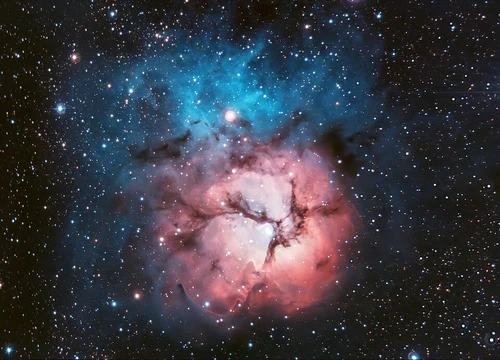
NGC 3132
A bipolar planetary nebula with a hot white dwarf central star.

NGC 3132, a planetary nebula in the constellation Vela, is also called the Eight-Burst Nebula, the Southern Ring Nebula, or Caldwell 74. It lies roughly 613 parsecs (2,000 light-years) from Earth and appears strongly elliptical from our vantage point. Three-dimensional models show it is actually bipolar, tilted about twenty degrees relative to our line of sight, with a low-density central cavity encircled by several ring-like structures. On July 12, 2022, it was among the five cosmic objects featured in the first official science images released by the James Webb Space Telescope.
Within the nebula, two stars sit close together: a 10th-magnitude star and a fainter 16th-magnitude star about 1.7 arcseconds apart. The fainter one is the planetary nebula’s central star, a white dwarf with a temperature around 140,000 K. It has shed its outer layers, and its intense ultraviolet radiation makes the nebula glow. The brighter star, HD 87892, is an A-type main-sequence star (type A2V) separated from the white dwarf by at least 1,277 astronomical units—roughly the distance to the edge of a dust cloud surrounding the white dwarf. The system is likely a quadruple star system. The progenitor star that formed the nebula had a mass about 2.7 times that of the Sun.
- Distance
- 613 pc (2,000 light-years)
- Constellation
- Vela
- Alternative names
- Eight-Burst Nebula, Southern Ring Nebula, Caldwell 74
- Central star temperature
- 140,000 K
- Progenitor star mass
- 2.7 solar masses
- Companion star
- HD 87892 (A2V, magnitude 10)
- Separation of stars
- 1.7 arcseconds (at least 1277 AU)
Lore & Background
NGC 3132 appears from Earth as a strongly elliptical nebula. Three-dimensional modeling reveals it is a bipolar nebula, with its major axis inclined about twenty degrees from the line of sight. The central low-density cavity is surrounded by multiple ring-like structures. Images show two stars close together within the nebulosity: one of 10th magnitude and another of 16th magnitude, located about 1.7 arcseconds apart. The central star of the planetary nebula is a white dwarf and is the fainter of the two. This hot central star, with a temperature of about 140,000 K, has blown off its outer layers and makes the nebula fluoresce brightly from its intense ultraviolet radiation. The 10th magnitude star, HD 87892, is an A-type main-sequence star of type A2V, separated from the white dwarf by at least 1277 AU. The A-type star orbits at roughly the same distance as the edge of a dust cloud surrounding the central white dwarf. The system is likely a quadruple star system. The progenitor star of the planetary nebula had a mass of about 2.7 times that of the Sun.
Reader's Guide
NGC 3132 was selected as one of the five cosmic objects observed by the James Webb Space Telescope as part of the release of its first official science images on July 12, 2022. Its significance lies in its bright, well-studied nature and its complex structure, which includes a bipolar shape, multiple ring-like features, and a central low-density cavity. The presence of a hot white dwarf central star (140,000 K) that ionizes the nebula, along with a nearby A-type companion star (HD 87892) and evidence of a likely quadruple star system, makes it a valuable target for understanding stellar evolution and binary interactions. The estimated distance of 613 parsecs and progenitor mass of 2.7 solar masses provide key parameters for modeling planetary nebula formation. Its multiple designations (Eight-Burst Nebula, Southern Ring Nebula, Caldwell 74) reflect its prominence in astronomical catalogs.
Did You Know?
- The central star of NGC 3132 is a white dwarf with a temperature of about 140,000 K.
- The system is likely a quadruple star system, including an A-type main-sequence star (HD 87892) separated by at least 1277 AU from the white dwarf.
Identity and Sky Position
NGC 3132 is a luminous planetary nebula located in the southern constellation of Vela, and it is one of the more thoroughly examined examples of its kind. Over the years it has accumulated several popular names that reflect how it looks to observers: the Eight-Burst Nebula, the Southern Ring Nebula, and its place in the Caldwell catalogue as object 74. It lies roughly 613 parsecs, or about two thousand light-years, from Earth, close enough that its structure is readily resolved. To the eye and to simple imaging it presents a strongly elliptical outline, which at first glance suggests a flattened ring. More careful three-dimensional modelling, however, reveals that the true geometry is bipolar rather than a simple disc. The major axis of this bipolar shell is tilted only about twenty degrees away from our line of sight, which is why the elongated, ring-like silhouette appears so pronounced. At its heart sits a low-density cavity, and this central void is encircled by several concentric ring-like structures that give the nebula its layered, burst-like character.
The Central Star System
At the centre of the glowing shell is a compact white dwarf, the remnant core of the star that originally produced the nebula. That progenitor star carried a mass of roughly 2.7 times the Sun's before it shed its outer layers; the exposed core is now extremely hot, on the order of 140,000 kelvin, and its fierce ultraviolet radiation is what excites the surrounding gas and makes the nebula fluoresce so brightly. Although it is the engine of the whole display, this white dwarf is actually the fainter of two stars visible within the nebulosity. The brighter companion, catalogued as HD 87892, is an A-type main-sequence star of spectral class A2V, shining at about tenth magnitude. The two are separated by at least 1277 astronomical units, and the A-type star orbits at roughly the same distance as the outer edge of a dust cloud that surrounds the white dwarf. Taken together with the other components, the arrangement strongly suggests that NGC 3132 is in fact a quadruple star system, making its nucleus one of the more complex cores known among planetary nebulae.
A First-Light Milestone
Beyond its intrinsic scientific interest, NGC 3132 holds a special place in the history of modern astronomy because of its role in the James Webb Space Telescope programme. When the observatory released its first official set of science images on 12 July 2022, the Southern Ring Nebula was chosen as one of only five cosmic objects to feature in that landmark debut. Being selected for such a high-profile announcement is a mark of the target's brightness, clarity, and visual richness, all qualities that make it an ideal showcase for a new instrument. The event also underscored how well suited the nebula is to high-resolution imaging: its layered rings, central cavity, and compact stellar nucleus provide a wealth of fine structure that rewards detailed observation. As a result, the nebula's image from that release helped introduce the capabilities of the new telescope to a wide audience, and it remains a frequently cited example of the kind of sharp, multi-layered planetary-nebula detail that modern space-based observatories can capture.
A Long-Studied Bright Target
NGC 3132 is described as a bright and extensively studied planetary nebula, and that reputation is reflected in the breadth of material available on it. It has been imaged and catalogued across a wide range of wavelengths and surveys, appearing in optical, infrared, and X-ray datasets as well as in dedicated heritage imaging projects. Its presence in the Hubble Heritage collection, for instance, highlights how it has been used to produce striking public-facing pictures, while its inclusion in multi-survey sky maps and catalogue entries shows that it has been a steady target for researchers building up a complete picture of its structure. The combination of a compact, hot central star, a nearby A-type companion, and a layered bipolar shell gives observers and modellers plenty of detail to work with, from the overall elliptical silhouette down to the small separation between the central stars. All of this has made the nebula a useful benchmark for studying how planetary nebulae form, evolve, and radiate, and it continues to be a popular and well-documented object in both professional and amateur astronomy.
Frequently Asked Questions
What is NGC 3132?
NGC 3132 is a planetary nebula catalogued as Caldwell 74, located in the southern constellation Vela. It is popularly known by several nicknames, including the Eight-Burst Nebula and the Southern Ring Nebula.
How far away is NGC 3132 and what powered it?
The nebula sits roughly 613 parsecs, or about 2,000 light-years, from Earth. Its central white dwarf now burns at approximately 140,000 kelvin, having evolved from a progenitor star with a mass around 2.7 solar masses.
Why does NGC 3132 look elliptical instead of round?
From our vantage point the nebula appears strongly stretched into an ellipse, but three-dimensional models show it is truly a bipolar structure tilted about twenty degrees from our line of sight. Within that tilted frame a low-density central cavity is wrapped by several concentric ring-like shells.
Is there a companion star near NGC 3132?
Yes, the A2V-type star HD 87892, which shines at 10th magnitude, is associated with the system alongside the hot white dwarf at the nebula's core.
Why was NGC 3132 in the first James Webb Space Telescope images?
On July 12, 2022, Webb released its inaugural set of official science photographs, and NGC 3132 was selected as one of the five targets in that debut batch. Its layered bipolar geometry and multiple ring structures made it an excellent showcase for the telescope's infrared sensitivity.
More in Planetary Nebulae, Part 2 1-24
Spotted an error? Know more?
Reader corrections go straight into our review queue. Suggest an edit · How this site is sourced