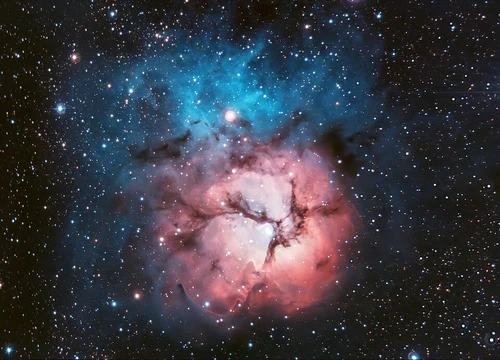
NGC 3242
A planetary nebula resembling Jupiter, discovered by William Herschel in 1785.

NGC 3242 is a planetary nebula located in the constellation Hydra. It is commonly known as the Ghost of Jupiter, Jupiter's Ghost, or the Eye Nebula, and is also cataloged as Caldwell 59. Discovered by William Herschel in 1785, it is notable for its resemblance to the planet Jupiter and its easy visibility through amateur telescopes.
- Discoverer
- William Herschel
- Discovery date
- February 7, 1785
- Catalog designations
- H IV.27, h 3248, GC 2102, NGC 3242, Caldwell 59
- Constellation
- Hydra
- Size
- approximately two light years long
- Central star type
- O-type star with spectral type O(H)
- Central star apparent magnitude
- 11
Lore & Background
William Herschel discovered NGC 3242 on February 7, 1785, and catalogued it as H IV.27. John Herschel later observed it from the Cape of Good Hope, South Africa, in the 1830s, numbering it as h 3248, and included it in the 1864 General Catalogue as GC 2102. It became NGC 3242 in J. L. E. Dreyer's New General Catalogue of 1888.
The nebula is most frequently called the Ghost of Jupiter, or Jupiter's Ghost, due to its similar shape to the planet, but it is also sometimes referred to as the Eye Nebula. It measures around two light years long from end to end and contains a central white dwarf with an apparent magnitude of 11. The inner layers of the nebula were formed some 1,500 years ago. The two ends of the nebula are marked by FLIERs, lobes of fast moving gas often tinted red in false-color pictures.
NGC 3242 can easily be observed with amateur telescopes and appears bluish-green to most observers. Larger telescopes can distinguish the outer halo as well. At the center of NGC 3242 is an O-type star with a spectral type of O(H).
Reader's Guide
NGC 3242 holds significance as a bright and easily observable planetary nebula, often serving as a popular target for amateur astronomers due to its bluish-green appearance and distinctive shape resembling Jupiter. Its discovery by William Herschel in 1785 and subsequent cataloging by John Herschel and J. L. E. Dreyer place it within the foundational history of deep-sky object cataloging. The nebula's inner layers, formed approximately 1,500 years ago, and its FLIERs—lobes of fast-moving gas—provide insights into the late stages of stellar evolution. The central O-type star with spectral type O(H) and its white dwarf companion (apparent magnitude 11) are key to understanding the nebula's structure. The nebula's legacy includes its multiple common names—Ghost of Jupiter, Jupiter's Ghost, and Eye Nebula—and its inclusion in the Caldwell catalogue as Caldwell 59. Its visibility through amateur telescopes and the ability to distinguish its outer halo with larger instruments make it a lasting subject for observation and study.
Did You Know?
- The nebula is approximately two light years long from end to end.
- Its inner layers were formed some 1,500 years ago.
Frequently Asked Questions
What is NGC 3242 and what nicknames does it go by?
NGC 3242 is a planetary nebula in the constellation Hydra that amateur astronomers often call the Ghost of Jupiter or the Eye Nebula because of its striking visual resemblance to the gas giant. It also carries the catalog number Caldwell 59.
Who found NGC 3242 and when?
William Herschel first recorded this object on February 7, 1785, during his systematic surveys of the southern sky. It has since been listed under several designations, including H IV.27 and GC 2102.
How big is NGC 3242 and what sits at its center?
The nebula stretches roughly two light years across and hosts a hot O-type central star classified with the spectral type O(H). This luminous remnant ionizes the surrounding shell of gas and gives the object its visible glow.
Is NGC 3242 easy to spot with a small telescope?
Fans frequently point to it as one of the more forgiving planetary nebulae for backyard observers, since its Jupiter-like shape stands out even in modest apertures. Its position in Hydra makes it a popular target during the summer months in the Northern Hemisphere.
Why do people call it Jupiter's Ghost?
The nickname comes from the nebula's rounded, banded appearance that closely mimics the cloud patterns of the planet Jupiter when viewed through a telescope. The 'ghost' part of the name reflects its faint, ethereal glow compared to the solid disk of the actual planet.
More in Planetary Nebulae, Part 2 1-24
Spotted an error? Know more?
Reader corrections go straight into our review queue. Suggest an edit · How this site is sourced