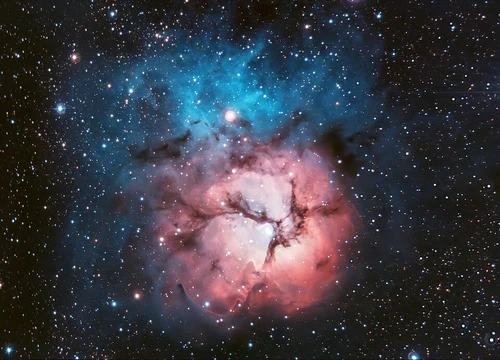
NGC 2867
Elliptical planetary nebula with a pulsating, hydrogen-deficient central star.

NGC 2867 (Caldwell 90) is an elliptical planetary nebula of Type II in the southern constellation Carina, located a little more than one degree north-northwest of the star Iota Carinae. John Herschel discovered it on April 1, 1834, and initially suspected it might be a new planet, but a check the following night showed it had not moved. The nebula lies about 7,270 light-years from the Sun.
Its central star has spectral type WC3 and is evolving into a white dwarf, having previously shed the atmosphere that formed the surrounding nebula. This star is a hydrogen-deficient GW Vir variable, exhibiting non-radial pulsations with an amplitude under 0.3 in magnitude. Its estimated temperature is 165+18−20 kK, its radius is about 5% of the Sun’s, and it shines with 1,400 times the Sun’s luminosity.
The nebula itself is fairly typical but shows carbon enrichment, suggesting the progenitor star was not massive but underwent a third dredge-up. The central star’s category has produced a very high degree of ionization in the nebula. The nebula’s shape is somewhat elongated, possibly due to interaction with surrounding interstellar matter. Its halo may be a recombination of two separate halos, hinting at an unusual mass-loss history.
Quick Facts
- Epoch
- J2000
- Constellation
- Carina
- Ra
- 09 · 21 · 25.38336
- Dec
- −58 · 18 · 40.6167
- Dist Ly
- 2228 pc
- Appmag V
- 9.7
- Names
- ESO 126-8, PN G278.1-05.9, Caldwell 90
Facts from the source article.
Lore & Background
NGC 2867 was discovered by John Herschel on April 1, 1834. Herschel initially thought he might have found a new planet, but on the following night he checked again and discovered it had not moved. The nebula is located at a distance of 7,270 light-years from the Sun. The central star of the nebula is of spectral type WC3 and is in the process of evolving into a white dwarf, having previously shed the atmosphere that created the surrounding nebula. It is now a hydrogen deficient GW Vir variable that is undergoing non-radial pulsations with an amplitude of less than 0.3 in magnitude. The star has an estimated temperature of 165+18−20 kK with 5% of the radius of the Sun and is radiating 1,400 times the Sun's luminosity. The surrounding nebula is fairly typical but does show carbon enrichment, which suggests the progenitor star was not massive but did pass through third dredge-up. The category of central star has excited a very high degree of ionization in the nebula. The shape of the nebula appears somewhat elongated, which may indicate an interaction with the surrounding interstellar matter. The nebula halo may be a recombination of two separate halos, which could indicate a peculiar mass-loss history.
Reader's Guide
NGC 2867 holds significance as a planetary nebula with a central star that is a rare hydrogen-deficient GW Vir variable, exhibiting non-radial pulsations. Its discovery by John Herschel in 1834 is notable because he initially mistook it for a new planet, only to confirm its nebular nature the following night. The nebula's carbon enrichment and high degree of ionization, driven by its hot central star, provide clues about the progenitor star's evolution, including a third dredge-up event. The elongated shape and possible dual halo structure suggest interactions with interstellar matter and a complex mass-loss history. These features make NGC 2867 a valuable object for studying stellar evolution and the late stages of low-mass stars, as documented in the source article.
Did You Know?
- Herschel initially thought he might have found a new planet, but checked the next night and found it had not moved.
- The central star is a hydrogen-deficient GW Vir variable with pulsation amplitude less than 0.3 magnitude.
- The nebula shows carbon enrichment, suggesting the progenitor star passed through third dredge-up.
Frequently Asked Questions
Who is NGC 2867?
NGC 2867, also listed as Caldwell 90, is an elliptical Type II planetary nebula in the southern constellation Carina. It sits roughly 7,270 light-years from our Sun.
How was NGC 2867 discovered?
John Herschel first noted the object on April 1, 1834, and initially guessed it might be a newly found planet. A follow-up observation the next night showed it had not shifted, confirming it was a fixed nebula rather than a wandering body.
What is NGC 2867's central star like?
At its core sits a hydrogen-deficient WC3 star that is pulsating as a GW Vir variable while steadily evolving into a white dwarf. The outer atmosphere it once possessed was shed and now glows as the surrounding elliptical shell.
Where exactly can I find NGC 2867 in the sky?
Head a little more than one degree north-northwest of the star Iota Carinae in Carina to spot the nebula. It presents a distinctly elliptical outline to visual and photographic observers.
Why is NGC 2867 important to planetary nebula studies?
Its pulsating, hydrogen-poor central star offers a clean example of a post-mass-loss star in the transition phase toward becoming a white dwarf. That makes it a useful reference point for tracking the late evolutionary steps of intermediate-mass stars.
More in Planetary Nebulae, Part 2 1-24
Spotted an error? Know more?
Reader corrections go straight into our review queue. Suggest an edit · How this site is sourced