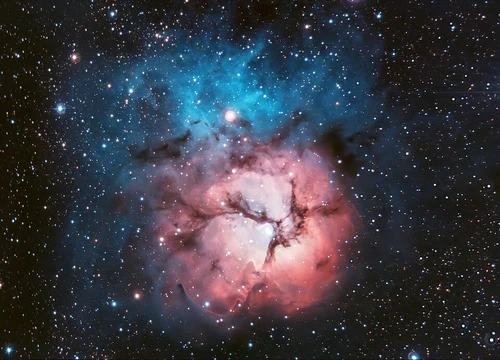
NGC 6210
A bright planetary nebula with complex structure and high galactic latitude.

NGC 6210, also known as the Turtle Nebula or simply the Turtle, is a bright planetary nebula located approximately 5.4 ± 1.3 kly from the Sun in the constellation of Hercules. It is notable for its unusually high position about 38° above the galactic plane at a vertical distance of about 3.3 kilolight-years (1 kpc), resulting in little extinction from intervening interstellar dust. The nebula formed from a low-mass progenitor star less massive than the Sun (~0.9 M☉), and its complex structure has led to proposals that it was shaped by mass transfer in a triple star system.
Quick Facts
- Credit
- HST/NASA/ESA
- Epoch
- J2000
- Constellation
- Hercules
- Ra
- 16 · 44 · 29.51960
- Dec
- +23 · 47 · 59.4913
- Dist Ly
- 1.67 ±
- Radius Ly
- 0.5
Facts from the source article.
Lore & Background
The nebula was first recorded as a star-like feature by Joseph Lalande on March 22, 1799, but credit for its discovery as a nebula goes to Wilhelm Struve in 1825. John L. E. Dreyer described it as 'a planetary nebula, very bright, very small, round, disc and border.' Its structure is complex and unusual, described as very amorphous and irregular in shape, roughly ellipsoidal with a radius of about 0.5 light-years. The nebula contains shells, lobes, knots, and haloes, consisting of a bright inner region filled with arches and filaments spanning 13″ × 16″ with expansion velocities of 19–24 km/s, and a fainter outer region with a pair of tubular structures that emits only about 1% of the total light.
The nebula exhibits five distinct axes of ejected material: a bipolar inner shell, a lop-sided elliptical intermediate shell, two bipolar flows forming point-symmetric outer lobes, and a final axis tracing collimated outflows of low-ionization knots. Many redshifted knots have ages greater than 2000 years, while blueshifted knots are younger. Starting at or before the initial ionization of the nebula around 3500 years ago, major changes occurred in the direction of its outflows. A surrounding halo is nearly twice as large but much fainter, with four arm-like extensions and at least three circularly symmetric, low-amplitude ripples indicating a highly disturbed kinematics.
The nebula's chemical abundances are low in helium, oxygen, nitrogen, argon, carbon, and elements such as silicon, iron, potassium, chlorine, phosphorus, sodium, and magnesium. Oxygen, sulfur, and neon abundances are average for its galactic position. These low abundances suggest the progenitor star may not have undergone second or third dredge-up phases. However, values may be inaccurate due to methods; for instance, sulfur is consistently lower than solar, and magnesium may be underestimated due to possible presence in magnesium sulfide (MgS), though no infrared evidence links magnesium to dust grains. The central star is a hydrogen-rich O(H) type star with an apparent visual magnitude of 12.66 and an estimated temperature of 65,000 K. Its outflow velocity is 2,180 km/s with a mass loss rate of 2.2×10⁻⁹ M☉ yr⁻¹, and a collimated jet feature to the northwest suggests ejection along two or possibly four directions, with curvature indicating possible rotation of the collimating source.
Reader's Guide
NGC 6210 is significant as a bright planetary nebula with an unusually high galactic latitude, providing a clear view with little interstellar extinction. Its complex morphology—featuring multiple shells, lobes, knots, and a disturbed halo with ripples—makes it a key object for studying the late-stage evolution of low-mass stars and the dynamics of mass loss. The proposal that its structure may result from mass transfer in a triple star system highlights its potential for understanding binary or multiple star interactions in nebular shaping. The central star's high temperature and fast outflow, along with collimated jets, offer insights into stellar winds and jet formation. The nebula's low chemical abundances, particularly the absence of evidence for second and third dredge-up phases, provide constraints on nucleosynthesis in low-mass progenitors. However, uncertainties in abundance measurements, such as for sulfur and magnesium, caution against overinterpretation. The object's discovery history, from Lalande's star-like observation to Struve's nebular identification and Dreyer's description, places it within the early cataloging of planetary nebulae. Its legacy lies in its role as a laboratory for studying complex outflow geometries, chemical enrichment, and the influence of multiplicity on planetary nebula formation.
Did You Know?
- NGC 6210 is also called the Turtle Nebula or simply the Turtle.
- It lies about 38° above the galactic plane, an unusually high position for a nebula.
- The nebula's structure may have been shaped by mass transfer in a triple star system.
- The central star has an outflow velocity of 2,180 km/s and a mass loss rate of 2.2×10⁻⁹ M☉ yr⁻¹.
Frequently Asked Questions
Who is NGC 6210?
NGC 6210, nicknamed the Turtle Nebula, is a bright planetary nebula sitting in the constellation Hercules roughly 5,400 light-years from Earth. It was first noted by Joseph Lalande in 1799, though credit for its formal discovery usually goes to Wilhelm Struve in 1825.
What makes NGC 6210's shape so unusual?
The nebula displays a complex, multi-layered structure that many researchers believe was sculpted by mass transfer between stars in a triple system. This makes it a key object for studying how binary or multiple companions shape the outflow of gas during a star's death throes.
Where do I point my telescope to find NGC 6210?
Look in the constellation Hercules, where the nebula shines at a high galactic latitude of about 38° above the plane. Its elevated position means very little interstellar dust dims its light, making it one of the cleaner views of a planetary nebula available to amateur observers.
What happened to NGC 6210's original star?
The progenitor was a relatively low-mass star, estimated at around 0.9 solar masses, which shed its outer layers to create the glowing shell we see today. The remaining core now burns as a hydrogen-rich O(H)-type central star with an apparent magnitude of 12.66.
Why do planetary nebula fans consider NGC 6210 a must-see?
Its combination of brightness, striking structure, and minimal dust extinction makes it a standout target in Hercules. The triple-star hypothesis also gives it a richer backstory than a simple single-star death, which keeps it a favorite in both imaging and theoretical discussions.
More in Planetary Nebulae, Part 2 1-24
Spotted an error? Know more?
Reader corrections go straight into our review queue. Suggest an edit · How this site is sourced